The plot?
Well, if you are familiar with any of other ‘films’ by director Don Skaro under his other pseudonym Roman Nowicki, you’ll anticipate that is is minimal.
The auteur of the Fantom Kiler and Fantom Seducer series is not exactly known for complex plotting. Rather it is about stringing together a few scenes with the same basic slasher/porno dynamic. Woman gets naked, then woman gets killed (in the former) or fucked (in the latter).
This is much the same, following the softcore dynamic of the former series, with Daleks in the place of Fantoms.
We begin with four women in a car, travelling through woods reputed to be the domain of the Serial Skinner, clearly a close cousin to the Fantoms.
Their car hits something (which we see is a Roswell type alien) so they get out to explore. Three of the four soon end up naked and prisoners of the Daleks.
Here I found it impossible not to think of Victor Lewis Smith’s TV Offal and his Gay Daleks skits, and of Jon Pertwee era Who companion Jo Grant actor Katy Manning appearing topless with a Dalek.
That said, the special effects are probably better than the original Who, if only by virtue of being 20-30-40 years later. (Is there a CGI setting to do CSO?)
Following the extermination (not insemination) of the women (white wee wee, white wee wee) an alien dominatrix in female form, indistinguishable from the others (i.e. bleached blond, silicone breasted, shaved pubis, heavy accented non-native English speaker) finds herself in the woods, where she is captured by a hunter seeking the Serial Skinner.
The Daleks intervene, attempting to teleport her back to their craft, but get the Skinner instead...
There are amusing aspects to Abducted by the Daleks, such as some of the credits (besides Don Skaro the script is by one Billy Hartnell, for instance) and the Star Trek TOS door opening/closing sound, but overall it is a tedious watch even at just 55 minutes.
Maybe Big Finish and Johnny Trunk / Wisbey should do an audio collaboration inspired by this?
Showing posts with label trash. Show all posts
Showing posts with label trash. Show all posts
Monday, 24 June 2013


Friday, 15 March 2013
Dunyayi kurtaran adam / Turkish Star Wars
As Pete Tombs mentions in his book Mondo Macabro a group of French Situationists once took a martial arts film, marketed as Crush Karate, and performed a detournement upon it, changing its title to Can Dialectics Break Bricks?
This comes to mind because Dunyayi kurtaran adam – literally The Man who Saved the World, apparently– has, as its colloquial name of Turkish Star Wars, would suggest qualities that seem almost to be those of an unconscious detouernement of its better known counterpart.
While not an expert on Turkish popular cinema by any means, a few common factors have emerged in the films that I have seen, these generally being the ones that seek to imitate a Hollywood or other foreign success and rework it for the Turkish market.
First, Islam tends to play a more significant role. This makes sense in a film like The Turkish Exorcist, but seems out of place here as a substitute for Star Wars’ force.
Second, there is absolutely no shame in lifting footage or music from the source film or films – a factor that likely explains why Turkish Star Wars will never appear on a legitimate DVD release in the US or UK even if it were to be called Not Star Wars: A Turkish Parody in the manner of the tedious deluge of Not [insert name of intellectual property here]: An XXX Parody that US porn producers have inflicted upon us in the past few years.


Holy intellectual property law Batman!
Third, the Turkish films tend to be more violent than their foreign models. Here, for instance, there are various shots of people getting a mace or a spear in the face and another of a boy having his head being crushed by a robot.

The gore is, however, difficult to take seriously simply because it is so inept and comic-book/cartoon like in style.
This brings us on to a fourth difference, the one that relates most strongly to the detournement idea: the use that the filmmakers make of their appropriated footage and what they film themselves is just so at odds with European and North American stylistic norms as to appear inept.
A one-two of initial cheap shots occurs during the credits through the Musak type theme and the presence of two men with the unfortunate sounding forename of Kunt. Yes, this is a Kunt Film.


After just under two minutes of names scrolling upwards on a black screen in a reasonable no-budget version of Star Wars the action proper begins. Or, rather, an assemblage of footage of a rocket launch, the X-Wing crews preparing for the battle of Yavin, their Imperial counterparts on the Death Star and a voice-off that, over the course of two-and-a-half-minutes explains what is going on – if, that is, you speak Turkish. As the version I watched this time did not have subtitles, I could only go by memory and how it made a lot of religious references.
Then, at the four minute 30 second mark we are introduced to our two protagonists, both pilots of one of the various spacecraft seen flying about during the voice-off. Here we can see that the filmmakers have used back-projection to interpolate them in the place of Luke Skywalker, Darth Vader and so on. Unfortunately they also play some of the back-projected footage the wrong way and generally show such a lack of awareness of the rules of continuity editing that we cannot follow the battle nor determine which of the various spacecraft are being flown by our heroes.
While this is going on we are also introduced to the main antagonist. Here the filmmakers actually shoot some new footag eof their own, showing a cut-price Darth Vader alike and his various goons in their lair, one that looks more like the cavern-like interiors of the Mos Eisley cantina than the antiseptic ones of the Death Star.

Our two heroes than crash land on a planet. The landscape here is reasonably effectivve as an alien world, though the filmmakers then ruin the mood by showing the Sphinx, pyramids and a selection of hieroglyphs alongside reintroducing the voice-of-god narrator, making it seem that we have wandered into a Chariots of the Gods type documentary. At this point the musical accompaniment also switches to the portentous horror-movie tones of Bach’s Tocatta and Fugue.
This proves, shortly afterwards, to be the cue for the introduction of a half dozen figures on horseback, They are either skeletons, in the manner of the Blind Dead, or merely men with skeleton designs, in the manner of the Marsh Phantoms of Captain Clegg.
Whatever the case, they are hostile and charging at our heroes. This leads to a long melee sequence in which our heroes prove adept at martial arts, while the filmmakers again illustrate their ineptitude by making it appear more as if the protagonists have been attacked by 20 or 30 riders. Taking two horses, they gallop to the accompaniment of the Indiana Jones theme. This is intercut with monsters jumping out in extreme close-up before us; exactly where these monsters are in relation to the two riders is unclear.


The men’s horses are then shot out from under them by some Cylon-B-grade robots and taken to a cliff-front settlement where the villains are torturing and murdering the locals, including the aforementioned head-crushing robot. On seeing this our heroes break free of their bonds and proceed to use their martial arts skills, as the Indiana Jones theme is again played.
Though suffering some injuries at the hands of the villains, they manage to drive them off and then have their wounds tended by a village woman. The playing of the Indiana Jones love theme and a shot-reverse-shot pattern of close-ups indicates an attraction between the woman and one of the men.
Love springs eternal, even in an unintentionally surreal Turkish Trash Masterpiece...
All this is only in the first twenty-odd minutes of the film. It runs an-hour-and-a-half.
This comes to mind because Dunyayi kurtaran adam – literally The Man who Saved the World, apparently– has, as its colloquial name of Turkish Star Wars, would suggest qualities that seem almost to be those of an unconscious detouernement of its better known counterpart.
While not an expert on Turkish popular cinema by any means, a few common factors have emerged in the films that I have seen, these generally being the ones that seek to imitate a Hollywood or other foreign success and rework it for the Turkish market.
First, Islam tends to play a more significant role. This makes sense in a film like The Turkish Exorcist, but seems out of place here as a substitute for Star Wars’ force.
Second, there is absolutely no shame in lifting footage or music from the source film or films – a factor that likely explains why Turkish Star Wars will never appear on a legitimate DVD release in the US or UK even if it were to be called Not Star Wars: A Turkish Parody in the manner of the tedious deluge of Not [insert name of intellectual property here]: An XXX Parody that US porn producers have inflicted upon us in the past few years.
Holy intellectual property law Batman!
Third, the Turkish films tend to be more violent than their foreign models. Here, for instance, there are various shots of people getting a mace or a spear in the face and another of a boy having his head being crushed by a robot.
The gore is, however, difficult to take seriously simply because it is so inept and comic-book/cartoon like in style.
This brings us on to a fourth difference, the one that relates most strongly to the detournement idea: the use that the filmmakers make of their appropriated footage and what they film themselves is just so at odds with European and North American stylistic norms as to appear inept.
A one-two of initial cheap shots occurs during the credits through the Musak type theme and the presence of two men with the unfortunate sounding forename of Kunt. Yes, this is a Kunt Film.
After just under two minutes of names scrolling upwards on a black screen in a reasonable no-budget version of Star Wars the action proper begins. Or, rather, an assemblage of footage of a rocket launch, the X-Wing crews preparing for the battle of Yavin, their Imperial counterparts on the Death Star and a voice-off that, over the course of two-and-a-half-minutes explains what is going on – if, that is, you speak Turkish. As the version I watched this time did not have subtitles, I could only go by memory and how it made a lot of religious references.
Then, at the four minute 30 second mark we are introduced to our two protagonists, both pilots of one of the various spacecraft seen flying about during the voice-off. Here we can see that the filmmakers have used back-projection to interpolate them in the place of Luke Skywalker, Darth Vader and so on. Unfortunately they also play some of the back-projected footage the wrong way and generally show such a lack of awareness of the rules of continuity editing that we cannot follow the battle nor determine which of the various spacecraft are being flown by our heroes.
While this is going on we are also introduced to the main antagonist. Here the filmmakers actually shoot some new footag eof their own, showing a cut-price Darth Vader alike and his various goons in their lair, one that looks more like the cavern-like interiors of the Mos Eisley cantina than the antiseptic ones of the Death Star.
Our two heroes than crash land on a planet. The landscape here is reasonably effectivve as an alien world, though the filmmakers then ruin the mood by showing the Sphinx, pyramids and a selection of hieroglyphs alongside reintroducing the voice-of-god narrator, making it seem that we have wandered into a Chariots of the Gods type documentary. At this point the musical accompaniment also switches to the portentous horror-movie tones of Bach’s Tocatta and Fugue.
This proves, shortly afterwards, to be the cue for the introduction of a half dozen figures on horseback, They are either skeletons, in the manner of the Blind Dead, or merely men with skeleton designs, in the manner of the Marsh Phantoms of Captain Clegg.
Whatever the case, they are hostile and charging at our heroes. This leads to a long melee sequence in which our heroes prove adept at martial arts, while the filmmakers again illustrate their ineptitude by making it appear more as if the protagonists have been attacked by 20 or 30 riders. Taking two horses, they gallop to the accompaniment of the Indiana Jones theme. This is intercut with monsters jumping out in extreme close-up before us; exactly where these monsters are in relation to the two riders is unclear.
The men’s horses are then shot out from under them by some Cylon-B-grade robots and taken to a cliff-front settlement where the villains are torturing and murdering the locals, including the aforementioned head-crushing robot. On seeing this our heroes break free of their bonds and proceed to use their martial arts skills, as the Indiana Jones theme is again played.
Though suffering some injuries at the hands of the villains, they manage to drive them off and then have their wounds tended by a village woman. The playing of the Indiana Jones love theme and a shot-reverse-shot pattern of close-ups indicates an attraction between the woman and one of the men.
Love springs eternal, even in an unintentionally surreal Turkish Trash Masterpiece...
All this is only in the first twenty-odd minutes of the film. It runs an-hour-and-a-half.
Sunday, 27 March 2011
Patrick vive ancora / Patrick Lives Again
One of the defining features of the Italian popular cinema of the 1960s, 1970s and 1980s was the filone or tributary approach: Take a successful film, or one that you expected to be successful, and produce an unofficial sequel, remake or reinterpretation hopefully close enough to the original to fool audiences whilst sufficiently different to avoid legal issues.
As its title suggests Patrick Still Lives / Patrick vive ancora is a classic example of the filone principle in action, its specific inspiration being Richard Franklin’s Australian production Patrick.
For those unfamiliar with the original it’s the story of a man named Patrick who is 1) in a coma, 2) has telekinetic powers, and 3) uses these to force his nurse to love him and 4) kill anybody else who gets in his way of his schemes.
Although not a big hit internationally, it must have presumably been a success in Italy; certainly the Italian distributors found it worthwhile enough to replace the original soundtrack with one by Argento associates and soundtrack specialists Goblin.
Director Mario Landi, writer Piero Regnoli and producer Gabriele Crisanti’s film cannot really be considered a sequel to Patrick, however. For English and Italian titles aside, it doesn’t follow on from Franklin’s film but rather takes the first three core elements from Patrick; adds a revenge plot justification to the fourth by way of Ten Little Indians.
Above all, it also ups the sleaze and splatter to levels that are extreme even by the standards of Italian exploitation, if also consistent with such other Crisanti productions as Giallo a venezia and Zombie Nights of Terror / Zombie 3.
Patrick vive ancora begins with Patrick (Gianni Dei) and his father Professor Herschell (Sacha Pitoeff) stuck in the middle of nowhere, their car having broken down. Patrick tries to flag down a passing vehicle for assistance, and gets a bottle in the face for his troubles.
We then cut to an operating theatre as a surgeon operates to save his Patrick’s life. He succeeds after a fashion – Patrick (still) lives (again), but in a comatose state.
Although it is never explained exactly how, Patrick then develops telekinetic powers, further fuelled by some of the other patients Professor Herschell has taken on at his private clinic, the interior and grounds of which should prove familiar to any student of Italian trash and which also feature prominently in Zombie 3.
During this time, the professor has also discovered the identities of six possible bottle throwers, whom he has now invited to spend a few days at the clinic in order that he and his son may extract their revenge...
For now, however, the filmmakers wisely allow for a spot of character development, in order that we know the guests are all hateful bourgeois figures who deserve to die in nasty ways – even if at least five of them are innocent in Patrick’s specific case.
This also affords them the opportunity to have the female cast members parade around in states of nakedness or threw something on and nearly missed-ness, and for everybody to down copious quantities of J&B and bitch at one another.

The obligatory catfight and one of a number of J&B bottles
The first to die is the improbably named Mr Cough, a politician. Going for a night swim, he is boiled alive by Patrick. Cough’s J&B consumption then becomes relevant, as Professor Herschell (Sacha Pitoeff) explains away Cough’s death as having been brought on by his alcoholism; the other guests seem to accept this.

Caused by drinking, apparently.
There’s a certain irony here in that, according to Argento, who worked with Pitoeff on Inferno, the actor was himself something of a drunk at this point in his life and career; brave souls may wish to suggest a double-bill of Patrick vive ancora and Last Year at Marienbad to Pitoeff fans.
Next up is Mr Davis, who gets a hook through his neck as he is hung up over a well.
Davis is soon discovered by Stella Randolph (Mariangela Giordano – Crisanti’s wife and a regular in his films). She flees in terror to the kitchens, where she finds a flayed cat in the fridge (a nice inversion of Giallo a Venezia, where Giordano’s character’s torso was left in a fridge for her cleaner to find) and is then menaced and killed by a long poker which, well, pokes her through the vagina and exits out her mouth.

The flayed cat

The reaction shot

An understandable response to being penetrated by a poker

The result

Another reaction shot
But while the sex-violence-sleaze interface is a constant in Crisanti’s productions, it seems more determined by shock value than anything else; certainly the ridiculousness of the special effects here creates a markedly different impression than the rather more plausible looking impaled woman in Deodato’s Cannibal Holocaust.
Professor Herschell informs the other guests that the police have been called and that they will have to stay at the villa until the authorities arrive.
Next we get another bit of character and plot development as Patrick uses his powers to force secretary Lidya to strip and masturbate for him.
This is character and plot development in that it later transpires that Lidya is amongst the suspected bottle throwers, and that her fate is a source of potential conflict between Patrick and his father. Not, of course, that you can expect any exchanges of dialogue between them over this...

Lydia and Patrick, and the purple and green


Before we get to the denouement, however, there are still other suspects for Patrick to remorselessly, relentlessly dispose of: One woman is guillotined by her car windows, while another (again servant rather than a guest) has her throat torn out by her Alsatians.
The hint of a connection to Argento’s Inferno and Suspiria is further reinforced by the neo-expressionist purple and green lighting that signify Patrick’s presence and power within his own chamber and the set-pieces. This is, however, about the only evidence of directorial flair in the film, which is otherwise efficiently and functionally – read cheaply – put together.
Curiously, however, we don’t see what happens to the man who discovers the woman’s severed head.
Does he live or die? Or was he never a suspect, which is possible given that by now we’ve got more potential bottle throwers than we need? Or did the filmmakers just run out of budget and/or ideas as far as presenting another imaginatively gory demise?
Certainly there is a sense of anti-climax to what follows, particularly given that we still don’t know who in fact threw that fateful bottle...
As its title suggests Patrick Still Lives / Patrick vive ancora is a classic example of the filone principle in action, its specific inspiration being Richard Franklin’s Australian production Patrick.
For those unfamiliar with the original it’s the story of a man named Patrick who is 1) in a coma, 2) has telekinetic powers, and 3) uses these to force his nurse to love him and 4) kill anybody else who gets in his way of his schemes.
Although not a big hit internationally, it must have presumably been a success in Italy; certainly the Italian distributors found it worthwhile enough to replace the original soundtrack with one by Argento associates and soundtrack specialists Goblin.
Director Mario Landi, writer Piero Regnoli and producer Gabriele Crisanti’s film cannot really be considered a sequel to Patrick, however. For English and Italian titles aside, it doesn’t follow on from Franklin’s film but rather takes the first three core elements from Patrick; adds a revenge plot justification to the fourth by way of Ten Little Indians.
Above all, it also ups the sleaze and splatter to levels that are extreme even by the standards of Italian exploitation, if also consistent with such other Crisanti productions as Giallo a venezia and Zombie Nights of Terror / Zombie 3.
Patrick vive ancora begins with Patrick (Gianni Dei) and his father Professor Herschell (Sacha Pitoeff) stuck in the middle of nowhere, their car having broken down. Patrick tries to flag down a passing vehicle for assistance, and gets a bottle in the face for his troubles.
We then cut to an operating theatre as a surgeon operates to save his Patrick’s life. He succeeds after a fashion – Patrick (still) lives (again), but in a comatose state.
Although it is never explained exactly how, Patrick then develops telekinetic powers, further fuelled by some of the other patients Professor Herschell has taken on at his private clinic, the interior and grounds of which should prove familiar to any student of Italian trash and which also feature prominently in Zombie 3.
During this time, the professor has also discovered the identities of six possible bottle throwers, whom he has now invited to spend a few days at the clinic in order that he and his son may extract their revenge...
For now, however, the filmmakers wisely allow for a spot of character development, in order that we know the guests are all hateful bourgeois figures who deserve to die in nasty ways – even if at least five of them are innocent in Patrick’s specific case.
This also affords them the opportunity to have the female cast members parade around in states of nakedness or threw something on and nearly missed-ness, and for everybody to down copious quantities of J&B and bitch at one another.

The obligatory catfight and one of a number of J&B bottles
The first to die is the improbably named Mr Cough, a politician. Going for a night swim, he is boiled alive by Patrick. Cough’s J&B consumption then becomes relevant, as Professor Herschell (Sacha Pitoeff) explains away Cough’s death as having been brought on by his alcoholism; the other guests seem to accept this.

Caused by drinking, apparently.
There’s a certain irony here in that, according to Argento, who worked with Pitoeff on Inferno, the actor was himself something of a drunk at this point in his life and career; brave souls may wish to suggest a double-bill of Patrick vive ancora and Last Year at Marienbad to Pitoeff fans.
Next up is Mr Davis, who gets a hook through his neck as he is hung up over a well.
Davis is soon discovered by Stella Randolph (Mariangela Giordano – Crisanti’s wife and a regular in his films). She flees in terror to the kitchens, where she finds a flayed cat in the fridge (a nice inversion of Giallo a Venezia, where Giordano’s character’s torso was left in a fridge for her cleaner to find) and is then menaced and killed by a long poker which, well, pokes her through the vagina and exits out her mouth.

The flayed cat

The reaction shot

An understandable response to being penetrated by a poker

The result

Another reaction shot
But while the sex-violence-sleaze interface is a constant in Crisanti’s productions, it seems more determined by shock value than anything else; certainly the ridiculousness of the special effects here creates a markedly different impression than the rather more plausible looking impaled woman in Deodato’s Cannibal Holocaust.
Professor Herschell informs the other guests that the police have been called and that they will have to stay at the villa until the authorities arrive.
Next we get another bit of character and plot development as Patrick uses his powers to force secretary Lidya to strip and masturbate for him.
This is character and plot development in that it later transpires that Lidya is amongst the suspected bottle throwers, and that her fate is a source of potential conflict between Patrick and his father. Not, of course, that you can expect any exchanges of dialogue between them over this...

Lydia and Patrick, and the purple and green


Before we get to the denouement, however, there are still other suspects for Patrick to remorselessly, relentlessly dispose of: One woman is guillotined by her car windows, while another (again servant rather than a guest) has her throat torn out by her Alsatians.
The hint of a connection to Argento’s Inferno and Suspiria is further reinforced by the neo-expressionist purple and green lighting that signify Patrick’s presence and power within his own chamber and the set-pieces. This is, however, about the only evidence of directorial flair in the film, which is otherwise efficiently and functionally – read cheaply – put together.
Curiously, however, we don’t see what happens to the man who discovers the woman’s severed head.
Does he live or die? Or was he never a suspect, which is possible given that by now we’ve got more potential bottle throwers than we need? Or did the filmmakers just run out of budget and/or ideas as far as presenting another imaginatively gory demise?
Certainly there is a sense of anti-climax to what follows, particularly given that we still don’t know who in fact threw that fateful bottle...
Tuesday, 8 June 2010
Queen Kong
This, as you might know, is the King Kong spoof that was deemed to be a bit too similar to Dino De Laurentiis's remake of the same year (1976) and as a result was prevented from being released. Female lead Rula Lenska was apparently pleased by this turn of events, as she felt that the release of the film would have hampered her career. 30-plus years later it's hard to see what the fuss was about: The film would be difficult to confuse with the De Laurentiis version and, while certainly bad at a technical level, nonetheless has a certain something about it.

We open with a man being chased by hostile natives and ending up in their cooking pot. It is the latest scene in Luce Habit's (Lenska's) latest epic and proves the last straw as far as the actor is concerned.

In case you couldn't tell, and a possible nod to the krimi?
The demanding director returns to London to seek out a new lead and soon finds one in the shape of happy-go-lucky gleaming-smiled rogue Ray Fay (Robin Askwith).


The female gaze and its object; much like Four Flies on Grey Velvet Handel's Hallelujah Chorus plays here
In a nod to the original King Kong Ray's first glimpsed attempting to steal an apple. In a joke at the expense of the remake he then tries stealing an “original reproduction” King Kong poster from an Italian junk shop owner. (Ray: “Where is he, the little Italian fink, I'm gonna sue ya!”)

“I'm taking this peach with me”
Luce pays off said fink, slips Ray a mickey finn as his attention is distracted by some hippy types from whom he attempts to cadge a joint, and has The Liberated Lady set sail before he can awaken and start questioning the contract he may or may not have signed.
The Liberated Lady then arrives at the Island of Lazanga. The high priestess (Valerie Leon) wants to sacrifice Ray to Queen Kong but Luce is having none of it. Ray winds up being offered up to the giant ape anyway only for her to fall in love with him. What neither the high priestess or Luce were expecting, however, was for the feeling to be mutual...
Around about this point the action jumps back to London as Luce decides to put Queen Kong on display...
Throughout the gags come thick and fast, mostly missing but with enough hitting not to be a complete disaster.
The first thing that made the film work for me was the filmmakers' awareness that what they were doing was, at some level, basically crap as when, en route to Lazanga we're treated some highly self-referential and deprecating commentary on the B-film and its limitations.
Luce: We're on our way to Darkest Africa, to make a film that will make you the biggest star in Uganda
Ray: Oh, terrific
Ray: They keep saying Kong, Kong, Kong, Kong, Kong, Kong
Luce: yes, that's true
Ray: Well do you think this has some underlying meaning or symbolism or social significance?
Luce: Perhaps it's a secret code
The second, following in part from this, was the inability to actually position the film as X (bad) or Y (good), with a particular excess of images that could be construed as either sexist or anti-sexist, racist or anti-racist, or both at the same time.
On the one hand we have the crew of The Liberated Lady singing a song that name-checks such feminist figures as Germaine Greer and Jane Fonda:
Burn your bra
Burn your panties
Call you ma
Call your aunties
And ship up on the Liberated Lady
It's the new dance sweeping every nation
As they swing to the beat of women's liberation
Ladies entering into the lion's den
Fighting for their place next to men
Grab a Honda with Jane Fonda
Give a cheer for Germaine Greer
Etc.
On the other hand we have the selfsame crew/singers dressed in hot pants and cropped tops doing a dance routine that presenting the kind of spectacle for the assumed male gaze a Laura Mulvey most definitely would not have approved of:


On the one hand we have the primitivism and ignorance of the inhabitants of Lazanga being foregrounded, as with a public baths which comprises a number of toilets and sinks.
On the other hand its native inhabitants are ethnically diverse and run the place very as a tourist trap – “Lazanga where they do the Konga” and accept American Express and Diners Club cards – offering the possibility that the likes of the baths are there as a joke at the expense of the civilised outsider who thinks he (or she) gets it.
At the core of this and further complicating things in the figure of Queen Kong.
One reading of the original King Kong is, after all, as a specifically white racist fantasy about the white beauty and the black beast: Kong represents a monstrous black male sexuality and must be destroyed so that the white man can continue to enjoy his exclusive access to the white woman.
If this seems far fetched consider Kong author Edgar Wallace's work as a war correspondent during the Boer War; his Sanders of the Rivers novels; or the frequently recurring Murders in the Rue Morgue styled trope of the ape/missing link monster-killer in his thrillers.
Or, in the Italian context of the co-production, consider a Fascist-era propaganda which depicted a US Negro soldier as an ape intent on assigning a price to the Venus de Milo to thereby also implicate the Fascists as defenders of Italian / European civilisation against the primitive/savage other.

The enslavement of the black woman by the white woman?
But what we have here is a scenario where the white proletarian male rebels against the white bourgeois female and affirms his love for a black female of ambiguous class position (Queen in her own land yet taken away from there in slave chains) in a way that cuts across class, gender and ethnic lines in interesting ways.

Unconcious vagina dentata reference?

Linda Hayden as a singing nun
In the end, it all perhaps comes down to that most conservative and radical of powers, the one which every identity ultimately relies upon and yet often also has problems with: Love.
And here there is perhaps one kind of love which proves unacceptable, which is not allowed to speak its name. No, not bestiality, if we read Queen Kong and Ray's relationship as that between ape woman and man, but homosexuality.
Consider the gay-coded actor at the start: “Listen dear, I'll sue you deaf, dumb and blind if you don't get me down from here. Mind the hair dear! Mind me ankles! Now get out the way you silly bitch! I'm calling my agent, and my lawyer, not to mention my tailor!”
Or Luce's remark as she prepares to take Queen Kong to London: “She might have been a Queen on this island, but in London half the guys you meet are queens”
Very much a film of its time...

We open with a man being chased by hostile natives and ending up in their cooking pot. It is the latest scene in Luce Habit's (Lenska's) latest epic and proves the last straw as far as the actor is concerned.

In case you couldn't tell, and a possible nod to the krimi?
The demanding director returns to London to seek out a new lead and soon finds one in the shape of happy-go-lucky gleaming-smiled rogue Ray Fay (Robin Askwith).


The female gaze and its object; much like Four Flies on Grey Velvet Handel's Hallelujah Chorus plays here
In a nod to the original King Kong Ray's first glimpsed attempting to steal an apple. In a joke at the expense of the remake he then tries stealing an “original reproduction” King Kong poster from an Italian junk shop owner. (Ray: “Where is he, the little Italian fink, I'm gonna sue ya!”)

“I'm taking this peach with me”
Luce pays off said fink, slips Ray a mickey finn as his attention is distracted by some hippy types from whom he attempts to cadge a joint, and has The Liberated Lady set sail before he can awaken and start questioning the contract he may or may not have signed.
The Liberated Lady then arrives at the Island of Lazanga. The high priestess (Valerie Leon) wants to sacrifice Ray to Queen Kong but Luce is having none of it. Ray winds up being offered up to the giant ape anyway only for her to fall in love with him. What neither the high priestess or Luce were expecting, however, was for the feeling to be mutual...
Around about this point the action jumps back to London as Luce decides to put Queen Kong on display...
Throughout the gags come thick and fast, mostly missing but with enough hitting not to be a complete disaster.
The first thing that made the film work for me was the filmmakers' awareness that what they were doing was, at some level, basically crap as when, en route to Lazanga we're treated some highly self-referential and deprecating commentary on the B-film and its limitations.
Luce: We're on our way to Darkest Africa, to make a film that will make you the biggest star in Uganda
Ray: Oh, terrific
Ray: They keep saying Kong, Kong, Kong, Kong, Kong, Kong
Luce: yes, that's true
Ray: Well do you think this has some underlying meaning or symbolism or social significance?
Luce: Perhaps it's a secret code
The second, following in part from this, was the inability to actually position the film as X (bad) or Y (good), with a particular excess of images that could be construed as either sexist or anti-sexist, racist or anti-racist, or both at the same time.
On the one hand we have the crew of The Liberated Lady singing a song that name-checks such feminist figures as Germaine Greer and Jane Fonda:
Burn your bra
Burn your panties
Call you ma
Call your aunties
And ship up on the Liberated Lady
It's the new dance sweeping every nation
As they swing to the beat of women's liberation
Ladies entering into the lion's den
Fighting for their place next to men
Grab a Honda with Jane Fonda
Give a cheer for Germaine Greer
Etc.
On the other hand we have the selfsame crew/singers dressed in hot pants and cropped tops doing a dance routine that presenting the kind of spectacle for the assumed male gaze a Laura Mulvey most definitely would not have approved of:


On the one hand we have the primitivism and ignorance of the inhabitants of Lazanga being foregrounded, as with a public baths which comprises a number of toilets and sinks.
On the other hand its native inhabitants are ethnically diverse and run the place very as a tourist trap – “Lazanga where they do the Konga” and accept American Express and Diners Club cards – offering the possibility that the likes of the baths are there as a joke at the expense of the civilised outsider who thinks he (or she) gets it.
At the core of this and further complicating things in the figure of Queen Kong.
One reading of the original King Kong is, after all, as a specifically white racist fantasy about the white beauty and the black beast: Kong represents a monstrous black male sexuality and must be destroyed so that the white man can continue to enjoy his exclusive access to the white woman.
If this seems far fetched consider Kong author Edgar Wallace's work as a war correspondent during the Boer War; his Sanders of the Rivers novels; or the frequently recurring Murders in the Rue Morgue styled trope of the ape/missing link monster-killer in his thrillers.
Or, in the Italian context of the co-production, consider a Fascist-era propaganda which depicted a US Negro soldier as an ape intent on assigning a price to the Venus de Milo to thereby also implicate the Fascists as defenders of Italian / European civilisation against the primitive/savage other.
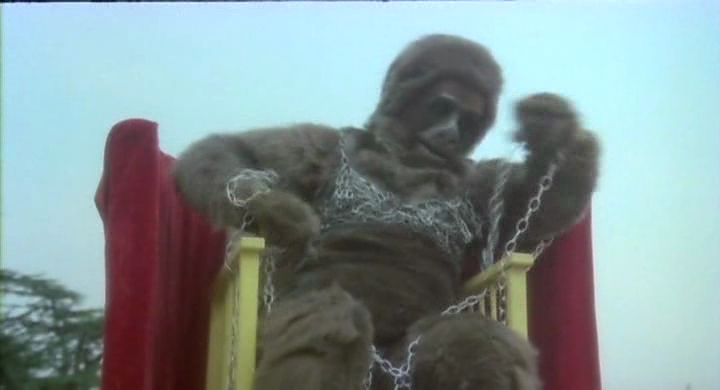
The enslavement of the black woman by the white woman?
But what we have here is a scenario where the white proletarian male rebels against the white bourgeois female and affirms his love for a black female of ambiguous class position (Queen in her own land yet taken away from there in slave chains) in a way that cuts across class, gender and ethnic lines in interesting ways.

Unconcious vagina dentata reference?

Linda Hayden as a singing nun
In the end, it all perhaps comes down to that most conservative and radical of powers, the one which every identity ultimately relies upon and yet often also has problems with: Love.
And here there is perhaps one kind of love which proves unacceptable, which is not allowed to speak its name. No, not bestiality, if we read Queen Kong and Ray's relationship as that between ape woman and man, but homosexuality.
Consider the gay-coded actor at the start: “Listen dear, I'll sue you deaf, dumb and blind if you don't get me down from here. Mind the hair dear! Mind me ankles! Now get out the way you silly bitch! I'm calling my agent, and my lawyer, not to mention my tailor!”
Or Luce's remark as she prepares to take Queen Kong to London: “She might have been a Queen on this island, but in London half the guys you meet are queens”
Very much a film of its time...
Thursday, 14 January 2010
The Playbirds
London, the late 1970s. Someone is killing the models of porn magazine Playbirds. With no real leads to go on, the police decide to send one of their own undercover / uncovered in a bid to make the maniac reveal himself from amongst the suspects already identified / proposed. They are:

Alan Lake as / is David Sullivan
Not that the film really open up space for discussing pornography anyway, other than to mock the anti-porn types of the time – as Sullivan did by naming another of his magazines, Whitehouse, after the religious puritan campaigner of the same surname. Still, the way in which his own alter-ego is presented seems somewhat curious. For he is crass, lacking in taste, obsessed with his horse racing (“use the whip!”) and generally someone you would very much like to see get his comeuppance.
We also get some footage of the mechanics of porn business, with copy upon copy of Playbirds being printed and stapled, rolling off the presses and being bundled up and into boxes for distribution: Fascinating from a documentary point of view, but distinctly anti-erotic.


The work of porn in the age of mechanical reproduction
Much the same can be said of the glamour shoots: Although the intention is clearly to make things seem sexy and exciting, the very fact that we're aware of this intentionality, or a lack of spontaneity and authenticity serves to distance us.
This emergent auto-critique also applies to the funniest and sleaziest moment in the entire film, in which Inspectors Porno and Bribeasy – er, Holbourne and Morgan – interview volunteers for going undercover and uncovered as a model in a bid to root out the maniac. Bump and grind music plays on the soundtrack as a succession of unsuccessful candidates strip off, the camera retaining a detached, observational eye throughout. Then, when glamour star Mary Millington steps into the breach, the camera becomes an active participant, moving around her and going in for close-ups as her routine continues.

Cue obligatory pseudo-lesbian scene
As with the giallo-inspired murder set-pieces, it's a moment of spectacle that makes us all the more aware of the banality of the bulk of the film, be it the detectives at work or 'Sullivan' at the racetrack.
Willy Roe is also the kind of point-and-shoot director whose attempts at visual style, such as a hand-held mirror based sex scene, don't really come off anyway.
Like other Sullivan productions most of the cast divides into two camps: Besides the models and porn types who cannot act but are happy providing the nudity and simulated sex, we also have various slumming thespians happy for just about the only work available them at the time.

Suzy Mandel
Somewhere in between, in uncredited roles, there are also some interesting other figures: unlikely 50-something porn performer Derek Aylward as a client in a massage parlour, candidly / knowingly acknowledged as the front for a brothel that the police are fully aware of, and performance artist / musician Cosey Fanni Tutti as a model; while her work within the British porn industry was also part of her wider art project – she posed for Sullivan's magazines and mounted an exhibition called Pornography – the film does not address this subject.
Playbirds goes off the rails a bit towards the end and finishes with one of those shock endings commonly found in weaker thrillers.
Yet if it leaves you dissatisfied and feeling cheated, this is perhaps apropos given the film's milieu, of a product which promises more than it can ever deliver and leaves you wanting more. (Not that such charges can only be levelled against porn...)
Insofar as the film is essentially 1959's The Cover Girl Murders revamped for a more permissive age and filtered through contemporary exploitation trends, intertexts are not difficult to find: The politician recalls the judge in Night after Night; the use of computer profiling in an attempt to narrow down the list of suspects The Bird with the Crystal Plumage; the glamour/model/sleaze setting Strip Nude for Your Killer, Delirium: Photos of Gioa and so on; the Playbirds of reality/Playbirds of fiction element the diegetic and non-diegetic Tenebres; the cod occultism Virgin Witch or Satanic Rites of Dracula; and fetishistic shots of black gloves around women's necks and a clue concealed in the photographic blow-up countless gialli.

The hands of doom

The white heat of the Scotland Yard computer system
The film also features plenty of jaw-droppingly funny / bad and just plain distasteful dialogue (“O goody, I'm going to be raped, I've never been raped before”) and some nice location shots of Soho for good measure.
[See also: http://www.beardyfreak.com/rvbirds.php
http://www.hysteria-lives.co.uk/hysterialives/Hysteria/the_playbird_murders.html ]
- The Playbirds photographer with a history of violence.
- The politician who preaches virtue in public and practices his vices in private.
- The Christian prophet of doom.
- The Playbirds owner who finds that his sales increase with each new murder.

Alan Lake as / is David Sullivan
Not that the film really open up space for discussing pornography anyway, other than to mock the anti-porn types of the time – as Sullivan did by naming another of his magazines, Whitehouse, after the religious puritan campaigner of the same surname. Still, the way in which his own alter-ego is presented seems somewhat curious. For he is crass, lacking in taste, obsessed with his horse racing (“use the whip!”) and generally someone you would very much like to see get his comeuppance.
We also get some footage of the mechanics of porn business, with copy upon copy of Playbirds being printed and stapled, rolling off the presses and being bundled up and into boxes for distribution: Fascinating from a documentary point of view, but distinctly anti-erotic.


The work of porn in the age of mechanical reproduction
Much the same can be said of the glamour shoots: Although the intention is clearly to make things seem sexy and exciting, the very fact that we're aware of this intentionality, or a lack of spontaneity and authenticity serves to distance us.
This emergent auto-critique also applies to the funniest and sleaziest moment in the entire film, in which Inspectors Porno and Bribeasy – er, Holbourne and Morgan – interview volunteers for going undercover and uncovered as a model in a bid to root out the maniac. Bump and grind music plays on the soundtrack as a succession of unsuccessful candidates strip off, the camera retaining a detached, observational eye throughout. Then, when glamour star Mary Millington steps into the breach, the camera becomes an active participant, moving around her and going in for close-ups as her routine continues.

Cue obligatory pseudo-lesbian scene
As with the giallo-inspired murder set-pieces, it's a moment of spectacle that makes us all the more aware of the banality of the bulk of the film, be it the detectives at work or 'Sullivan' at the racetrack.
Willy Roe is also the kind of point-and-shoot director whose attempts at visual style, such as a hand-held mirror based sex scene, don't really come off anyway.
Like other Sullivan productions most of the cast divides into two camps: Besides the models and porn types who cannot act but are happy providing the nudity and simulated sex, we also have various slumming thespians happy for just about the only work available them at the time.

Suzy Mandel
Somewhere in between, in uncredited roles, there are also some interesting other figures: unlikely 50-something porn performer Derek Aylward as a client in a massage parlour, candidly / knowingly acknowledged as the front for a brothel that the police are fully aware of, and performance artist / musician Cosey Fanni Tutti as a model; while her work within the British porn industry was also part of her wider art project – she posed for Sullivan's magazines and mounted an exhibition called Pornography – the film does not address this subject.
Playbirds goes off the rails a bit towards the end and finishes with one of those shock endings commonly found in weaker thrillers.
Yet if it leaves you dissatisfied and feeling cheated, this is perhaps apropos given the film's milieu, of a product which promises more than it can ever deliver and leaves you wanting more. (Not that such charges can only be levelled against porn...)
Insofar as the film is essentially 1959's The Cover Girl Murders revamped for a more permissive age and filtered through contemporary exploitation trends, intertexts are not difficult to find: The politician recalls the judge in Night after Night; the use of computer profiling in an attempt to narrow down the list of suspects The Bird with the Crystal Plumage; the glamour/model/sleaze setting Strip Nude for Your Killer, Delirium: Photos of Gioa and so on; the Playbirds of reality/Playbirds of fiction element the diegetic and non-diegetic Tenebres; the cod occultism Virgin Witch or Satanic Rites of Dracula; and fetishistic shots of black gloves around women's necks and a clue concealed in the photographic blow-up countless gialli.

The hands of doom

The white heat of the Scotland Yard computer system
The film also features plenty of jaw-droppingly funny / bad and just plain distasteful dialogue (“O goody, I'm going to be raped, I've never been raped before”) and some nice location shots of Soho for good measure.
[See also: http://www.beardyfreak.com/rvbirds.php
http://www.hysteria-lives.co.uk/hysterialives/Hysteria/the_playbird_murders.html ]
Wednesday, 6 January 2010
Appuntamento in nero / Scandal in Black
Angela (Mirella Banti) is the wife of a diplomat, John Baldwin (Andy J Forest). One day she visits a down-market cinema and is attacked in the toilets by a maniac. The incident proves the last straw for John, who is secretly having an affair with Angela's live-in friend Eva (Mary Lindstrom), a model. Not wanting to divorce Angela for fear of scandal, John decides to murder her and blame it on the maniac at large...
Even when presented in this form, Scandal in Black has an obvious plausibility concern in why a respectability-obsessed career politician would be living with the (perhaps lesbian coded) friend of his wife to begin with: Wouldn't this in itself be scandalous enough or at least provide plausible cause for scandal when manipulated by the media and rivals or enemies?
Things get worse when we consider the way in which Angela's supposed rape in the toilets is handled by the police, with no sign of their making any sort of forensic examinations. For, had they done so, they might have realised that Angela faked her attack.
The reason why isn't entirely clear: It could have something to do with a traumatic incident fifteen years previously, as shown in a pre-credits sequence. But if so there's no definite and convincing point of connection ever really established. Instead, the initial trauma feels somewhat shoehorned in because that's what the textbook dictates a giallo should have. Yet in its presentation, with rape prominent and the identity of the attacker obvious rather than concealed, it also seems to be aiming at something more.
Whatever this something more is remains obscure, however, quickly leading to the conclusion that Scandal in Black is best approached by not questioning things too much and going with the flow.
What we get are various reversals of fortune amongst the conspirators, very much a case of who is screwing who, both metaphorically and literally; various well-worn filone tropes including black gloves, blades, damaged dolls, blackmail subplots, threatening phone calls, shower scenes and a death (specifically decapitation) by power tool; all topped off by some of the most consistently defective detective work around:

“Did you realise last week’s hit and run victim worked in the same movie theatre where Mrs Baldwin was attacked?”
“How do you know that?”
Or how about:
“Even in a small city like this hundreds of women are molested every week. Most of the time that’s the end of it; nothing else ever happens.”
And this from a female officer who was once molested herself. Perhaps something is lost in translation, but even so...

Shower abstraction of female form

And clear blade
Throughout all this the main tension in the film, one that is never quite satisfactorily resolved, is between the erotic thriller and slasher film aspects of the giallo. There are more softcore sex scenes and fewer murder set pieces. This slows things down somewhat, since the sex scenes rarely advance the plot.

The doll
The real issue, however, is that the continuing presence of violence numbers makes the sex-violence interface that bit more evident and thus detracts from enjoyment of the sex scenes. This would be fine if a Laura Mulvey styled “visual unpleasure” was the aim, but it's not, at least in general terms.


Sexist, or a critique of sexism?
The opening scenes encapsulate this tension perfectly: First we have the rape scene, which is not supposed to be sexy. Then we have Angela driving in her sports car en route to the cinema, seductively dressed and very much performing for the camera and the male spectator. Taken together we have a pleasure which is at best a guilty one.
As a whole it feels as though the filmmakers have taken the plot of a Lenzi “psycho-sexy” giallo from the late 1960s and filtered it through the lens of an Argento psycho-sexual giallo from a few years later. This would be fine, but for the fact that when Lenzi himself worked in an Argento idiom, as in Seven Blood Stained Orchids, he did so as an alternative to his own earlier approach. Thus when one character is killed with an electric drill within that film, the effect is more an impressive piece of splatter than something uncomfortably psycho-sexual: The drill may be phallic, if one wants to interpret it that way, but it is first and foremost a drill. Here, by contrast, we have an approach that is too self-conscious for its own good, as when Angela remarks of her phantom attacker that “He used the bottle neck as if it were a phallus”.
The Lenzi connection may seem less arbitrary when we consider that leading man Forest was a regular in Lenzi productions of this time. His performance here – to the extent any performance can be judged through a bad English dub – is somewhat one note if suitably unlikeable. Leading lady Banti is perhaps best known for her role as one of the lesbian victims in Tenebre. She acquits herself well enough, as does the more decorative Lindstrom, in what appears to have been her only film appearance.

Hedman plus posters
Also in the cast are Franco Citti and Marina Hedman. The former, though most associated with Pasolini, appeared in the odd filone production, such as The Cat with the Eyes of Jade. The latter, a hardcore porn performer, is amusingly cast as one of the employees of the cinema, whose walls are adorned with posters for the likes of Fatal Temptation and Emmanuelle 5.
The scoring, by Marco Rossetti, is decent, but suffers from that artificial, synthetic quality, where every drum beat has exactly the same pre-programmed sound. Had the film been made in 1975 rather than 1990 you could imagine it all being more organic (read real instruments, and a Hammond B3 rather than a synth), and much the better for it.
In sum, entertaining enough if you can turn off your critical faculties, which I was not able to do...
Even when presented in this form, Scandal in Black has an obvious plausibility concern in why a respectability-obsessed career politician would be living with the (perhaps lesbian coded) friend of his wife to begin with: Wouldn't this in itself be scandalous enough or at least provide plausible cause for scandal when manipulated by the media and rivals or enemies?
Things get worse when we consider the way in which Angela's supposed rape in the toilets is handled by the police, with no sign of their making any sort of forensic examinations. For, had they done so, they might have realised that Angela faked her attack.
The reason why isn't entirely clear: It could have something to do with a traumatic incident fifteen years previously, as shown in a pre-credits sequence. But if so there's no definite and convincing point of connection ever really established. Instead, the initial trauma feels somewhat shoehorned in because that's what the textbook dictates a giallo should have. Yet in its presentation, with rape prominent and the identity of the attacker obvious rather than concealed, it also seems to be aiming at something more.
Whatever this something more is remains obscure, however, quickly leading to the conclusion that Scandal in Black is best approached by not questioning things too much and going with the flow.
What we get are various reversals of fortune amongst the conspirators, very much a case of who is screwing who, both metaphorically and literally; various well-worn filone tropes including black gloves, blades, damaged dolls, blackmail subplots, threatening phone calls, shower scenes and a death (specifically decapitation) by power tool; all topped off by some of the most consistently defective detective work around:

“Did you realise last week’s hit and run victim worked in the same movie theatre where Mrs Baldwin was attacked?”
“How do you know that?”
Or how about:
“Even in a small city like this hundreds of women are molested every week. Most of the time that’s the end of it; nothing else ever happens.”
And this from a female officer who was once molested herself. Perhaps something is lost in translation, but even so...

Shower abstraction of female form

And clear blade
Throughout all this the main tension in the film, one that is never quite satisfactorily resolved, is between the erotic thriller and slasher film aspects of the giallo. There are more softcore sex scenes and fewer murder set pieces. This slows things down somewhat, since the sex scenes rarely advance the plot.

The doll
The real issue, however, is that the continuing presence of violence numbers makes the sex-violence interface that bit more evident and thus detracts from enjoyment of the sex scenes. This would be fine if a Laura Mulvey styled “visual unpleasure” was the aim, but it's not, at least in general terms.


Sexist, or a critique of sexism?
The opening scenes encapsulate this tension perfectly: First we have the rape scene, which is not supposed to be sexy. Then we have Angela driving in her sports car en route to the cinema, seductively dressed and very much performing for the camera and the male spectator. Taken together we have a pleasure which is at best a guilty one.
As a whole it feels as though the filmmakers have taken the plot of a Lenzi “psycho-sexy” giallo from the late 1960s and filtered it through the lens of an Argento psycho-sexual giallo from a few years later. This would be fine, but for the fact that when Lenzi himself worked in an Argento idiom, as in Seven Blood Stained Orchids, he did so as an alternative to his own earlier approach. Thus when one character is killed with an electric drill within that film, the effect is more an impressive piece of splatter than something uncomfortably psycho-sexual: The drill may be phallic, if one wants to interpret it that way, but it is first and foremost a drill. Here, by contrast, we have an approach that is too self-conscious for its own good, as when Angela remarks of her phantom attacker that “He used the bottle neck as if it were a phallus”.
The Lenzi connection may seem less arbitrary when we consider that leading man Forest was a regular in Lenzi productions of this time. His performance here – to the extent any performance can be judged through a bad English dub – is somewhat one note if suitably unlikeable. Leading lady Banti is perhaps best known for her role as one of the lesbian victims in Tenebre. She acquits herself well enough, as does the more decorative Lindstrom, in what appears to have been her only film appearance.

Hedman plus posters
Also in the cast are Franco Citti and Marina Hedman. The former, though most associated with Pasolini, appeared in the odd filone production, such as The Cat with the Eyes of Jade. The latter, a hardcore porn performer, is amusingly cast as one of the employees of the cinema, whose walls are adorned with posters for the likes of Fatal Temptation and Emmanuelle 5.
The scoring, by Marco Rossetti, is decent, but suffers from that artificial, synthetic quality, where every drum beat has exactly the same pre-programmed sound. Had the film been made in 1975 rather than 1990 you could imagine it all being more organic (read real instruments, and a Hammond B3 rather than a synth), and much the better for it.
In sum, entertaining enough if you can turn off your critical faculties, which I was not able to do...
Thursday, 31 December 2009
Confessions from the David Galaxy Affair / The David Galaxy Affair / Sex Star
During the 1970s the bottom pretty much fell out of the British film industry. One of the few genres to remain profitable was the sex film. Because of the strictness of British censorship laws hardcore porn, never became the dominant form as in the US and in continental Europe. Instead, a particularly British kind of softcore sex film continued to dominate, much as it had done in the previous decade.
At the same time new players entered the game. Some were established filmmakers struggling to find work in even more marginally respectable genres such as horror – take a bow Val Guest, for instance. Others were part of the emergent pornocracy. Of these the most important was arguably David Sullivan, the UK’s answer to Penthouse’s Bob Guccione. Unlike Guccione, however, Sullivan had no pretensions to art: The idea of producing a Caligula, of making a serious and would-be respectable X film, would never have crossed his mind. Gore Vidal, John Gielgud and so on cost real money.
Rather, Sullivan was a master of bait and switch, promising the dirty mac brigade more than his films ever delivered and taking them for a ride. There was no benefit, after all, in either telling the truth or endeavouring to actually offer punters the hardcore they wanted, as demonstrated by the fates of John Lindsay – sent to jail for openly selling hardcore – and Mary Millington– hounded to suicide for believing in sexual liberation as a freedom issue and practicing what she preached.
Instead, it was always about reaching a comfortable and profitable arrangement with the established order rather than really challenging it.

The mark of quality - not!
But Sullivan was also like Guccione in another way: An early master of media synergy, he promoted the films he produced via his porn magazines and vice versa. Though Confessions from the David Galaxy Affair doesn’t go as far as The Playbirds – a nasty, giallified remake of The Cover Girl Murders with a title derived from one of Sullivan’s magazines and Millington’s policewoman going undercover as a model – it nevertheless again features Millington alongside other models from his stable such as Vicky Scott.
In truth, however, this is the first con aspect of Confessions from the David Galaxy Affair, insofar as the roles played by Sullivan’s models are relatively minor.
Or perhaps it isn’t a con, in that the title at least foregrounds Galaxy himself, even as it alludes to the Confessions of series that it has nothing whatsoever to really do with, alongside throwing in a general purpose Affair for good measure.
This only leads to a larger problem, however, inasmuch as Galaxy, as played by Alan Lake is really a pretty repulsive individual that its difficult for anyone to feel much for; indeed in the course of the narrative he telephones his mother, who tells him in no uncertain terms to fuck right off.
He’s a sexist, racist, homophobic unreconstructed example of 1970s machismo with a profitable sideline in fortune telling. He may also be guilty of involvement in a bank robbery some five years ago, a robbery in which a guard died.
This last aspect is the thing that amounts to a narrative drive, although it doesn’t exactly propel the story along at pace. Rather, we have subplots involving Galaxy’s new potential landlady, played by Lake’s real life wife Diana Dors – she also contributes vocals to the truly awful theme song – and his attempt to raise some cash by being the man who can give the woman who’s had 1000 lovers what she’s never had, namely an orgasm. (Hence the opportunistic “Mary Millington meets Super-Stud!!” tagline.)
Somewhat incongrously, we also have a trip to a VD clinic – a strange interjection of reality, albeit a strangely comforting one from a time when everything could be cured by a quick course of penicillin – and a visit to the racetrack.
Dors, the British Marilyn Monroe (or Jane Mansfield) was actually a pretty good actress, as demonstrated by her work in Yield to the Night. Unfortunately by this point in time – four years before her death from cancer and Lake’s suicide soon after – her talent was very much in decline.
Much the same might be said for Lake, though it’s questionable how much talent he had in the first place. Had it not been a David Sullivan production one could almost imagine his intention in playing Galaxy as being to alienate the audience, to set them against the character or make them begin to question their own assumptions and attitudes.

Alan Lake - sex god or Mr Self Destruct?
But Sullivan certainly didn’t do irony; as we’ve said, gold was all he was interested in.
As such, the hints of self-hatred that may be detected in Lake’s performance must be ascribed a darker, more personal motive. One moment that encapsulates this, as Lake’s own De Niro/La Motta moment, comes at the end of the film when he’s in a cell, Lake having himself been imprisoned for his part in a pub brawl. Revenge will be his...
As is often the case in this kind of production the supporting cast, the kind simply grateful for the chance of some work, provide less troubling relief. Euro-horror fans will note John Moulder-Brown of The House that Screamed and Vampire Circus, the most fantastique of Hammer’s vampire outings. Followers of British TV of the time will surely recognise Glynn “Dave” Edwards; in a possible in-joke the apartments where Galaxy lives are called Winchester, just like the club ran by Edward’s character in the long-running series Minder.
Willy Roe’s direction is functional and efficient, certainly more than this was too much to ask for, but perhaps thankfully he at least doesn't give us any less.
In the final analysis, Confessions from the David Galaxy Affair can be recommended to scholars of British sleaze and low culture, if no one else.
At the same time new players entered the game. Some were established filmmakers struggling to find work in even more marginally respectable genres such as horror – take a bow Val Guest, for instance. Others were part of the emergent pornocracy. Of these the most important was arguably David Sullivan, the UK’s answer to Penthouse’s Bob Guccione. Unlike Guccione, however, Sullivan had no pretensions to art: The idea of producing a Caligula, of making a serious and would-be respectable X film, would never have crossed his mind. Gore Vidal, John Gielgud and so on cost real money.
Rather, Sullivan was a master of bait and switch, promising the dirty mac brigade more than his films ever delivered and taking them for a ride. There was no benefit, after all, in either telling the truth or endeavouring to actually offer punters the hardcore they wanted, as demonstrated by the fates of John Lindsay – sent to jail for openly selling hardcore – and Mary Millington– hounded to suicide for believing in sexual liberation as a freedom issue and practicing what she preached.
Instead, it was always about reaching a comfortable and profitable arrangement with the established order rather than really challenging it.

The mark of quality - not!
But Sullivan was also like Guccione in another way: An early master of media synergy, he promoted the films he produced via his porn magazines and vice versa. Though Confessions from the David Galaxy Affair doesn’t go as far as The Playbirds – a nasty, giallified remake of The Cover Girl Murders with a title derived from one of Sullivan’s magazines and Millington’s policewoman going undercover as a model – it nevertheless again features Millington alongside other models from his stable such as Vicky Scott.
In truth, however, this is the first con aspect of Confessions from the David Galaxy Affair, insofar as the roles played by Sullivan’s models are relatively minor.
Or perhaps it isn’t a con, in that the title at least foregrounds Galaxy himself, even as it alludes to the Confessions of series that it has nothing whatsoever to really do with, alongside throwing in a general purpose Affair for good measure.
This only leads to a larger problem, however, inasmuch as Galaxy, as played by Alan Lake is really a pretty repulsive individual that its difficult for anyone to feel much for; indeed in the course of the narrative he telephones his mother, who tells him in no uncertain terms to fuck right off.
He’s a sexist, racist, homophobic unreconstructed example of 1970s machismo with a profitable sideline in fortune telling. He may also be guilty of involvement in a bank robbery some five years ago, a robbery in which a guard died.
This last aspect is the thing that amounts to a narrative drive, although it doesn’t exactly propel the story along at pace. Rather, we have subplots involving Galaxy’s new potential landlady, played by Lake’s real life wife Diana Dors – she also contributes vocals to the truly awful theme song – and his attempt to raise some cash by being the man who can give the woman who’s had 1000 lovers what she’s never had, namely an orgasm. (Hence the opportunistic “Mary Millington meets Super-Stud!!” tagline.)
Somewhat incongrously, we also have a trip to a VD clinic – a strange interjection of reality, albeit a strangely comforting one from a time when everything could be cured by a quick course of penicillin – and a visit to the racetrack.
Dors, the British Marilyn Monroe (or Jane Mansfield) was actually a pretty good actress, as demonstrated by her work in Yield to the Night. Unfortunately by this point in time – four years before her death from cancer and Lake’s suicide soon after – her talent was very much in decline.
Much the same might be said for Lake, though it’s questionable how much talent he had in the first place. Had it not been a David Sullivan production one could almost imagine his intention in playing Galaxy as being to alienate the audience, to set them against the character or make them begin to question their own assumptions and attitudes.

Alan Lake - sex god or Mr Self Destruct?
But Sullivan certainly didn’t do irony; as we’ve said, gold was all he was interested in.
As such, the hints of self-hatred that may be detected in Lake’s performance must be ascribed a darker, more personal motive. One moment that encapsulates this, as Lake’s own De Niro/La Motta moment, comes at the end of the film when he’s in a cell, Lake having himself been imprisoned for his part in a pub brawl. Revenge will be his...
As is often the case in this kind of production the supporting cast, the kind simply grateful for the chance of some work, provide less troubling relief. Euro-horror fans will note John Moulder-Brown of The House that Screamed and Vampire Circus, the most fantastique of Hammer’s vampire outings. Followers of British TV of the time will surely recognise Glynn “Dave” Edwards; in a possible in-joke the apartments where Galaxy lives are called Winchester, just like the club ran by Edward’s character in the long-running series Minder.
Willy Roe’s direction is functional and efficient, certainly more than this was too much to ask for, but perhaps thankfully he at least doesn't give us any less.
In the final analysis, Confessions from the David Galaxy Affair can be recommended to scholars of British sleaze and low culture, if no one else.
Monday, 21 December 2009
April Fool's Day / Slaughter High
As a late, cheap and derivative entry in the original slasher film cycle, the essential challenge that Slaughter High presents the reviewer with is that of saying something original.
The opening gambit is itself a cliché: The traumatic scene in the past, on a significant calendar date, as class nerd Marty Rantzen (Simon Scuddamore) is horribly disfigured by his jock and cheerleader classmates when one of their April Fool's Day pranks goes wrong. (Haven't these kids seen Pranks or Terror Train?)

Alien brand beer

Blood

Boobs
One of the cheerleaders, Carol (Caroline Munro), then wakes up from this scene just as she is pleading Marty for forgiveness.
It's a spark of inspiration, useful for situating her as a probable final girl alongside placing the film's oft-criticised shock ending within a wider narrative context.
The phone rings. Her agent, Manny (Dick Randall) has a job, but it sounds suspiciously like a porn film. Accordingly she declines and goes to her ten year class reunion instead – on the night of the 31st March and 1st April...
In this we again see the film playing to its strengths, or at least doing what it can to acknowledge and neutralise its weaknesses:
The filmmakers seem to be saying that, yes, they know that their cast are way too old to be playing high-schoolers, and are thus now keen to move things on to their late twenty-something present.
Then there's that Randall was the film's co-producer, got his start in nudie films, and has his office walls lined with posters for the trashy likes of Pieces and Supersonic Man.
Then there's that Munro's shower scene, which allows for the obligatory nod to Psycho and some early use of the stalker cam, is itself devoid of nudity.
Randall and his frequent co-production partner at the time, Steve Minasian, obviously weren't paying her enough for that. (Anyone wanting a giallo/slasher/trash triple threat triptych could do a lot worse than watch this film, Pieces and the Santa Claus slasher Don't Open Till Christmas.)
This said, we have already had some full frontal male nudity courtesy of Simon Scuddamore as Marty. Likewise, before the hour and a half is out we will get also get some exposed breasts courtesy of a couple of the female no-names later on.
As Carol and the others arrive at the now-abandoned high school someone watches them from inside.
With a storm erupting outside, they decide to break into the building to take shelter and have a look around.

Marty as he was - bad hair, glasses, desperate to be one of the cool kids

Marty as he is, with jester's cap, mask and psychosis
One of the jocks jumps out wearing a hockey mask, a la Jason (Minasian was involved with the Friday the 13th series, as was composer Harry Manfredini, who contributes a rather sound-alike score) while someone else makes comments about Halloween.
Again, no sense in pretending that you're original seems to be the message.
The group find a copy of their yearbook and are thus reminded about Marty. They never worry about the fact that no-one else from their year has shown up, but that's pretty much par for the course. After all, the now abandoned school also still has a caretaker on its grounds, or rather had – as he's Marty's first victim, being impaled on a coat hook. Again the inconsistent logic – why does the revenge seeking nerd kill someone who didn't do anything to him – doesn't really matter.
The next to die is one of the group, a jock who drinks some acid-spiked beer and promptly suffers from an exploding chest, Alien style.


Maniac Meets Dawn of the Dead?
While one of the girls goes to have a bath – cue beginnings of idiot plot wanderings around in the dark, getting picked off one-by-one – the others look for a way out. They find they have been locked in. One of the guys manages to get out and to his car, but is then speared from behind by Marty, following which he tops up the bath with acid...
By now we're forty or so minutes in, with an equal number to go and can pretty much predict the shocks and splatter and so forth by the clock: Couple go off to have sex, get electrocuted via metal bed frame; guy goes off to try to fix car, gets a rotor blade to the chest, etc., etc., until the slightly more extended final showdown (most quotable line: “April Fucking Fool, You Motherfuckers!”) and sequel-raising coda.
It was not to be, however, with Scuddamore committing suicide shortly after the film's completion. One very much hopes that it had no bearings upon his actions.
Though US-set the film was clearly made in the UK, with some of the accents veering from one side of the Atlantic to the other. The effects are satisfactory given the era and budget. While the cinematography is perhaps a bit dark in places, this adds atmosphere. The stalker cam work is plentiful and pretty decent, while the direction as a whole is better than might be thought considering that three men are credited with it. Certainly the production values as a whole are at least those of a 'proper' movie, unlike, say, Michael J Murphy's Last Night.
The opening gambit is itself a cliché: The traumatic scene in the past, on a significant calendar date, as class nerd Marty Rantzen (Simon Scuddamore) is horribly disfigured by his jock and cheerleader classmates when one of their April Fool's Day pranks goes wrong. (Haven't these kids seen Pranks or Terror Train?)

Alien brand beer

Blood

Boobs
One of the cheerleaders, Carol (Caroline Munro), then wakes up from this scene just as she is pleading Marty for forgiveness.
It's a spark of inspiration, useful for situating her as a probable final girl alongside placing the film's oft-criticised shock ending within a wider narrative context.
The phone rings. Her agent, Manny (Dick Randall) has a job, but it sounds suspiciously like a porn film. Accordingly she declines and goes to her ten year class reunion instead – on the night of the 31st March and 1st April...
In this we again see the film playing to its strengths, or at least doing what it can to acknowledge and neutralise its weaknesses:
The filmmakers seem to be saying that, yes, they know that their cast are way too old to be playing high-schoolers, and are thus now keen to move things on to their late twenty-something present.
Then there's that Randall was the film's co-producer, got his start in nudie films, and has his office walls lined with posters for the trashy likes of Pieces and Supersonic Man.
Then there's that Munro's shower scene, which allows for the obligatory nod to Psycho and some early use of the stalker cam, is itself devoid of nudity.
Randall and his frequent co-production partner at the time, Steve Minasian, obviously weren't paying her enough for that. (Anyone wanting a giallo/slasher/trash triple threat triptych could do a lot worse than watch this film, Pieces and the Santa Claus slasher Don't Open Till Christmas.)
This said, we have already had some full frontal male nudity courtesy of Simon Scuddamore as Marty. Likewise, before the hour and a half is out we will get also get some exposed breasts courtesy of a couple of the female no-names later on.
As Carol and the others arrive at the now-abandoned high school someone watches them from inside.
With a storm erupting outside, they decide to break into the building to take shelter and have a look around.

Marty as he was - bad hair, glasses, desperate to be one of the cool kids

Marty as he is, with jester's cap, mask and psychosis
One of the jocks jumps out wearing a hockey mask, a la Jason (Minasian was involved with the Friday the 13th series, as was composer Harry Manfredini, who contributes a rather sound-alike score) while someone else makes comments about Halloween.
Again, no sense in pretending that you're original seems to be the message.
The group find a copy of their yearbook and are thus reminded about Marty. They never worry about the fact that no-one else from their year has shown up, but that's pretty much par for the course. After all, the now abandoned school also still has a caretaker on its grounds, or rather had – as he's Marty's first victim, being impaled on a coat hook. Again the inconsistent logic – why does the revenge seeking nerd kill someone who didn't do anything to him – doesn't really matter.
The next to die is one of the group, a jock who drinks some acid-spiked beer and promptly suffers from an exploding chest, Alien style.


Maniac Meets Dawn of the Dead?
While one of the girls goes to have a bath – cue beginnings of idiot plot wanderings around in the dark, getting picked off one-by-one – the others look for a way out. They find they have been locked in. One of the guys manages to get out and to his car, but is then speared from behind by Marty, following which he tops up the bath with acid...
By now we're forty or so minutes in, with an equal number to go and can pretty much predict the shocks and splatter and so forth by the clock: Couple go off to have sex, get electrocuted via metal bed frame; guy goes off to try to fix car, gets a rotor blade to the chest, etc., etc., until the slightly more extended final showdown (most quotable line: “April Fucking Fool, You Motherfuckers!”) and sequel-raising coda.
It was not to be, however, with Scuddamore committing suicide shortly after the film's completion. One very much hopes that it had no bearings upon his actions.
Though US-set the film was clearly made in the UK, with some of the accents veering from one side of the Atlantic to the other. The effects are satisfactory given the era and budget. While the cinematography is perhaps a bit dark in places, this adds atmosphere. The stalker cam work is plentiful and pretty decent, while the direction as a whole is better than might be thought considering that three men are credited with it. Certainly the production values as a whole are at least those of a 'proper' movie, unlike, say, Michael J Murphy's Last Night.
Subscribe to:
Posts (Atom)