http://www.italianfilmreview.com/
These guys are 'friends of ours' ;-)
They've also just revamped the look of the site.
Enjoy
Showing posts with label exploitation all'italiana. Show all posts
Showing posts with label exploitation all'italiana. Show all posts
Monday, 2 August 2010


Tuesday, 8 June 2010
Queen Kong
This, as you might know, is the King Kong spoof that was deemed to be a bit too similar to Dino De Laurentiis's remake of the same year (1976) and as a result was prevented from being released. Female lead Rula Lenska was apparently pleased by this turn of events, as she felt that the release of the film would have hampered her career. 30-plus years later it's hard to see what the fuss was about: The film would be difficult to confuse with the De Laurentiis version and, while certainly bad at a technical level, nonetheless has a certain something about it.

We open with a man being chased by hostile natives and ending up in their cooking pot. It is the latest scene in Luce Habit's (Lenska's) latest epic and proves the last straw as far as the actor is concerned.

In case you couldn't tell, and a possible nod to the krimi?
The demanding director returns to London to seek out a new lead and soon finds one in the shape of happy-go-lucky gleaming-smiled rogue Ray Fay (Robin Askwith).


The female gaze and its object; much like Four Flies on Grey Velvet Handel's Hallelujah Chorus plays here
In a nod to the original King Kong Ray's first glimpsed attempting to steal an apple. In a joke at the expense of the remake he then tries stealing an “original reproduction” King Kong poster from an Italian junk shop owner. (Ray: “Where is he, the little Italian fink, I'm gonna sue ya!”)

“I'm taking this peach with me”
Luce pays off said fink, slips Ray a mickey finn as his attention is distracted by some hippy types from whom he attempts to cadge a joint, and has The Liberated Lady set sail before he can awaken and start questioning the contract he may or may not have signed.
The Liberated Lady then arrives at the Island of Lazanga. The high priestess (Valerie Leon) wants to sacrifice Ray to Queen Kong but Luce is having none of it. Ray winds up being offered up to the giant ape anyway only for her to fall in love with him. What neither the high priestess or Luce were expecting, however, was for the feeling to be mutual...
Around about this point the action jumps back to London as Luce decides to put Queen Kong on display...
Throughout the gags come thick and fast, mostly missing but with enough hitting not to be a complete disaster.
The first thing that made the film work for me was the filmmakers' awareness that what they were doing was, at some level, basically crap as when, en route to Lazanga we're treated some highly self-referential and deprecating commentary on the B-film and its limitations.
Luce: We're on our way to Darkest Africa, to make a film that will make you the biggest star in Uganda
Ray: Oh, terrific
Ray: They keep saying Kong, Kong, Kong, Kong, Kong, Kong
Luce: yes, that's true
Ray: Well do you think this has some underlying meaning or symbolism or social significance?
Luce: Perhaps it's a secret code
The second, following in part from this, was the inability to actually position the film as X (bad) or Y (good), with a particular excess of images that could be construed as either sexist or anti-sexist, racist or anti-racist, or both at the same time.
On the one hand we have the crew of The Liberated Lady singing a song that name-checks such feminist figures as Germaine Greer and Jane Fonda:
Burn your bra
Burn your panties
Call you ma
Call your aunties
And ship up on the Liberated Lady
It's the new dance sweeping every nation
As they swing to the beat of women's liberation
Ladies entering into the lion's den
Fighting for their place next to men
Grab a Honda with Jane Fonda
Give a cheer for Germaine Greer
Etc.
On the other hand we have the selfsame crew/singers dressed in hot pants and cropped tops doing a dance routine that presenting the kind of spectacle for the assumed male gaze a Laura Mulvey most definitely would not have approved of:


On the one hand we have the primitivism and ignorance of the inhabitants of Lazanga being foregrounded, as with a public baths which comprises a number of toilets and sinks.
On the other hand its native inhabitants are ethnically diverse and run the place very as a tourist trap – “Lazanga where they do the Konga” and accept American Express and Diners Club cards – offering the possibility that the likes of the baths are there as a joke at the expense of the civilised outsider who thinks he (or she) gets it.
At the core of this and further complicating things in the figure of Queen Kong.
One reading of the original King Kong is, after all, as a specifically white racist fantasy about the white beauty and the black beast: Kong represents a monstrous black male sexuality and must be destroyed so that the white man can continue to enjoy his exclusive access to the white woman.
If this seems far fetched consider Kong author Edgar Wallace's work as a war correspondent during the Boer War; his Sanders of the Rivers novels; or the frequently recurring Murders in the Rue Morgue styled trope of the ape/missing link monster-killer in his thrillers.
Or, in the Italian context of the co-production, consider a Fascist-era propaganda which depicted a US Negro soldier as an ape intent on assigning a price to the Venus de Milo to thereby also implicate the Fascists as defenders of Italian / European civilisation against the primitive/savage other.

The enslavement of the black woman by the white woman?
But what we have here is a scenario where the white proletarian male rebels against the white bourgeois female and affirms his love for a black female of ambiguous class position (Queen in her own land yet taken away from there in slave chains) in a way that cuts across class, gender and ethnic lines in interesting ways.

Unconcious vagina dentata reference?

Linda Hayden as a singing nun
In the end, it all perhaps comes down to that most conservative and radical of powers, the one which every identity ultimately relies upon and yet often also has problems with: Love.
And here there is perhaps one kind of love which proves unacceptable, which is not allowed to speak its name. No, not bestiality, if we read Queen Kong and Ray's relationship as that between ape woman and man, but homosexuality.
Consider the gay-coded actor at the start: “Listen dear, I'll sue you deaf, dumb and blind if you don't get me down from here. Mind the hair dear! Mind me ankles! Now get out the way you silly bitch! I'm calling my agent, and my lawyer, not to mention my tailor!”
Or Luce's remark as she prepares to take Queen Kong to London: “She might have been a Queen on this island, but in London half the guys you meet are queens”
Very much a film of its time...

We open with a man being chased by hostile natives and ending up in their cooking pot. It is the latest scene in Luce Habit's (Lenska's) latest epic and proves the last straw as far as the actor is concerned.

In case you couldn't tell, and a possible nod to the krimi?
The demanding director returns to London to seek out a new lead and soon finds one in the shape of happy-go-lucky gleaming-smiled rogue Ray Fay (Robin Askwith).


The female gaze and its object; much like Four Flies on Grey Velvet Handel's Hallelujah Chorus plays here
In a nod to the original King Kong Ray's first glimpsed attempting to steal an apple. In a joke at the expense of the remake he then tries stealing an “original reproduction” King Kong poster from an Italian junk shop owner. (Ray: “Where is he, the little Italian fink, I'm gonna sue ya!”)

“I'm taking this peach with me”
Luce pays off said fink, slips Ray a mickey finn as his attention is distracted by some hippy types from whom he attempts to cadge a joint, and has The Liberated Lady set sail before he can awaken and start questioning the contract he may or may not have signed.
The Liberated Lady then arrives at the Island of Lazanga. The high priestess (Valerie Leon) wants to sacrifice Ray to Queen Kong but Luce is having none of it. Ray winds up being offered up to the giant ape anyway only for her to fall in love with him. What neither the high priestess or Luce were expecting, however, was for the feeling to be mutual...
Around about this point the action jumps back to London as Luce decides to put Queen Kong on display...
Throughout the gags come thick and fast, mostly missing but with enough hitting not to be a complete disaster.
The first thing that made the film work for me was the filmmakers' awareness that what they were doing was, at some level, basically crap as when, en route to Lazanga we're treated some highly self-referential and deprecating commentary on the B-film and its limitations.
Luce: We're on our way to Darkest Africa, to make a film that will make you the biggest star in Uganda
Ray: Oh, terrific
Ray: They keep saying Kong, Kong, Kong, Kong, Kong, Kong
Luce: yes, that's true
Ray: Well do you think this has some underlying meaning or symbolism or social significance?
Luce: Perhaps it's a secret code
The second, following in part from this, was the inability to actually position the film as X (bad) or Y (good), with a particular excess of images that could be construed as either sexist or anti-sexist, racist or anti-racist, or both at the same time.
On the one hand we have the crew of The Liberated Lady singing a song that name-checks such feminist figures as Germaine Greer and Jane Fonda:
Burn your bra
Burn your panties
Call you ma
Call your aunties
And ship up on the Liberated Lady
It's the new dance sweeping every nation
As they swing to the beat of women's liberation
Ladies entering into the lion's den
Fighting for their place next to men
Grab a Honda with Jane Fonda
Give a cheer for Germaine Greer
Etc.
On the other hand we have the selfsame crew/singers dressed in hot pants and cropped tops doing a dance routine that presenting the kind of spectacle for the assumed male gaze a Laura Mulvey most definitely would not have approved of:


On the one hand we have the primitivism and ignorance of the inhabitants of Lazanga being foregrounded, as with a public baths which comprises a number of toilets and sinks.
On the other hand its native inhabitants are ethnically diverse and run the place very as a tourist trap – “Lazanga where they do the Konga” and accept American Express and Diners Club cards – offering the possibility that the likes of the baths are there as a joke at the expense of the civilised outsider who thinks he (or she) gets it.
At the core of this and further complicating things in the figure of Queen Kong.
One reading of the original King Kong is, after all, as a specifically white racist fantasy about the white beauty and the black beast: Kong represents a monstrous black male sexuality and must be destroyed so that the white man can continue to enjoy his exclusive access to the white woman.
If this seems far fetched consider Kong author Edgar Wallace's work as a war correspondent during the Boer War; his Sanders of the Rivers novels; or the frequently recurring Murders in the Rue Morgue styled trope of the ape/missing link monster-killer in his thrillers.
Or, in the Italian context of the co-production, consider a Fascist-era propaganda which depicted a US Negro soldier as an ape intent on assigning a price to the Venus de Milo to thereby also implicate the Fascists as defenders of Italian / European civilisation against the primitive/savage other.
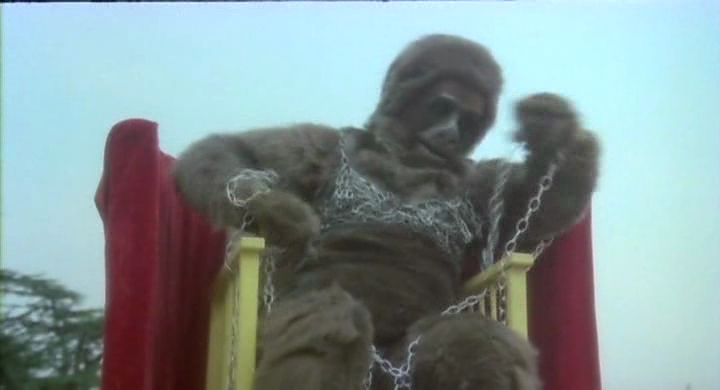
The enslavement of the black woman by the white woman?
But what we have here is a scenario where the white proletarian male rebels against the white bourgeois female and affirms his love for a black female of ambiguous class position (Queen in her own land yet taken away from there in slave chains) in a way that cuts across class, gender and ethnic lines in interesting ways.

Unconcious vagina dentata reference?

Linda Hayden as a singing nun
In the end, it all perhaps comes down to that most conservative and radical of powers, the one which every identity ultimately relies upon and yet often also has problems with: Love.
And here there is perhaps one kind of love which proves unacceptable, which is not allowed to speak its name. No, not bestiality, if we read Queen Kong and Ray's relationship as that between ape woman and man, but homosexuality.
Consider the gay-coded actor at the start: “Listen dear, I'll sue you deaf, dumb and blind if you don't get me down from here. Mind the hair dear! Mind me ankles! Now get out the way you silly bitch! I'm calling my agent, and my lawyer, not to mention my tailor!”
Or Luce's remark as she prepares to take Queen Kong to London: “She might have been a Queen on this island, but in London half the guys you meet are queens”
Very much a film of its time...
Tuesday, 21 October 2008
Two types of exploitation?
Earlier this evening a fellow student and I introduced an intended double bill of exploitation all'italiana comprising Mattei's SS Girls, which we didn't show due to unforeseen technical difficulties, and Vari's Sister Emanuelle, which we did.
In her discussion of Sister Emanuelle, my co-host mentioned the article on Italian nun films in the Alternative Europe collection. She noted how it drew a distinction between those films that engaged with the figure of the nun specifically and those which were more exploitation films that just used the nun rather than, say, the prisoner in jail or a concentration camp, but did not address anything specific to her situation. There are, as it were, nunsploitation films and nunsploitation films.
Besides making me want to revisit the Alternative Europe essay, this got me thinking about these ideas more generally.
Obviously nun, WIP and Nazi themed Italian films have a lot in common, like the period with which we most associate them, primarily the 1970s; their tendency towards 'total institutions' settings; their emphasis on corrupt authority; sexual perversity and the various ritual scenes / sequences.
But there are also certain more specific features that the better filone filmmaker might engage with: in the case of the nun films it is Catholicism / religion; in that of the Nazi films fascism and resistance, and, in the case of the WIP film, perhaps a focus on the official corruption in the present rather than the past.
Going beyond this, it also makes me think of what I've previously referred to as the “hat” theory of filone, following the remarks of screenwriter Ernesto Gastaldi and critic Christopher Wagstaff on how the difference between a film in one filone cycle and other could often be reduced to the paradigmatic choice of this or that hat or other prop.
What I'm wondering is whether the distinction between the best directors in any given filone and the rest is that the best directors do something more than just make the same old film within a particular genre in also bringing out or introducing other themes more specific to it.
In the case of the western it's maybe the difference between Leone's distinctively Italian westerns, which responded to the Hollywood western and its myths rather than merely emulated them, as had the 25 or so previous entries within the cycle made by Italian filmmakers, or of westerns all'italiana compared to westerns all'italiana.
In the case of the thriller, it's perhaps the way in which a specifically modern world of science and technology is foregrounded by the likes of Argento's animal trilogy, Bazzoni's The Fifth Cord and Questi's Death Laid and Egg where more routine filmmakers often seem to use these elements primarily as backdrop.
Or, in the case of the crime film, it's maybe the way someone like Di Leo explores the meaning of the criminal code in an age of anonymous, impersonal, 'only business' relationships, compared to the good cop vs bad robbers type entries from some other directors.
Thoughts on other directors and / or cycles and counter-examples welcome...
[If anyone in the Edinburgh area is interested, next week is a follow-up double-bill of Mattei's Hell of the Living Dead and Fulci's Zombie; send me an email if you want more details]
In her discussion of Sister Emanuelle, my co-host mentioned the article on Italian nun films in the Alternative Europe collection. She noted how it drew a distinction between those films that engaged with the figure of the nun specifically and those which were more exploitation films that just used the nun rather than, say, the prisoner in jail or a concentration camp, but did not address anything specific to her situation. There are, as it were, nunsploitation films and nunsploitation films.
Besides making me want to revisit the Alternative Europe essay, this got me thinking about these ideas more generally.
Obviously nun, WIP and Nazi themed Italian films have a lot in common, like the period with which we most associate them, primarily the 1970s; their tendency towards 'total institutions' settings; their emphasis on corrupt authority; sexual perversity and the various ritual scenes / sequences.
But there are also certain more specific features that the better filone filmmaker might engage with: in the case of the nun films it is Catholicism / religion; in that of the Nazi films fascism and resistance, and, in the case of the WIP film, perhaps a focus on the official corruption in the present rather than the past.
Going beyond this, it also makes me think of what I've previously referred to as the “hat” theory of filone, following the remarks of screenwriter Ernesto Gastaldi and critic Christopher Wagstaff on how the difference between a film in one filone cycle and other could often be reduced to the paradigmatic choice of this or that hat or other prop.
What I'm wondering is whether the distinction between the best directors in any given filone and the rest is that the best directors do something more than just make the same old film within a particular genre in also bringing out or introducing other themes more specific to it.
In the case of the western it's maybe the difference between Leone's distinctively Italian westerns, which responded to the Hollywood western and its myths rather than merely emulated them, as had the 25 or so previous entries within the cycle made by Italian filmmakers, or of westerns all'italiana compared to westerns all'italiana.
In the case of the thriller, it's perhaps the way in which a specifically modern world of science and technology is foregrounded by the likes of Argento's animal trilogy, Bazzoni's The Fifth Cord and Questi's Death Laid and Egg where more routine filmmakers often seem to use these elements primarily as backdrop.
Or, in the case of the crime film, it's maybe the way someone like Di Leo explores the meaning of the criminal code in an age of anonymous, impersonal, 'only business' relationships, compared to the good cop vs bad robbers type entries from some other directors.
Thoughts on other directors and / or cycles and counter-examples welcome...
[If anyone in the Edinburgh area is interested, next week is a follow-up double-bill of Mattei's Hell of the Living Dead and Fulci's Zombie; send me an email if you want more details]
Subscribe to:
Posts (Atom)