Showing posts with label Edgar Wallace. Show all posts

Tuesday, 8 June 2010

Queen Kong

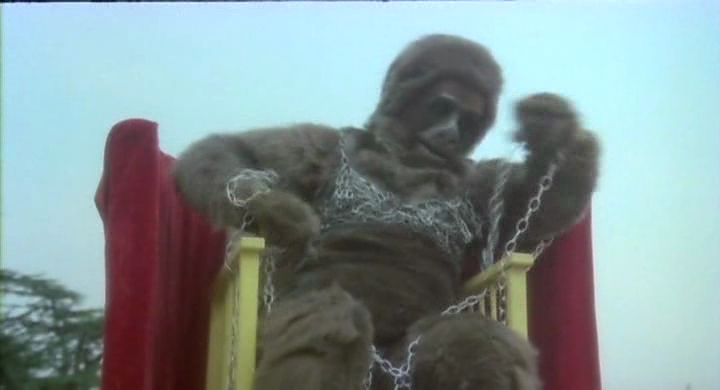
This, as you might know, is the King Kong spoof that was deemed to be a bit too similar to Dino De Laurentiis's remake of the same year (1976) and as a result was prevented from being released. Female lead Rula Lenska was apparently pleased by this turn of events, as she felt that the release of the film would have hampered her career. 30-plus years later it's hard to see what the fuss was about: The film would be difficult to confuse with the De Laurentiis version and, while certainly bad at a technical level, nonetheless has a certain something about it.


We open with a man being chased by hostile natives and ending up in their cooking pot. It is the latest scene in Luce Habit's (Lenska's) latest epic and proves the last straw as far as the actor is concerned.


In case you couldn't tell, and a possible nod to the krimi?

The demanding director returns to London to seek out a new lead and soon finds one in the shape of happy-go-lucky gleaming-smiled rogue Ray Fay (Robin Askwith).


The female gaze and its object; much like Four Flies on Grey Velvet Handel's Hallelujah Chorus plays here

In a nod to the original King Kong Ray's first glimpsed attempting to steal an apple. In a joke at the expense of the remake he then tries stealing an “original reproduction” King Kong poster from an Italian junk shop owner. (Ray: “Where is he, the little Italian fink, I'm gonna sue ya!”)


“I'm taking this peach with me”

Luce pays off said fink, slips Ray a mickey finn as his attention is distracted by some hippy types from whom he attempts to cadge a joint, and has The Liberated Lady set sail before he can awaken and start questioning the contract he may or may not have signed.

The Liberated Lady then arrives at the Island of Lazanga. The high priestess (Valerie Leon) wants to sacrifice Ray to Queen Kong but Luce is having none of it. Ray winds up being offered up to the giant ape anyway only for her to fall in love with him. What neither the high priestess or Luce were expecting, however, was for the feeling to be mutual...

Around about this point the action jumps back to London as Luce decides to put Queen Kong on display...

Throughout the gags come thick and fast, mostly missing but with enough hitting not to be a complete disaster.

The first thing that made the film work for me was the filmmakers' awareness that what they were doing was, at some level, basically crap as when, en route to Lazanga we're treated some highly self-referential and deprecating commentary on the B-film and its limitations.

Luce: We're on our way to Darkest Africa, to make a film that will make you the biggest star in Uganda
Ray: Oh, terrific

Ray: They keep saying Kong, Kong, Kong, Kong, Kong, Kong
Luce: yes, that's true
Ray: Well do you think this has some underlying meaning or symbolism or social significance?
Luce: Perhaps it's a secret code

The second, following in part from this, was the inability to actually position the film as X (bad) or Y (good), with a particular excess of images that could be construed as either sexist or anti-sexist, racist or anti-racist, or both at the same time.

On the one hand we have the crew of The Liberated Lady singing a song that name-checks such feminist figures as Germaine Greer and Jane Fonda:

Burn your bra
Burn your panties
Call you ma
Call your aunties
And ship up on the Liberated Lady
It's the new dance sweeping every nation
As they swing to the beat of women's liberation
Ladies entering into the lion's den
Fighting for their place next to men
Grab a Honda with Jane Fonda
Give a cheer for Germaine Greer
Etc.

On the other hand we have the selfsame crew/singers dressed in hot pants and cropped tops doing a dance routine that presenting the kind of spectacle for the assumed male gaze a Laura Mulvey most definitely would not have approved of:


On the one hand we have the primitivism and ignorance of the inhabitants of Lazanga being foregrounded, as with a public baths which comprises a number of toilets and sinks.

On the other hand its native inhabitants are ethnically diverse and run the place very as a tourist trap – “Lazanga where they do the Konga” and accept American Express and Diners Club cards – offering the possibility that the likes of the baths are there as a joke at the expense of the civilised outsider who thinks he (or she) gets it.

At the core of this and further complicating things in the figure of Queen Kong.

One reading of the original King Kong is, after all, as a specifically white racist fantasy about the white beauty and the black beast: Kong represents a monstrous black male sexuality and must be destroyed so that the white man can continue to enjoy his exclusive access to the white woman.

If this seems far fetched consider Kong author Edgar Wallace's work as a war correspondent during the Boer War; his Sanders of the Rivers novels; or the frequently recurring Murders in the Rue Morgue styled trope of the ape/missing link monster-killer in his thrillers.

Or, in the Italian context of the co-production, consider a Fascist-era propaganda which depicted a US Negro soldier as an ape intent on assigning a price to the Venus de Milo to thereby also implicate the Fascists as defenders of Italian / European civilisation against the primitive/savage other.


The enslavement of the black woman by the white woman?

But what we have here is a scenario where the white proletarian male rebels against the white bourgeois female and affirms his love for a black female of ambiguous class position (Queen in her own land yet taken away from there in slave chains) in a way that cuts across class, gender and ethnic lines in interesting ways.


Unconcious vagina dentata reference?


Linda Hayden as a singing nun

In the end, it all perhaps comes down to that most conservative and radical of powers, the one which every identity ultimately relies upon and yet often also has problems with: Love.

And here there is perhaps one kind of love which proves unacceptable, which is not allowed to speak its name. No, not bestiality, if we read Queen Kong and Ray's relationship as that between ape woman and man, but homosexuality.

Consider the gay-coded actor at the start: “Listen dear, I'll sue you deaf, dumb and blind if you don't get me down from here. Mind the hair dear! Mind me ankles! Now get out the way you silly bitch! I'm calling my agent, and my lawyer, not to mention my tailor!”

Or Luce's remark as she prepares to take Queen Kong to London: “She might have been a Queen on this island, but in London half the guys you meet are queens”

Very much a film of its time...

Sunday, 15 February 2009

Un giallo di Edgar Wallace

Poster for The Dead Eyes of London, as Gli Occhi di Londra or The Eyes of London, and proclaiming it to be an Edgar Wallace giallo:

Tuesday, 16 September 2008

Das Verrätertor / Traitor's Gate

This 1964 krimi departs from the norm in two obvious ways. First, it's a West German / UK co-production, with Freddie Francis in the director's chair and Jimmy Sangster – concealed beneath his Henry Samson pseudonym – responsible for adapting the Edgar Wallace source novel. Second, it's got a different emphasis from usual, with no murder mystery component whatsoever. Instead it is more of a heist thriller in the tradition of Jules Dassin's Rififi, with a gang of jewel thieves hatching the audacious plan of stealing the Crown Jewels from the Tower of London.


The colour on black and white animated titles are interesting as always

As such, Scotland Yard has less of a part to play, with the main audience identification figures instead being a young couple – he's a guard at the tower, she's a means by which he can be coerced into cooperating with the gang – and a hapless German tourist who become involved up in the gang's plans by design and accident respectively.


Money-directed professional voyeurism

Though the former are classic Wallace types – the girl is even taken prisoner by yet another one of those cars that dispenses knockout gas into the passenger compartment at the flick of a dashboard switch – the tourist is the obvious invention of the filmmakers, presumably intended to make the film more accessible to German audiences, especially given that he is played by series regular Eddi Arent.


The touristic gaze

Otherwise it's largely business as usual, with Klaus Kinski prominent as one of the robbers and another escaping from Dartmoor, seemingly the only correctional facility in the Wallaceverse, pursued by those firearm equipped policemen that curiously go against the myth of the British police his work otherwise promulgated.

Having said this, the presence of Francis and Sangster does however seem to give the British aspects of the production a touch more authenticity than was often the case on the all-German productions, with more substantial location shooting around the Tower and Picadilly Circus.

If both locations highlight the imagined / inauthentic aspect of the krimi, this is also more deliberate than usual thanks to Arent's character and the inherently touristic nature of the Tower itself, with Beefeater guards and suchlike already 'putting on a show'.


Soho sleaze; note the apparent lesbians behind Arent

The device of having the robbers first do a dress rehearsal with a mock up of the chamber in the tower also helps here, self-consciously foregrounding the studio bound nature of other aspects of the production to provide that convenient get out whereby the failure of something to look like the real thing could be passed off as a knowing gesture.

This said, the dramatic explosion on board a ship at the film's climax is all too obviously a bit of modelwork, while the execution of the real robbery proves fairly perfunctory compared to Rififi's daring silent centrepiece sequence and the in some ways comparable Grand Slam, in which Kinski also appears.

Fans of Francis and Sangster's work for Hammer and company may care to note the presence of Evil of Frankenstein's Katy Wild and dancer / choreographer Julie Mendez, who also appeared in She, in small roles; the latter also briefly exposes her breasts in the obligatory Soho club scene to provide an early instance of the kind of more daring material increasingly commonplace in the colour krimis.

Those seeking giallo connections will find them in the fact that the camera operator is none other than Ronnie Taylor, later to serve as director of photography on Argento's Opera and Sleepless.

With future Academy Award winners Francis and Taylor on board it's little surprise that Traitor's Gate looks good, although Francis's characteristically skilful but anonymous approach towards direction – as David Pirie argues, he was probably a better craftsman than Terence Fisher, but sometimes only brought craft to his work – means that there also less of the experimentation and neo-expressionism characterising Harald Reinl and Alfred Vohrer's krimis.

While there are plenty of subjective shots through telescopes, binoculars and so forth, as the robbers stake out the Tower, there is nothing comparable to the skull's eye view shots in The Skull nor the filter lighting effects in Dracula Has Risen From the Grave.


Kinski and weapon in a shot that would look good in 3D

Though Kinski is a bit more subdued than his usual this can be accounted for more positively as being an indication of his character being a solid professional. In contrast it's the same old thing from Arent, either welcome or a necessary evil depending on your tolerance for his comic pratfalls and to-camera mugging; to the uninitiated, think of Arent as the Michael Ripper or Luciano Pigozzi of the krimi, that kind of reassuring figure whose presence reassures that you're going to get what you expect, even if not always anything beyond this.

In line with this Peter Thomas delivers an effective score characterised by his usual quirks of unusual (male) vocalism and odd noises against the swing and lounge beats, making one wonder if he might be considered as something of the krimi equivalent of Ennio Morricone in the Italian western.

Saturday, 30 August 2008

Der Gorilla von Soho / The Gorilla of Soho / The Ape Creature / The Gorilla Gang

The bodies of drowned men, all elderly, wealthy foreigners with no relatives in the UK, keep being hauled out of the Thames. While the first seemed like an accident – the victim's wallet still being full – the fourth in as many months offers a challenge to statistical probability and suggests that something more sinister may be afoot.


Here we see the Gorilla of Soho, in its natural habitat...

As it so happens the victim, an Australian millionaire, was found with something else in his possession: a doll with writing on it.

The first problem facing Inspector Perkins (Horst Tappert) and Sergeant Pepper (Uwe Friedrichsen) is that the writing, in addition to being obscured, is in an language they do not know.


Yet another doll

Accordingly Miss Susan McPherson (Uschi Glas) is brought in. An expert on African languages, she soon identifies the words “crime,” “murder” and, most revealing of all, “the monster and the gorilla”


Female narcissism


Female to be looked at ness, as Pepper frames Susan


Not so easy to place

The notorious Gorilla Gang has returned...

The revelation that Ellis had left his wealth to the organisation Love and Peace for People shortly before his untimely demise naturally leads Perkins there. He arrives to find known blackmailer Sugar (Herbert Fux, in his only krimi role) and the organisation's head, Henry Parker, in the middle of a heated exchange; though not party to the exchange that Sugar is being paid off because of something to do with Henry's brother, Donald, the Inspector certainly knows that something is up.

Accordingly his next point of call is a nightclub with scantily clad models who pose on pedestals for the members – who, as it turns out include Sir Arthur – to photograph and sketch them. He is not there for this, however, but rather to speak with club habitue Sugar and to dig around to see what he can find out, thereby learning that one of the girls at the club, Cora, was involved with Donald Parker.


Herbert Fux, lit in the dominant red of the nightclub

Meanwhile Sugar is confronted by a gunman and almost grabbed by a digger – shades of My Dear Killer's opening decapitation murder – but escaped by diving into the river; it's supposed to be the Thames but remains as unconvincing as the rest of the non-stock footage.


Fux and a foreground gunman, in the dominant blue of the nighttime exteriors

This stock footage, meanwhile, is itself somewhat badly used in the obviously back projected driving sequences, with the same iconic red bus appearing behind the drivers no matter where they're supposed to be in London.

Next the investigators visits St Mary's, a convent-run institution for wayward girls where Dorothy Smith, a mute black girl, tries unsuccessfully to communicate something to Perkins on his way to ask the mother superior about Jack Corner, the ex-boss of the Gorilla Gang who had worked at St Mary's following his release from prison three years earlier.

Apparently Corner suffered horrible burns as a result of an accident in the boiler room – a fate with echoes of Sheila Isaac's fate in The Case of the Bloody Iris or the scalding of Amanda Righetti in Deep Red – but disappeared shortly thereafter.

On the way back Susan discovers another doll in her bag with writing on it, again in an African language: “The gorilla sometimes comes at night; the mother superior doesn't know,” revealing that one of the girls knows more that the others. Curiously, however, they don't connect the African language to Dorothy, the only non-white girl there, encouraging Susan to go undercover at the convent as a welfare officer.

Meanwhile the gang, the contours of whose activities are gradually taking shape, are plotting the murder of their next victim, Mr Stuart. At a meeting with Henry Parker and his lawyer, Dr Jekyll [sic], Stuart, another wealthy foreigner of advancing years, surprises the foundation's director with the news that they are not to be the prime beneficiaries of his will. Rather, he has just discovered that he has a daughter, Susan Ward, whom he is intend on tracking down.

That same night Stuart falls victim to the gorilla and is delivered to St Mary's. There the Sister and a reluctant Dorothy dispose of his body as they have clearly done the gang's previous victims. The girl also plants a doll on Stuart, whose body is fished out of the Thames shortly afterwards. Perkins discovers the doll, whilst the post-mortem reveals the curious fact that he been drowned in fresh rather than sea water...

At this point we're only about half-way through; safe to say that everything ultimately ties together and is resolved in a re-assuring manner with everyone getting their just desserts one way or another...

Though certainly entertaining at the camp and trash level, this is one of those awkward post-Blood and Black Lace pre-The Bird with the Crystal Plumage krimis that shows the filmmakers trying to find a more contemporary aesthetic, attitude and approach but largely failing.

Part of the sense of deja vu throughout the proceedings must also, however, be attributed to the highly formulaic nature of the material. Obviously popular genre works, both literary and cinematic, are always formalaic to an extent, but there is nevertheless the distinct impression of the filmmakers adapting a bottom of the pile krimi featuring rather many elements that had appeared earlier in the cycle and which thus now feel distinctly past their best before date.

Thus, for example, the gorilla costume wearing villain instantly recalls the likes of The Monk with the Whip and The Frog with the Mask. This in itself is not a problem but it does leave one wondering why that bit more, insofar as the film's Gorilla Gang – I suspect the novel may be different – seem to have been given their appellation for no particular reason. And, in a film like this that moment of questioning in the viewer is fatal.

It would have been better if the gang had been using a trained gorilla in their crimes. While certainly more difficult to render on screen convincing way – here it's worth remembering that 2001: A space Odyssey was released in the out the same year – this would also have kept one more in that state of wonderment and presented a nice line of descent back to Poe's Murders in the Rue Morgue and thus the very origins of the detective genre and sensation literature.

As it is, despite the alternative Ape Creature title, the filmmakers don't even try to cover up that it is a man in a suit, with the on-screen presentation of making it clear from the outset that we are dealing with a man in a gorilla suit.

Again the contrast with the likes of the the monk with his whip or the archer in green is telling, insofar as the films in which they appear present us with an enigma of the sort absent here: are these supernatural figures from the past who have somehow manifested in the present, along the lines of Conan Doyle's Hound of the Baskervilles, or merely something more mundane?

Not everything is the filmmakers' fault, however, with the plot being very obviously a retread of The Dead Eyes of London, beginning with the paradigmatic substitution of reform school girls for blind beggars as the subjects for dubiously motivated philanthropy and continuing through the foundling who is unwitting heir to a fortune; the man-beast cat's paw figure; the woman helping the police because of her special linguistic abilities and soon falling into peril thereby, and the pushing of one blackmailer down a lift shaft.

If all this is partially masked by the shift to colour and to another set of stock performers – Horst Tappert assuming the Joachim Fuchsberger role; Uschi Glas the Karin Baal one; Uwe Friedrichsen the Eddi Arent one etc. – the behind-the-scenes team are essentially the same, featuring such ubiquitous krimi film names as director Alfred Vohrer, production manager Horst Wendland, editor Jutta Hering, cinematographer Karl Lob and composer Peter Thomas.

While Thomas and Hering's contributions are solid, with the former exhibiting the ability to adapt to the new musical idioms of the time whilst still producing something distinctively his, Lob fails to push the expressive use of colour far enough in the set-pieces and lights the expository scenes in somewhat flatly. Putting it another way if Lob's work on Dead Eyes of London was almost comparable to that of Bava on Black Sunday – as two films released in the same year and independently of one another showcasing traditional black and white Expressionism circa 1960 – his work his work here falls far short of his Italian counterpart on Blood and Black Lace – as one of the key models for the new colour Expressionism / expressivism.


Another almost there but not quite murder set piece begins

Vohrer's direction is, in itself, nothing to be ashamed of. It's brisk and efficient and contains enough self-conscious stylish moments and images without becoming self-indulgent. But there's also little he hasn't done before. Maybe it's a case of seeking to demonstrate a consistency of authorial voice – the opening credits, after all, proclaim “an Alfred Vohrer film” before anything else – but if so, it's also one without that vital element of development that Peter Wollen identified as the distinction between the John Ford and Howard Hawks.

A key moment here is one of the film's most striking images, in which another character is reflected in the mirror of a Kinski-esque blackmailing ex-con's sunglasses. For, in fact, Vohrer had used the exact same shot with Kinski himself in Dead Eyes, where he had played this selfsame role.


The Kinksi-alike – or in a giallo the Luciano Rossi-alike

Likewise, while the choreographing of one of the murder set pieces to the smooth jazz record playing on the dansette is a nice touch – the victims legs cease kicking just as the music stops – this is offset somewhat by the re-introduction of non-diegetic mood music moments later as their body is discovered. (I'm also fairly certain that another krimi had featured a similar device, in a manner more directly prefiguring Tenebre. Please let me know if you know which film it is. )

This said, the period between Dead Eyes of London and The Gorilla of Soho can hardly be compared to the 40+ years of Ford and Hawks' careers, nor the ever-desperate production context of the German popular cinema in the 60s with the solidity of Studio era Hollywood.

Indeed, another element that emerges from the film is precisely that of the rapidly changing social and moral climate of the 1960s basically outstripping (at times literally) the ability of the filmmakers to adapt their material. Thus, for example, whereas 1964's The Phantom of Soho had featured a brief blink-and-you'll miss it flash of exposed breast from of its nightclub performers, here the nightclub is wall-to-wall breasts and buttocks; bush was still a no-no though the obscuring literal and metaphorical fig leafs here would soon come off for the later giallo-krimi crossovers, the St Pauli thrillers and the Schulmadchen report cycle alike.

If this is again just a syntygmatic shift, other elements attest to more profound changes. While the name of the Peace and Love Foundation clearly resonates with post-Summer of Love idealism, the reference to it as a Salvation Army type organisation and its actual philanthropic work in finding work for ex-convicts along with their distinct recidivist tendencies are grounded in an early 20th century weltangschauung that was becoming increasingly shaky in the Age of Aquarius. (Consider here also the case of Jack Henry Abbott, and the question of how far his inability to cope with his release from prison was the result of inherent psychopathy or long institutionalisation or the relative weight commentators might afford these alternatives depending on their politics.)

Likewise, it's the question of whether the Sergeant Pepper character, with his less dedicated attitude towards his work and chasing after every figure in a skirt, is a Wallace name that has been given a non-Wallace characterisation or is entirely the invention of the filmmakers as a younger, hipper alternative to the hitherto traditional but ostensibly outmoded Eddi Arent upper class twit type.

After all, the “you've never had it so good” ideology of the period was one in which the old politics of social class supposedly no longer mattered, though the cynic in me would suggest that it was more the case that new post-war model of mass production requiring more mass consumption than anything else, with the gap between the haves and have nots certainly returning with a vengeance less than ten years later and the persistence of the lumpenproletariat or underclass – old wine, new labels? – emerging as a challenge to left and right alike.

Elsewhere we get a couple of girls at St Mary's engaging in a catfight, apparently because one made vaguely lesbian advances towards the other; the head of Scotland Yard showing a distinct interest in one of girls at the club, and, at the end, a decidedly phallic “ende” that seems to belong more to the world of Bond and the Beatles than bowler hats. Yes, the times they were a changing...

To sum up, not a good krimi but one which is certainly entertaining and which proves to offer a lot to talk about – I haven't even mentioned the underwater gorilla sequences, which have to be seen to be believed – even if itself it doesn't really have much to say.

Nice piece on the krimi film

Here:

http://www.corabuhlert.com/ewgerman.pdf

Sunday, 17 August 2008

Das Geheimnis der gelben Narzissen / The Devil's Daffodil / The Daffodil Killer

With newspaper hoardings announcing a second daffodil murder a young woman goes to make a call to Scotland Yard, but is herself murdered by a black clad masked figure before she can can be put through to them.


The daffodil killer strikes again in a scene full of giallo-style iconography but comparatively lacking in style

After leaving a daffodil on the body the killer then goes after Global Airlines investigator Jack Tarling, played by archetypal krimi detective hero Joachim Fuchsberger, finding him with a cargo of fake daffodils containing heroin intercepted by customs officials as part of a cargo from Hong Kong.

While successful in blowing up the customs officials the daffodil killer fails to kill Tarling, who then meets with his Hong Kong counterpart, Ling Chu, played by the unlikely seeming figure of Christopher Lee, as planned.


Fuchsberger and Lee

After announcing their presence to Scotland Yard the two men then investigate the convoluted mystery, beginning with the daffodils' importer, Lyons, before moving on the Soho nightclub where the first three murder victims all worked, the Cosmos...


Yet more daffodils and a characteristic mirror shot

With the subsequent proceedings continuing very much in the conventional krimi vein – Klaus Kinski is also on hand in characteristically twitchy mood, though Eddi Arent's comic relief is absent – the most interesting aspect of The Mystery of the Yellow Daffodil is arguably its production context, as one of the few collaborations between German and British filmmakers on an Edgar Wallace adaptation.

From the point of view of the krimi productions, the chief benefit of the co-production emerges as its affording more location shooting and less stock footage than usual. Even here, however, while Picadilly Circus is effectively used as the backdrop for one assassination – the victim ironically falling into a flower-seller's basket after being shot – Scotland Yard is still represented by a plaque on some random building elsewhere over which, inevitably, Big Ben chimes.


On location in exotic Soho

Insofar as the German audience would happily accept this attempt at conveying London-ness, what really hurts the film is the blandness of the Shepperton Studio interiors, which generally have a somewhat flatter and anonymous look to their lighting and lack the kind of production details that are so much a part of the charm of their German counterparts.

In fairness Terence Fisher's Sherlock Holmes and the Deadly Necklace suffered from a similar aesthetic discomfort when moving geographically in the other direction, suggesting that both British and German filmmakers of this type were perhaps somewhat set in their own comfortable ways of working at home.

Certainly if the later example of Cave of the Vampires is taken into account director Akos Rathony gives the impression of being a competent veteran but one who never found his particular niche, the first signalling his similarity with Fisher and the second his difference.

Ultimately one thus feels that it is the film's very title that indicates what it most lacks: an expressive use of colour.

If it is Blood and Black Lace rather than Hammer that would prove the catalyst here, The Mystery of the Yellow Daffodils' intersection of a drug smuggling plot with a masked killer working his way through a number of glamorous women, all from a particular place, and the prominence given elegant yet sleazy sounding bongo rhythm heavy music combine to suggest that some influences may conceivably have gone in the other direction.

It's as if, having seen what the British could bring to the krimi the Germans then sought to see whether the Italians could do any better, with the colour flooding into the antique shop from the adjacent dance hall and the more surreal look given the masked killer in Bava's film indicating that they most certainly could. (Not that this prevented future German-British krimi collaborations, as Circus of Fear demonstrates, but the results were decidedly uninspired.)

With Fuchsberger's investigator operating in the same respectable, s(t)olid manner as his more usual Scotland Yard men, it is Lee's character who is given responsibility for the more ruthless aspects of the investigation, including a spot of torture where he drowns out the victim's screams by turning up the radio.

Much like the notion of having a white actor playing a non-white this is a piece of stereotyping whose implications – these sadistic Orientals with their history of fiendish tortures as per Fu Manchu etc. – are decidedly awkward today.

This is however partly offset by Lee's always respectful performance, alongside the simple fact that at the time the ability to perform the role would have likely appeared a positive sign of his versatility as an actor rather than as negative display of potential cultural insensitivity; here it must be remembered that Lee also appeared in all manner of European productions with no-one ever really seeming to complain that his portrayal of, say, a WWII veteran German officer in The Virgin of Nuremberg was offensive or taking away work from indigenous actors.

More important than this, however, is that within the context of The Mystery of the Yellow Daffodils itself the filmmakers actually make an oblique comment on the performative rather than essentialised nature of identity by having Ling Chu have a habit for quoting Confucian proverbs and epigrams in a Charlie Chan manner only to eventually reveal that he has been making them up as he went along.

Finally, it should be noted that the film was shot in both German and English language versions, with some differences in the casting of the smaller roles. That the German version is the only one available, complete with a commentary track but no English subtitle option, presents a clear indication of the differing popularity of Wallace in the two territories today.

Another review of the film: http://dantenet.com/er/ERchives/reviews/d_reviews/daffodil.html

Tuesday, 24 June 2008

I gialli di edgar wallace 3

Just a poster I found on Ebay, dated as 1960 and suggesting that the British Edgar Wallace hour-long TV films made at Merton Park circulated on Italian screens as double-bills under an Edgar Wallace / giallo label.


The directors of this particular pairing include Clive Donner, the casts Harry H. Corbett and Hazel Court.

Tuesday, 17 June 2008

Der Fluch der gelben Schlange / The Curse of the Yellow Snake

This CCC krimi from 1963 feels very much like a cross between Edgar Wallace and Sax Rohmer, with a Fu Manchu like mastermind plotting world domination, beginning with the expulsion of the British from Hong Kong.

In other words it's the kind of film that's highly problematic in these more politically correct times in that its stereotypes go beyond the usual ones of an imaginary / idealised England, which we insiders can always laugh off as camp or kitsch, to also encompass those of an Other culture, where it can be difficult to find an acceptable position to take.

But rather than refusing to engage with such films – and here I would include the Harry Alan Towers Fu Manchu films along with the likes of Hammer's Terror of the Tongs and Stranglers of Bombay – I would argue that it is the cult film fan's responsibility to see them and attempt to contextualise them so that they can be understood as the products of their time, place and circumstances.

Here, of course, what we have is a 1960s German adaptation of a 1920s British novel. One defence could be to argue that the orientalist aspects of the piece are more ignorant and innocent and thus excusable than those of the contemporaneous Dr No, while Caucasian actor Pinkus Braun's Eurasian villain is likewise not in the same league of grossly insensitive caricatures as Mickey Rooney's Mr. Yunioshi in Breakfast at Tiffanys.

In other words, there's always some way of making excuses for the things we like, so why should cult fans be any different?


Some nice expressionistic compositions, albeit compromised by panning and scanning from the original 1.66:1 to 1.33:1

The story begins in a studio-set Hong Kong as two agents of the Fighting Hand society steal the Yellow Snake, a legendary talisman that guarantees victory in war to whomsoever possesses it and begins the battle on the Day of the Dragon, November 17.

Our hero, Clifford Lynn (Joachim Fuchsberger), immediately raises the prospect of an inside job to his adoptive father, Joe Bray (Fritz Tillmann), that the murdered guardian of the hidden snake might have been “more loyal to his colour than you think,” and that his half-brother, Graham / Fing Su (Braun), could well be the one behind the crime.

He's right, of course, but until everything turns to type midway through, we've got an interesting subtext of filial piety as Cliff is send to London to undergo an arranged marriage to one of Bray's business partners which neither he nor either of the prospective brides to be are particularly happy about, all to be overseen by Fing Su...

And, even when Fing Su and Cliff show their true colours – i.e. yellow and red, white and blue respectively – as the true villain and hero of the piece, there's still an element of this remaining, in that Fing Su's loyalty, as his choice of name serves to indicate, is to his late mother's side of the family and her motherland...


The two brothers can hardly bear to look at one another

Thus, though I wouldn't say Fing Su is quite presented as more sinned against than sinning, things are definitely more complicated than they initially appear – much, indeed, like Rohmer's novels with their self-deconstructing presentation of Petrie's desires for the 'exotic' KĂ¢ramanèh.

And in the end that is perhaps why I so enjoy popular works like these: they are not trying to be art, but only to entertain their audience and, in so doing, unselfconsciously express the unconscious desires, fears and beliefs of this audience. (More awkwardly, of course, they also helped shape them at the time they were originally circulated; but again I'd say that something like the Indiana Jones films are far more pernicious here today precisely because they'll be approached by more people unthinkingly. In most circles you don't have to defend your liking for them, whereas if you watch Eurotrash or whatever you have to work through to your position.)


An obligatory this is England shot

Other pleasures to be had from the film include Fuchsberger's charming yet somewhat grey knight performance; Werner Peters' characteristically shifty mercenary businessman; a woman and child as property subtext if we want to look for it, and some nice expressionistic angles and lighting from director Franz Josef Gottlieb and cinematographer Siegfried Hold.

As with Eddi Arent's comic relief, the score is however likely to divide audiences. Rather than attempting to convey orienticity the composers take a decidedly modernist experimental approach, with strange electronic noises perhaps reminiscent of the Darmstadt School or the BBC Radiophonic Workshop. While they work in the context of the film, especially as many are emphathetic to its visual images, I don't think they'd be the best cues to have on a krimi compilation CD.

A useful article on Fu Manchu derivatives: http://www.njedge.net/~knapp/clones.htm

Friday, 17 August 2007

Im Banne des Unheimlichen / The Hand of Power / The Zombie Walks

The funeral of Sir Oliver is interrupted by the sound of his corpse laughing. While this understandably makes headlines, Inspector Higgins of Scotland Yard sees no reason for the authorities to get involved until a skull-masked figure starts menacing and murdering the remaining members of the family and their associates.


The skeletal presence in the credits sequence playing over Sir Oliver's coffin

Needless to say there is no shortage of suspects, especially since Sir Oliver’s own death – if indeed he is in fact definitely such – might well be down to foul play...


Establishing shot stock footage #1

Giallo fans will note a number of apparent similarities with The Case of the Scorpion’s Tail, through the centrality of animal and a plot involving blowing up an air-plane, and The Black Belly of the Tarantula and The Crimes of the Black Cat, through the bizarre murder method employed, the skull-masked killer’s scorpion motif ring having a spike poisoned with a deadly paralysing agent.


The delights and dangers of testimone oculare...


The kind of extravagant, excessive production design that wouldn't be too out of place in Inferno, as Higgins seeks advice from an expert on poisons

Another touch in common with the giallo more generally – Blow Up, The Cat o’ Nine Tails and the aforementioned The Case of the Scorpion’s Tail among others, as well as horror entries like Bloody Pit of Horror – is the importance of a minor detail in a photograph in throwing some light on the mystery.

The sense of being a transitional work is, however, perhaps more immediately apparent in terms of the more overt horror film element compared to earlier krimis. Ultimately, however, the mystery is resolved in favour of natural terror rather than supernatural horror, more The Hound of the Baskervilles than The Plague of the Zombies if we're talking English gothic models, by way of moving further into the realms of the improbable but not ever reaching the far shore of the impossible.

Or, more concretely, whilst the zombie state as a particular form of catatonia in which a still living person looks dead is improbable, the zombie state as that of a dead body returning to life is impossible. Oddly, however, the weirdest idea in the whole film is perhaps that of one of Sir Cecil’s staff has green skin, and being taken for a Creole from the West Indies on account of this. Put it down to a more innocent, less culturally aware and sensitive age...

In terms of the former Hammer film, it’s also worth noting the telling exchange between Higgins and the resident cleric. Higgins suggests something akin to Peter Cushing’s Sherlock Holmes, that both men fight evil in their own way, but the cleric is having none of it, as if to indicate that he is more (giallo) suspect than (Hammer) savant.

There are some nice match edits and other characteristically extravagant touches from Alfred Vohrer and his team – cinematographer Karl Lob, editor Jutta Herring etc. – with the shift to colour also allowing for the use of expressive (or neo-expressionist) red and green lighting effects that would not be out of place in a Bava film, bringing a new element to that otherwise familiar mixture of establishing shots of New Scotland Yard, Piccadilly Circus and red double decker busses combined with obvious, invariably fog-shrouded German exteriors and studio sets.


You're going to meet death now, the living dead...

Peter Thomas’s music is likewise his brash, brassy crime jazz for the most part, but also sees the inclusion of some Hubler and Schwab type interludes, most notably the sitar and porn funk keyboard led piece playing in a restaurant / nightclub scene that, but for the absence of nudity, wouldn’t be too out of place in a Franco film from the same period; in this regard it’s worth mentioning that Ewa Stromberg has a small role as a library assistant.

The animated titles are another highlight: a skeleton appears superimposed on Sir Oliver’s coffin and then alternately spits out the titles or grabs them with a bony arm.