In this book Richard Nowell challenges some of the dominant understandings of the slasher film, while providing a model for charting the rise and fall of a film cycle.
Nowell argues that Carol J Clover's position in Men, Women and Chainsaws is less satisfactory than Vera Dika's. This is becase Clover's reading is based upon selective readings of a comparatively small sample and somewhat inchoate films.
Contra Clover, Nowell contends that slasher films had a broader audience than young males, with filmmakers and advertising targetting both genders.
To help show this Nowell performs a content analysis of key texts such Halloween and Friday the 13th. In addition to simply counting the number of deaths, he charts various features – the victim's gender, whether there was a scene of stalking, whether the death was protracted, etc.
Nowell also suggests that the influence of Halloween in the development of the slasher film was less than that of Friday the 13th. The difference between the two films stems from how they were distributed: Halloween was distributed independently, Friday the 13th by major studios, Paramount in the US and Warners internatiolly. The advantages of being distributed by a major were their ability to strike a greater number of prints to distribute to theatres and a larger advertising budget – indeed with many slashers the amount of money spent on advertising by the studio would outweigh the cost of film to make and acquire.
While selling a film to a major studio as a negative pickup meant backers would get a return on their investment in short order, it also meant that profits went to the studio.
This raises questions in relation to the different contexts of other national cinemas. In the case of Italy, for instance, there would appear to have been a similar situation in terms of production. For, as Christopher Wagstaff indicates, the industry was based around a large number of small scale producers, with production companies sometimes being established to make a single film or relying on the profits from one film to finance the next. What was different, however, was the relative absence of anything comparable to the Hollywood studio system – this despite the efforts of Dino De Laurentiis and Carlo Ponti.
The most important aspect of Nowell's study is, however, his emphasis upon the film cycle. A film cycle starts and ends when production of a particular film type – slasher, western, animal comedy, etc. – rises above what Nowell terms “base level”. Here we might consider the numbers of spaghetti westerns made in 1964 compared to 1965, or the number of gialli made in 1969 compared to 1970.
Nowell's model of the film cycle draws upon the American west for its terminology and conceptualisation. Simultaneously, however, he also emphasises the disproportionate importance of Canadian productions to the slasher cycle.
The first of Nowell's concepts is the “pioneer production”, exemplified by the (Canadian) Black Christmas. The film, however, was not particularly successful commercially and so failed to provide the “trailblazer hit” required to inaugurate a cycle. Halloween, a “prospector production” was a trailblazer hit, albeit one whose impact was reduced on account of its independent release. Friday the 13th was a “prospector production” and the wake of imitators following in its wake were “carpentbagger cash-ins”. This increase in base level production was unsustainable, resulting in the end of the cycle.
Applying these idea to the giallo we might consider Blood and Black Lace as a pioneer production which failed to become a trailblazing hit. The Bird with the Crystal Plumage provided the trailblazer hit, with subsequent films with animals in their titles (The Bloodstained Butterfly, Lizard in a Woman's Skin etc.) prospector productions. The era of carpetbagger productions appeas to coincide with the rise of the poliziotto in 1973-75. Here we might consider the emergence of hybrid thriller/cop films like like What Have You Done to Your Daughters and Suspicious Death of a Minor, with their professional rather than amateur detectives. Another indicator of the shift is the work of Umberto Lenzi, with his shift from the thriller to the crime film, and the presumably poor box-office of Eyeball (another animal referencing title in the original Italian – Gatti rossi in un labirinto di vetro).
Showing posts with label giallo. Show all posts
Showing posts with label giallo. Show all posts
Tuesday, 18 October 2016


Wednesday, 6 March 2013
Tell Them They're Dead
A giallo-inspired trailer from Lee Stokes; sure he would appreciate some feedback from you.
Wednesday, 19 September 2012
Giallo Score Project
Giallo score project -- not giallo soundtracks but a way of quantifying how far the films match up to an ideal-typical giallo: http://www.gialloscore.com/
Monday, 10 September 2012
European Nightmares

Following a short general introduction European Nightmares divides into seven sections, each prefaced by a separate introduction/overview from the volume's editors.
The first section deals with the Reception and Perception of European horror cinema, the other six with national or regional horror cinemas, the British, French, Spanish, Italian, Germany/Northern Europe, and Turkey/Eastern Europe.
The first section begins with Peter Hutching’s chapter, in which he emphasises the difficulty of defining Eurohorror as a distinct genre. Hutchings first compares Resident Evil and Suspiria, noting that while both films have US and European elements the former is rarely considered Eurohorror whereas the latter is perhaps the quintessential Eurohorror film.
Hutchings then takes a more historical focus, noting how the 1960s and 1970s typically saw English-language critics refer to continental horror films as Italian horror, Spanish horror, or other nationally specific instances of horror. Eurohorror, as an overarching descriptive label, dated from the 1980s and 1990s.
In the UK this was indirectly encouraged by the Video Nasties moral panic, in that Italian and Spanish films were disproportionately represented in the lists of banned titles, and then by the efforts of fan-critics such as Cathal Tohill and Pete Tombs to identify common traits. (One productive line of inquiry here may be to see if a random sample of European horror films have what David Bordwell terms a “group style” or if a Eurohorror group style, as implied by Tohill and Tombs' invocation of the fantastique, might be discerned.)
Brigid Cherry’s chapter follows neatly on from Hutchings by again emphasising the importance of Suspiria whilst shifting the focus of attention somewhat from critic to fan discourses (though as indicated in the earlier chapter, these boundaries are permeable). Using material drawn from internet discussion forums, she suggests that a distinction may also be drawn between Eurohorror and Eurogore, with audience preferences for one, other, or both tending to correlate with gender and level of subcultural capital, female viewers preferring horror over gore and older or longer term viewers possessing greater subcultural capital. Unfortunately subsequent chapters will not address this distinction.
Ernst Mathjis and Russ Hunter’s chapter looks at the particular place of horror within Belgian cinema culture, or rather its peculiar absence. For while internationally successful as horror films, The Devil’s Nightmare, Daughters of Darkness, Man Bites Dog and The Ordeal were invariably discussed by Belgian critics in other terms and treated negatively.
The final chapter in this section, by David Huxley, looks at the reception of domestic and continental horror productions in the UK in the 1950s and 1960s from both the censors and critics. He indicates that a range of views were evident from the outset and that generally they became better regarded in the more liberal context of the 1960s.
Huxley’s chapter leads smoothly onto the section on British horror cinema, which has two chapters looking at Village of the Damned and at a number of genre films, including Shaun of the Dead and 28 Days Later produced during the period of New Labour government (1997-2010).
Both chapters, authored by John Sears and Linnie Blake respectively, make broadly socio-political readings of the films as symptomatic of wider issues such as class and gender.
While the editors’ introduction to the section on French horror cinema mentions Jean Rollin and the lack of recognition and discussion accorded his work in his native land, he is also ironically absent from this collection, with the chapters by Emily Brick and Matthias Hurst instead concentrating upon more recent films, namely Baise-moi and Switchblade Romance.
Brick situates the former film in the context of the rape-revenge subgenre, Hurst the latter in relation to questions of gender, identity and subjectivity. (It is difficult to write about Switchblade Romance without spoiling its twist ending, though a comparison with The Grip of the Strangler, Tenebrae and/or The Stendhal Syndrome might prove constructive.)
By this point the strengths and weaknesses of the collection are becoming evident. On the one hand there is no dogmatic attachment to any particular theory. On the other hand this makes the study a bit less cohesive. This is also apparent in the three chapters on Spanish horror cinema.
In the first Paul Willis notes that most studies of Spanish horror films of the 1960s and 1970s have tended to foreground their anti-Francoist characteristics. Such studies, however, neglect the strain of Spanish horror that is more reactionary than progressive. One example of this is the Paul Naschy vehicle Exorcismo, which Willis sees as presenting a negative portrayal of youth culture and a positive one of the Catholic religion that was a bedrock of the regime.
In the second Phil Smith looks at the Blind Dead and the zombie more generally (including those of Romero and Fulci) in relation to the Situationist notion of aimless wandering. While certainly an interesting idea, this is one of those pieces where you suspect the author came to the films via the theory rather than to a theory via the films.
In the third Barry Jordan looks at the contemporary Spanish horror films of Alejando Amenabar, particularly his early shorts. Their place within a distinctive national tradition is, however, somewhat unclear. Amenabar indicates his influences to be Hollywood filmmakers, while Jordan says that he makes his films as if Spanish horror cinema had not existed. As such, it might be questioned whether Amenabar is really a Eurohorror filmmaker in the De Ossorio or Fulci manner.
The section on Italian horror has two chapters. The first, by Mark Goodall, looks at Bruno Mattei’s Zombie Creeping Flesh/Hell of the Living Dead and highlights the often under-acknowledged influence of the earlier mondo cycle on Italian horror. The second, by Anna Powell, looks at Suspiria from a Deleuzean perspective, challenging psychoanalytic interpretations of Argento’s work.
If there’s a problem with both discussions it is in not offering much that is new. Goodall, after all, is the author of a book on the mondo film, while Powell had earlier written about Suspiria in Deleuze and Horror film.
While the introduction to the section on German and North European horror films mentions the krimi as a horror/thriller genre the three subsequent chapters focus on the Hollywood career of Robert Siodmak, Ingmar Bergman’s The Serpent’s Egg, and Michael Haneke's films, with varying degrees of success.
It is hard to see the relevance of Mark Jancovich's chapter on Siodmak's Hollywood career in the 1930s and 1940s, given the claimed post-War European focus of the collection. Worse, Jancovich could have discussed Siodmak's 1957 West German horror-thriller Nights When the Devil Comes, based on the real story of a serial killer at large in Nazi Germany during the Second World War.
Samuel Umland's discussion of the relationship between The Serpent's Egg and Fritz Lang's Mabuse films, especially The Testament of Dr Mabuse, is more interesting and thought-provoking, as when he draws out the meanings attached to particular character names in Bergman's film and oeuvre.
Catherine Wheatley's chapter on Michael Haneke's horrors of everyday life emphasises the arthouse at the expense of the grindhouse. It also spends some of its time discussing the French-set (and titled) Cache when, for my money at least, an analysis of Gerard Kargl's Angst would have been more nation-specific.
The concluding section on Eastern Europe contains one general overview chapter, by Christina Stojanova, and two focusing on Hungarian and Turkish horror cinemas specifically, by Patricia Allmer and Kaya Özkaracular.
The overview chapter by introduces John Carpenter's distinction between a left-wing Frankensteinian horror, in which the threat comes from within, and a right-wing Draculean horror, in which the threat comes from outwith. It's an interesting thesis and perhaps one which could have been applied more widely in relation to earlier chapters, most notably that on Spanish horror, given that films were frequently set outside Spain.
That the book concludes with Turkish horror makes sense given the country's position at the margin of Europe and dominant religious tradition being Islam rather than Christianity. Both factors are to the fore in the films discussed, notably the self-explanatory Dracula in Istanbul and The Exorcist rip-off Seytan.
All in all, another useful collection, but also one which points to the need for volumes devoted to particular national horror cinemas beyond the British and the Italian.
Tuesday, 26 June 2012
Berberian Sound Studio
This is the proverbial curate's egg of a film: Good in parts.
The story is straightforward: In the 1970s A British soundman, Gilderoy, is hired by an Italian director to work on his film, where the dialogue (we never see the images) suggests something akin to Dario Argento's horror films Suspiria or Inferno, but which the director insists is an auteur rather than a genre work.
Peter Strickland's direction and writing initially impress. He clearly knows his stuff, whether the faux solarised and rotoscoped titles (think A Bay of Blood); the close-ups of reel to reel tape recorders (think A Lizard in a Woman's Skin and Deep Red); the black leather gloved hand (think just about any giallo) that starts the projector running, or the red telephone (think Blood and Black Lace) used by a receptionist.
If you're a fan of gialli and horror all'italiana (likely for readers of this blog) you'll enjoy playing spot the possible hommage or intertext , whether Clap You're Dead, Closed Circuit, Watch Me When I Kill. If you're not a lot of the imagery and dialogue will simply go past you.
The big problem with the film (besides the absence of the J&B or Punt e mes bottle) is that that it doesn't really go anywhere. Weird shit happens to Gilderoy, much as weird shit happens to Suzy Banyon in Suspiria, but it is not developed.
The two things that rescue the film are the performance by Toby Jones, as someone far removed from the typical male lead, and the attention paid to sound design. Michel Chion would love this film, with its exposure of tricking the ear techniques.
The story is straightforward: In the 1970s A British soundman, Gilderoy, is hired by an Italian director to work on his film, where the dialogue (we never see the images) suggests something akin to Dario Argento's horror films Suspiria or Inferno, but which the director insists is an auteur rather than a genre work.
Peter Strickland's direction and writing initially impress. He clearly knows his stuff, whether the faux solarised and rotoscoped titles (think A Bay of Blood); the close-ups of reel to reel tape recorders (think A Lizard in a Woman's Skin and Deep Red); the black leather gloved hand (think just about any giallo) that starts the projector running, or the red telephone (think Blood and Black Lace) used by a receptionist.
If you're a fan of gialli and horror all'italiana (likely for readers of this blog) you'll enjoy playing spot the possible hommage or intertext , whether Clap You're Dead, Closed Circuit, Watch Me When I Kill. If you're not a lot of the imagery and dialogue will simply go past you.
The big problem with the film (besides the absence of the J&B or Punt e mes bottle) is that that it doesn't really go anywhere. Weird shit happens to Gilderoy, much as weird shit happens to Suzy Banyon in Suspiria, but it is not developed.
The two things that rescue the film are the performance by Toby Jones, as someone far removed from the typical male lead, and the attention paid to sound design. Michel Chion would love this film, with its exposure of tricking the ear techniques.
Wednesday, 13 June 2012
5 Donne per l'assassino / Five Women for the Killer
As Giorgio Pisani’s (Francis Matthews’) flight arrives – i.e. a classic giallo opening – he is called to the phone – i.e. a key giallo technology – over the intercom. It is his wife, and she is about to give birth.
Pisani contacts family friend Dr Lydia Frantzi (Pascale Rivault) and hurries to his home, finding his newborn son – and his wife dead; Lydia could not save her.
Later, at the hospital, Pisani finds his medical record left on a desk, as if for him to read. Doing so, he learns that he is infertile (apparently a hereditary condition, whose logic thereby makes one wonder.)
Over the next few days two women, whose only points in common are that they are both pregnant and have encountered Pisani, one fleetingly and the other on multiple occasions, are murdered. The method (graphically shown) is the same in both instances: A blade from the pubic region, upwards.
Pisani is brought in for questioning by a police inspector (Howard Ross/Renato Rossini), but released since there is nothing concrete against him.
It’s about this point that Stelvio Massi’s 1974 giallo begins to lose its way. The basic problem is that up until this point we’ve been following Pisani. Now, however, he becomes a suspect while the focus of the narrative shifts to other characters and the police investigation. (That some of the murders show the killer wearing the same distinctive driving gloves as Pisani helps reinforce the suspicion.)
We’re thus given no clear point of identification, in the manner that a Hitchcockian double-pursuit narrative, with Pisani seeking to identify the killer in order to demonstrate his own innocence to the authorities, would have provided.
This tends also to bring out the weaknesses in Massi’s direction. It is not that it lacks style, with there being plenty of hand-held camera work, shock zooms, rack focus, and compositions foregrounding objects before the characters or mirrors. Likewise, in contrast with Mikel Koven’s prosaic narrative/poetic set piece division of scenes, there are potentially poetic touches in even the more routine scenes – the kind of thing that arguably elevates Argento’s work above the generic norm.
This, however, is where the problem arises. For, unlike Argento, there is little sense that Massi’s stylistic devices are employed with any consistent or coherent logic, such that form informs content. The zooms, for instance, sometimes work to heighten dramatic impact, but sometimes just appear to have been used for economy/convenience. As such, they also lack the self-consciously excessive quality that their counterparts in, say, the opening moments of Bava’s Five Dolls for an August Moon have.
This also applies to Giorgio Gaslini’s jazzy score. It’s certainly good and would warrant an extended version CD re-release (it was available via a 1996 Japanese disc, running barely 30 minutes). Unfortunately sometimes it isn’t clear how it fits into the film and its images.
There are, however, some moments when all comes together. One example is the funeral of Giorgio’s wife, where Massi nicely introduces several of the suspects and red herrings. Another is the scene in which one of the titular five women senses she is being stalked and nervously goes to her door and looks through its fish-eye lens, only to find her eccentric but entirely harmless neighbour there. Suspense is thereby built up and deflated, only for shock to then be privileged as, after said neighbour has left, she is suddenly attacked by the killer.
Another point of interest for giallo fans is seeing Ross cast against type as the detective/investigator rather than a perpetrator or suspect, as with the aforementioned Bava film and Fulci’s The New York Ripper.
Hammer enthusiasts, meanwhile, may find it intriguing to see Francis Matthews of Dracula Prince of Darkness and Rasputin the Mad Monk in a contemporary setting.
Future porn queen/MP Ilona Staller has a brief role as a sexually liberated foreigner whose pregnancy precipitates her demise.
Not bad, just not as good as it could have been with a bit more care and attention.
Again thanks must go out to the community for bringing us this composite Italian/German sourced version, in widescreen and with English fansubs. It certainly beats the panned and scanned, Italian-language, VHS-sourced version of the film I viewed a few years back.
Pisani contacts family friend Dr Lydia Frantzi (Pascale Rivault) and hurries to his home, finding his newborn son – and his wife dead; Lydia could not save her.
Later, at the hospital, Pisani finds his medical record left on a desk, as if for him to read. Doing so, he learns that he is infertile (apparently a hereditary condition, whose logic thereby makes one wonder.)
Over the next few days two women, whose only points in common are that they are both pregnant and have encountered Pisani, one fleetingly and the other on multiple occasions, are murdered. The method (graphically shown) is the same in both instances: A blade from the pubic region, upwards.
Pisani is brought in for questioning by a police inspector (Howard Ross/Renato Rossini), but released since there is nothing concrete against him.
It’s about this point that Stelvio Massi’s 1974 giallo begins to lose its way. The basic problem is that up until this point we’ve been following Pisani. Now, however, he becomes a suspect while the focus of the narrative shifts to other characters and the police investigation. (That some of the murders show the killer wearing the same distinctive driving gloves as Pisani helps reinforce the suspicion.)
We’re thus given no clear point of identification, in the manner that a Hitchcockian double-pursuit narrative, with Pisani seeking to identify the killer in order to demonstrate his own innocence to the authorities, would have provided.
This tends also to bring out the weaknesses in Massi’s direction. It is not that it lacks style, with there being plenty of hand-held camera work, shock zooms, rack focus, and compositions foregrounding objects before the characters or mirrors. Likewise, in contrast with Mikel Koven’s prosaic narrative/poetic set piece division of scenes, there are potentially poetic touches in even the more routine scenes – the kind of thing that arguably elevates Argento’s work above the generic norm.
This, however, is where the problem arises. For, unlike Argento, there is little sense that Massi’s stylistic devices are employed with any consistent or coherent logic, such that form informs content. The zooms, for instance, sometimes work to heighten dramatic impact, but sometimes just appear to have been used for economy/convenience. As such, they also lack the self-consciously excessive quality that their counterparts in, say, the opening moments of Bava’s Five Dolls for an August Moon have.
This also applies to Giorgio Gaslini’s jazzy score. It’s certainly good and would warrant an extended version CD re-release (it was available via a 1996 Japanese disc, running barely 30 minutes). Unfortunately sometimes it isn’t clear how it fits into the film and its images.
There are, however, some moments when all comes together. One example is the funeral of Giorgio’s wife, where Massi nicely introduces several of the suspects and red herrings. Another is the scene in which one of the titular five women senses she is being stalked and nervously goes to her door and looks through its fish-eye lens, only to find her eccentric but entirely harmless neighbour there. Suspense is thereby built up and deflated, only for shock to then be privileged as, after said neighbour has left, she is suddenly attacked by the killer.
Another point of interest for giallo fans is seeing Ross cast against type as the detective/investigator rather than a perpetrator or suspect, as with the aforementioned Bava film and Fulci’s The New York Ripper.
Hammer enthusiasts, meanwhile, may find it intriguing to see Francis Matthews of Dracula Prince of Darkness and Rasputin the Mad Monk in a contemporary setting.
Future porn queen/MP Ilona Staller has a brief role as a sexually liberated foreigner whose pregnancy precipitates her demise.
Not bad, just not as good as it could have been with a bit more care and attention.
Again thanks must go out to the community for bringing us this composite Italian/German sourced version, in widescreen and with English fansubs. It certainly beats the panned and scanned, Italian-language, VHS-sourced version of the film I viewed a few years back.
Wednesday, 6 June 2012
L'assassino... è al telefono / The Killer is on the Phone
Whilst preparing for the murder of his current target hitman Ranko Dragovic (Telly Savalas) has a chance encounter with Eleanor (Anne Heywood), the wife of one of Dragovic's previous victims from five years earlier. She had been suffering from amnesia about this traumatic event, but now begins to recall details of it, thus making herself a threat to the killer.
I'd previously seen this 1972 giallo by Alberto De Martino from an old VHS source, and dubbed into English, so it was a welcome opportunity to see it again for the first time in a clean, widescreen, Italian dub with English fansubs.
Savalas is a suitably menacing, near-silent presence, recalling his role in Bava's Lisa and the Devil, while Heywood passes muster in the Frightened Woman role more usually assigned to an Edwige Fenech, Florinda Bolkan, Carroll Baker or Dagmar Lassander.
The theme of the unreliability of memory is, of course, a staple of the filone -- one thinks of The Girl Who Knew too Much, The Bird with the Crystal Plumage and Lizard in a Woman's Skin before this, and of Footprints on the Moon and The Man Without Memory a couple of years afterwards.
While not reaching the heights of these points of comparison, The Killer on the Phone is nevertheless a solidly put together production, benefiting in particular from a lush Stelvio Cipriani score and attractive cinematography from Aristide Massaccessi.
De Martino tries to inject a bit of style into proceedings, but his contributions are more hit and miss. The slow-motion lyrical flashback scenes as Eleanor recovers her previously repressed memories whilst under the influence of a truth drug are a bit over the top in that post Elvira Madigan way. The director is on surer footing when it comes to such staples of the form as the fetishisation of weaponry and black gloves; the close-ups of eyes; the shock zooms and, yes, plenty of product placement for Justerini & Brooks.


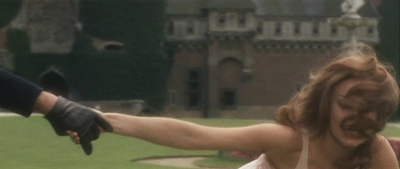

The use of the theatrical milieu is also worth noting, Eleanor being an actress by profession. This allows for some confusion over reality versus role-play, as the boundaries between her dramatic work and her traumatic psychodrama become blurred; despite currently being in preparation for a production of Lady Godiva she recites Lady MacBeth's famous murder speech, potentially hinting that she's not as innocent in the affair as appears on the surface.
The theatre space provides the location for an effective finale that sees 'the curtain descend, everything end' or 'bring the house down' in an almost literal way for at least one of the dramatis personae; to say more would spoil things.
I'd previously seen this 1972 giallo by Alberto De Martino from an old VHS source, and dubbed into English, so it was a welcome opportunity to see it again for the first time in a clean, widescreen, Italian dub with English fansubs.
Savalas is a suitably menacing, near-silent presence, recalling his role in Bava's Lisa and the Devil, while Heywood passes muster in the Frightened Woman role more usually assigned to an Edwige Fenech, Florinda Bolkan, Carroll Baker or Dagmar Lassander.
The theme of the unreliability of memory is, of course, a staple of the filone -- one thinks of The Girl Who Knew too Much, The Bird with the Crystal Plumage and Lizard in a Woman's Skin before this, and of Footprints on the Moon and The Man Without Memory a couple of years afterwards.
While not reaching the heights of these points of comparison, The Killer on the Phone is nevertheless a solidly put together production, benefiting in particular from a lush Stelvio Cipriani score and attractive cinematography from Aristide Massaccessi.
De Martino tries to inject a bit of style into proceedings, but his contributions are more hit and miss. The slow-motion lyrical flashback scenes as Eleanor recovers her previously repressed memories whilst under the influence of a truth drug are a bit over the top in that post Elvira Madigan way. The director is on surer footing when it comes to such staples of the form as the fetishisation of weaponry and black gloves; the close-ups of eyes; the shock zooms and, yes, plenty of product placement for Justerini & Brooks.


The theatre space provides the location for an effective finale that sees 'the curtain descend, everything end' or 'bring the house down' in an almost literal way for at least one of the dramatis personae; to say more would spoil things.
Sunday, 6 November 2011
Aska susayanlar seks ve cinayet / Thirsty for Love, Sex and Murder
One of the criticisms frequently leveled against Italian genre cinema is that it is derivative or imitative. As Luigi Cozzi said, producers and backers didn't want to know what your film was about but rather what films it was like. Yet few went as far down the copyright infringing route as Patrick Lives Again, that unofficial sequel to the original Patrick. The more usual approach was that taken by the various zombie films that appeared in the wake of Dawn of the Dead: It was clear what their inspiration was, but there was enough that was different and sometimes even original.
From what I've seen, Turkish exploitation cinema is another thing entirely. Most notoriously the so-called Turkish Star Wars uses footage from George Lucas's film, intercut with new material, and large chunks of score from Raiders of the Lost Ark. And then there are the Spiderman, Superman and Batman films.
What we have here, meanwhile, is a Turkish version of Sergio Martino's 1970 giallo The Strange Vice of Signora Wardh, with both plot and scenes lifted wholesale.
Even so, the filmmakers do make some changes and additions:
The maniac in the opening scene is more clearly visible, and identified by his victim before she dies as having a scar. This makes the Mrs Wardh character, Mine, suspect that he could be her ex-lover, the Jean one, Tarik, with whom she had an intense sado-masochistic relationship.
The Mr Wardh character, Metin, is sexually incapable, thus providing a further justification/rationale for his wife's falling for the George Corro one, Yilmaz, when she's introduced to him by her friend, the Carol Brandt one, Oya, at a party.
When Mine is blackmailed over this relationship and Oya goes to meet the blackmailer she isn't killed, merely chased and forced to drop the money.
In final third, the identities of the conspirators against Mine are also different, as is the ending.
The film is also differently paced, in that it runs barely an hour rather than 90 minutes. There's less emphasis upon drama and suspense and more upon action, with the general approach being to get straight into, through and out of each scene via the fastest route possible. Hollywood-style visual grammar and decoupage are conspicious by their absence. While it's not intentionally avant-garde, the effect is often just as jarring. This is particularly evident in the approach the filmmakers take to scoring, where a few bars culled from Morricone and Nicolai crime scores or an original chord, riff or beat almost sound like experiments in sampling, looping and layering.

The killer...

attacks...

there's going to be a lot of this...

what the... oh, it's a subjective shot from the victim's POV of a plane coming in to land...

and re-uniting Mine and Metin
You can also see that the filmmakers are trying to emulate their model(s) and inject a touch of visual inspiration, with zooms; odd angles; rapid cutting; or the likes of shots partly through liquid-filled glass or the maniac's dark glasses in the foreground; taken at ground level from behind a car; or of Mine framed through the gap between the handle and body of an old-style telephone.
More importantly in terms of their target audience -- read young Turkish men wanting Meral Zeren more than Edwige Fenech or to be Kadir Inanan rather than George Hilton -- the filmmakers don't skimp on the exploitation goods. Just about every woman quickly get undressed down to her underwear, often naked -- though, it should be noted, with no full-frontal nudity -- and, undoubtedly more disconcertingly for more sensitive types, abused, threatened or slashed up.
The scene that best exemplifies this is when a woman comes home, takes off her coat, revealing that she is naked beneath it, goes into the shower and is then slaughtered. Perhaps she was one of the women at an earlier party who was wearing a paper dress that got torn off. But there was no mention of a paper bra and panties.
For today's audiences, the film also has the attraction of providing cultural and historical insights, in terms of showing modern, swinging post-1960s Turks, along with no mentions whatsoever of Islam and little sense of moral disapproval. A lot of this stuff, whether fashions, decors, hairstyles, vehicles or dialogue is also, of course, highly entertaining from a kitsch/camp/trash perspective, if you're not interested in that sort of thing: “You smell of alcohol and cigarettes.” “A man should smell of alcohol and cigarettes.”
If you've never seen any gialli - unlikely for a reader of this blog, I know - then this probably isn't the Turkish exploitation film for you, but if you have and want to start exploring then its an intriguing and entertaining introduction that may well leave you wanting more...
From what I've seen, Turkish exploitation cinema is another thing entirely. Most notoriously the so-called Turkish Star Wars uses footage from George Lucas's film, intercut with new material, and large chunks of score from Raiders of the Lost Ark. And then there are the Spiderman, Superman and Batman films.
What we have here, meanwhile, is a Turkish version of Sergio Martino's 1970 giallo The Strange Vice of Signora Wardh, with both plot and scenes lifted wholesale.
Even so, the filmmakers do make some changes and additions:
The maniac in the opening scene is more clearly visible, and identified by his victim before she dies as having a scar. This makes the Mrs Wardh character, Mine, suspect that he could be her ex-lover, the Jean one, Tarik, with whom she had an intense sado-masochistic relationship.
The Mr Wardh character, Metin, is sexually incapable, thus providing a further justification/rationale for his wife's falling for the George Corro one, Yilmaz, when she's introduced to him by her friend, the Carol Brandt one, Oya, at a party.
When Mine is blackmailed over this relationship and Oya goes to meet the blackmailer she isn't killed, merely chased and forced to drop the money.
In final third, the identities of the conspirators against Mine are also different, as is the ending.
The film is also differently paced, in that it runs barely an hour rather than 90 minutes. There's less emphasis upon drama and suspense and more upon action, with the general approach being to get straight into, through and out of each scene via the fastest route possible. Hollywood-style visual grammar and decoupage are conspicious by their absence. While it's not intentionally avant-garde, the effect is often just as jarring. This is particularly evident in the approach the filmmakers take to scoring, where a few bars culled from Morricone and Nicolai crime scores or an original chord, riff or beat almost sound like experiments in sampling, looping and layering.

The killer...

attacks...

there's going to be a lot of this...

what the... oh, it's a subjective shot from the victim's POV of a plane coming in to land...

and re-uniting Mine and Metin
You can also see that the filmmakers are trying to emulate their model(s) and inject a touch of visual inspiration, with zooms; odd angles; rapid cutting; or the likes of shots partly through liquid-filled glass or the maniac's dark glasses in the foreground; taken at ground level from behind a car; or of Mine framed through the gap between the handle and body of an old-style telephone.
More importantly in terms of their target audience -- read young Turkish men wanting Meral Zeren more than Edwige Fenech or to be Kadir Inanan rather than George Hilton -- the filmmakers don't skimp on the exploitation goods. Just about every woman quickly get undressed down to her underwear, often naked -- though, it should be noted, with no full-frontal nudity -- and, undoubtedly more disconcertingly for more sensitive types, abused, threatened or slashed up.
The scene that best exemplifies this is when a woman comes home, takes off her coat, revealing that she is naked beneath it, goes into the shower and is then slaughtered. Perhaps she was one of the women at an earlier party who was wearing a paper dress that got torn off. But there was no mention of a paper bra and panties.
For today's audiences, the film also has the attraction of providing cultural and historical insights, in terms of showing modern, swinging post-1960s Turks, along with no mentions whatsoever of Islam and little sense of moral disapproval. A lot of this stuff, whether fashions, decors, hairstyles, vehicles or dialogue is also, of course, highly entertaining from a kitsch/camp/trash perspective, if you're not interested in that sort of thing: “You smell of alcohol and cigarettes.” “A man should smell of alcohol and cigarettes.”
If you've never seen any gialli - unlikely for a reader of this blog, I know - then this probably isn't the Turkish exploitation film for you, but if you have and want to start exploring then its an intriguing and entertaining introduction that may well leave you wanting more...
Wednesday, 5 October 2011
Trhauma
No that isn’t a typo and no this isn’t the 1993 Argento film.
Rather, Trhauma is the actual title of this 1980 giallo-slasher entry from Gianni Martucci and Alessandro (“Al”?) Capone.
The story begins with a prologue, recalling Halloween, Friday the 13th and, indeed, Nine Guests for a Crime: One boy convinces another, who seems to be be blind in one eye, to climb a tree, which he then falls out of with apparently fatal results.
Following this we cut to the present as a group of bourgeois types arrive at a holiday home in an isolated area. Soon two of them, a photographer and his model, wander off to do some shooting. After they become separated, she’s killed by one-eyed jack, now a man.

Less than ten minutes in and we have a naked woman
The others are concerned about her absence, but don’t do anything about it until it’s too late and the phone lines have been cut. As the killer closes in and the body-count rises, we learn some of their secrets, including gambling debts, lesbian affairs and blackmail.

Franco Diogene prepares to enter the pool and the water prepares to leave
Eventually a final girl/woman is identified and a tense extended stalk and chase scene ensues. The abrupt resolution and closing epigram, however, seem more giallo than slasher, bringing things back full circle.
An unpretentious and effective little film that doesn’t outstay its welcome and delivers on suspense, shocks and sleaze and sees the filmmakers make good use of their locations.
Rather, Trhauma is the actual title of this 1980 giallo-slasher entry from Gianni Martucci and Alessandro (“Al”?) Capone.
The story begins with a prologue, recalling Halloween, Friday the 13th and, indeed, Nine Guests for a Crime: One boy convinces another, who seems to be be blind in one eye, to climb a tree, which he then falls out of with apparently fatal results.
Following this we cut to the present as a group of bourgeois types arrive at a holiday home in an isolated area. Soon two of them, a photographer and his model, wander off to do some shooting. After they become separated, she’s killed by one-eyed jack, now a man.

Less than ten minutes in and we have a naked woman
The others are concerned about her absence, but don’t do anything about it until it’s too late and the phone lines have been cut. As the killer closes in and the body-count rises, we learn some of their secrets, including gambling debts, lesbian affairs and blackmail.

Franco Diogene prepares to enter the pool and the water prepares to leave
Eventually a final girl/woman is identified and a tense extended stalk and chase scene ensues. The abrupt resolution and closing epigram, however, seem more giallo than slasher, bringing things back full circle.
An unpretentious and effective little film that doesn’t outstay its welcome and delivers on suspense, shocks and sleaze and sees the filmmakers make good use of their locations.
Tuesday, 19 July 2011
Caramelle da uno sconosciuto / Sweets from a Stranger
We open with the murder of a prostitute by a black gloved, razor wielding killer.
Soon after a second lady of the night is murdered, but manages to whisper a vague, fragmentary clue to a colleague before dying.
With the police both unconcerned and ineffectual, the prostitutes take it upon themselves to unmask the killer...


An evaluation of the situation that may prove to be of particular significance
Around about this point the film moves into more of a dramatic mode, to examine the womens’ lives more generally. It’s an interesting shift in focus and not intrinsically negative, but does make for a lack of stalk and slash thrills if these are what you were expecting and after, although it does return to more generic territory towards the end.
If however you want a quasi-documentary look at a collective of prostitutes, or just something different, then it might appeal.
This assumes, however, that the sleaze and exploitation won’t cut against the serious intent too much, though the film is quite light on these counts compared to Rino Di Silvestro’s Red Light Girls and Carlo Lizzani’s Teenage Prostitution Racket from the mid-1970s – or, indeed, the third part of Massimo Dallamano’s schoolgirls in peril trilogy, Rings of Fear, to which director and co-writer Franco Ferrini also contributed in the latter capacity and which ultimately proves most intertextually significant here.

A Bava-style angel and some symbolic yellow
Ferrini is best known as an Argento collaborator, of course, with that director’s long-time editor of choice, Franco Fraticelli, also handling duties here.


With a tongue of fire?
Arthouse favourite and two-time Bava favourite Laura Betti has a small role as an old-time, independent prostitute who falls victim to the killer.
Soon after a second lady of the night is murdered, but manages to whisper a vague, fragmentary clue to a colleague before dying.
With the police both unconcerned and ineffectual, the prostitutes take it upon themselves to unmask the killer...


An evaluation of the situation that may prove to be of particular significance
Around about this point the film moves into more of a dramatic mode, to examine the womens’ lives more generally. It’s an interesting shift in focus and not intrinsically negative, but does make for a lack of stalk and slash thrills if these are what you were expecting and after, although it does return to more generic territory towards the end.
If however you want a quasi-documentary look at a collective of prostitutes, or just something different, then it might appeal.
This assumes, however, that the sleaze and exploitation won’t cut against the serious intent too much, though the film is quite light on these counts compared to Rino Di Silvestro’s Red Light Girls and Carlo Lizzani’s Teenage Prostitution Racket from the mid-1970s – or, indeed, the third part of Massimo Dallamano’s schoolgirls in peril trilogy, Rings of Fear, to which director and co-writer Franco Ferrini also contributed in the latter capacity and which ultimately proves most intertextually significant here.

A Bava-style angel and some symbolic yellow
Ferrini is best known as an Argento collaborator, of course, with that director’s long-time editor of choice, Franco Fraticelli, also handling duties here.


With a tongue of fire?
Arthouse favourite and two-time Bava favourite Laura Betti has a small role as an old-time, independent prostitute who falls victim to the killer.
Saturday, 11 June 2011
Movie Matters Giallo Podcast
Movie Matters 'Giallo Special' podcast:
On iTunes: http://tiny.cc/b84kn
Or their blog: http://tiny.cc/com9r
Enjoy!
On iTunes: http://tiny.cc/b84kn
Or their blog: http://tiny.cc/com9r
Enjoy!
Monday, 14 March 2011
Giallo and Gothic connections
Bava’s The Girl Who Knew too Much has certain affinities with Austen’s Northanger Abbey. In Bava’s film Nora Davis is an American thriller aficionado who travels to Rome and finds herself embroiled in a murder mystery much like those presented in her favourite reading material. In Austen’s novel Gothic enthusiast Catherine Morland visits the titular abbey which, from her reading of The Mysteries of Udolpho, she expects to be a place of Gothic horror and mystery.
Wednesday, 9 February 2011
Night After Night After Night
Directed by one Lewis J. Force – actually Lindsay Shonteff, who requested that his name be taken off the credits – Night After Night After Night comes across as something like a hybrid of The Cover Girl Killer and The New York Ripper with a touch of House of Whipcord thrown in for good measure.
Contemporary giallo-type touches include a black leather wearing, knife-wielding killer on the loose; an assortment of suspects and red herrings and an agreeable level of sleaziness.
The more traditional whodunit is meanwhile represented by the focus on a professional rather than an amateur investigator, in the form of Inspector Bill Rowan.
Rowan is, however, given a more personal interest than applies in the usual detective story, when his wife Jenny falls victim to the maniac as she is stabbed to death whilst taking a shower.
The prime suspect in the murders, even before this, was Pete Laver. A misogynistic womaniser, he doesn’t help his case by reciprocating Rowan’s overt hostility by saying what he’d like to do to Jenny...

The duel: Laver vs. Rowan
The other likely candidates, as far as the audience is concerned, are the moralistic Judge Lomax and his smut-obsessed clerk.

The clerk and his favourite reading material
The filmmakers play reasonably fair with us in terms of the story and the characters’ relationships with one another, providing the opportunity to figure out whodunit by the time that, just over two-thirds of the way through, the killer’s identity is revealed and a manhunt scenario then takes over.

The amount of time that passes between the arrest and the trial isn't too clear
The low budget is most evident in the courtroom and police station scenes, both of which feel somewhat cramped through their emphasis upon medium shots and close-ups to the exclusion of establishing shots. Shonteff’s direction is more agreeable when style comes to the fore, whether within the stalking and slashing stuff or the maniac’s freak outs.
A decent time-passer.
Contemporary giallo-type touches include a black leather wearing, knife-wielding killer on the loose; an assortment of suspects and red herrings and an agreeable level of sleaziness.
The more traditional whodunit is meanwhile represented by the focus on a professional rather than an amateur investigator, in the form of Inspector Bill Rowan.
Rowan is, however, given a more personal interest than applies in the usual detective story, when his wife Jenny falls victim to the maniac as she is stabbed to death whilst taking a shower.
The prime suspect in the murders, even before this, was Pete Laver. A misogynistic womaniser, he doesn’t help his case by reciprocating Rowan’s overt hostility by saying what he’d like to do to Jenny...

The duel: Laver vs. Rowan
The other likely candidates, as far as the audience is concerned, are the moralistic Judge Lomax and his smut-obsessed clerk.

The clerk and his favourite reading material
The filmmakers play reasonably fair with us in terms of the story and the characters’ relationships with one another, providing the opportunity to figure out whodunit by the time that, just over two-thirds of the way through, the killer’s identity is revealed and a manhunt scenario then takes over.

The amount of time that passes between the arrest and the trial isn't too clear
The low budget is most evident in the courtroom and police station scenes, both of which feel somewhat cramped through their emphasis upon medium shots and close-ups to the exclusion of establishing shots. Shonteff’s direction is more agreeable when style comes to the fore, whether within the stalking and slashing stuff or the maniac’s freak outs.
A decent time-passer.
Wednesday, 24 November 2010
Brody vs Giallo Producers
So, will those in the US just import the Giallo DVD or torrent it?
http://www.bbc.co.uk/news/entertainment-arts-11827672
http://www.bbc.co.uk/news/entertainment-arts-11827672
Wednesday, 3 November 2010
Giallo & Thrilling All’Italiana
This new book from Glittering Images by Antonio Bruschini and Stefano Piselli is somewhat reminiscent of Adrian Luther-Smith’s Blood and Black Lace in that it could be considered something of a viewer’s guide to the form. But while there are necessarily overlaps between the two books, they complement one another, such that the genre fan could do with having both on his or her bookshelf.

The book has four sections: An introductory overview, a filmography, a recent interview with Dario Argento, and a bibliography.
The interview and introduction don’t say anything particularly new, though in the latter case this is because there is only so much that can be said with the same basic facts. To wit: The literary giallo dates back to 1929 and the first publications by Mondadori. The giallo film, in the form we normally understand it, emerged 30 years later, with Mario Bava’s The Girl Who Knew Too Much and Blood and Black Lace. The form then reached its height of popularity in the early 1970s with Dario Argento’s The Bird with the Crystal Plumage and its successors.
The filmography section is the largest. Whereas Luther-Smith’s book is organised by title – a structure that sometimes causes difficulties with AKA titles – Giallo & Thrilling All’Italiana is arranged chronologically.
Films from the 1930s through to the 1950s are only given credits, likely reflecting difficulties in actually accessing them. Films from the 1960s onwards are also given a review/overview, ranging in length from a sentence to a paragraph, and two ratings, the first pertaining to the overall quality of the film as a giallo and the second to its sexy / kinky value.
The reader will likely disagree with some of the authors’ ratings, although they seem mostly fair and consistent. Blood and Black Lace, The Bird with the Crystal Plumage, Deep Red and The House with the Windows that Laughed are among the five-star films, What Have You Done to Solange, Don't Torture a Duckling and Who Saw Her Die the four-star films.
On balance, Luther-Smith’s book is probably the better one for those new to the giallo on account of featuring somewhat longer and more detailed discussions of the core group of films (those by Bava, Argento, Martino, Lenzi, Fulci etc.) with both synopsis and review and being originally written in English rather than translated, sometimes awkwardly, from the Italian.
Giallo & Thrilling All’Italiana, however, is probably the better for those venturing further afield, particularly into earlier, minor and crossover releases.
To give but one example, there is nothing about the 1960 film Chiamate 22-22 tenente Sheridan (the big-screen version of a then popular Italian TV detective series set in San Francisco) in Luther-Smith’s book.
The book is also superior when it comes to its bibliography, in that this includes giallo novels adapted for the screen along with fumetti and cineromanzi derived from films. (I had never realised before that Fernando Di Leo’s The Boys Who Killed and Duccio Tessari’s Death Occurred Last Night are adaptations of Giorgio Scerbanenco novels and feature the same detective character.)
Disappointingly the interior illustrations are only in monochrome. They are also somewhat awkwardly placed, usually with a gap of a few pages between the text and the images related to it. For instance, Bloody Pit of Horror is discussed on page 26 but the stills from it do not appear until page 32.

The book has four sections: An introductory overview, a filmography, a recent interview with Dario Argento, and a bibliography.
The interview and introduction don’t say anything particularly new, though in the latter case this is because there is only so much that can be said with the same basic facts. To wit: The literary giallo dates back to 1929 and the first publications by Mondadori. The giallo film, in the form we normally understand it, emerged 30 years later, with Mario Bava’s The Girl Who Knew Too Much and Blood and Black Lace. The form then reached its height of popularity in the early 1970s with Dario Argento’s The Bird with the Crystal Plumage and its successors.
The filmography section is the largest. Whereas Luther-Smith’s book is organised by title – a structure that sometimes causes difficulties with AKA titles – Giallo & Thrilling All’Italiana is arranged chronologically.
Films from the 1930s through to the 1950s are only given credits, likely reflecting difficulties in actually accessing them. Films from the 1960s onwards are also given a review/overview, ranging in length from a sentence to a paragraph, and two ratings, the first pertaining to the overall quality of the film as a giallo and the second to its sexy / kinky value.
The reader will likely disagree with some of the authors’ ratings, although they seem mostly fair and consistent. Blood and Black Lace, The Bird with the Crystal Plumage, Deep Red and The House with the Windows that Laughed are among the five-star films, What Have You Done to Solange, Don't Torture a Duckling and Who Saw Her Die the four-star films.
On balance, Luther-Smith’s book is probably the better one for those new to the giallo on account of featuring somewhat longer and more detailed discussions of the core group of films (those by Bava, Argento, Martino, Lenzi, Fulci etc.) with both synopsis and review and being originally written in English rather than translated, sometimes awkwardly, from the Italian.
Giallo & Thrilling All’Italiana, however, is probably the better for those venturing further afield, particularly into earlier, minor and crossover releases.
To give but one example, there is nothing about the 1960 film Chiamate 22-22 tenente Sheridan (the big-screen version of a then popular Italian TV detective series set in San Francisco) in Luther-Smith’s book.
The book is also superior when it comes to its bibliography, in that this includes giallo novels adapted for the screen along with fumetti and cineromanzi derived from films. (I had never realised before that Fernando Di Leo’s The Boys Who Killed and Duccio Tessari’s Death Occurred Last Night are adaptations of Giorgio Scerbanenco novels and feature the same detective character.)
Disappointingly the interior illustrations are only in monochrome. They are also somewhat awkwardly placed, usually with a gap of a few pages between the text and the images related to it. For instance, Bloody Pit of Horror is discussed on page 26 but the stills from it do not appear until page 32.
Thursday, 21 October 2010
Giallo film dispute
"Oscar-winning actor Adrien Brody has sued the makers of a thriller for more than $2m (£1.3m), claiming he has not been fully paid for the project.
Brody, 37, says he is owed $640,000 (£407,000) for Turin-set film Giallo and that it was released on DVD in the US on Tuesday without his permission."
More: http://www.bbc.co.uk/news/entertainment-arts-11581743Monday, 2 August 2010
While the City Sleeps
This Fritz Lang film sees three newspaper men battle for control of the Kyne media empire, with the spoils agreed to go to whoever discovers the identity of a serial killer. It's the latter aspect that's of interest from a giallo perspective because of the killer's wearing black gloves as he strangles his victims and being a comic book reader.

Black Leather Rock

Killerman strikes!

Black Leather Rock

Killerman strikes!
Sunday, 1 August 2010
La casa de las muertas vivientes / An Open Coffin ... an Empty Tomb
Oliver Bromfield arrives at his ancestral home with his new wife Ruth (Daniela Giordano); as we soon learn his previous wife Helen died in somewhat mysterious circumstances a year before.
Perhaps for this reason, or perhaps because of the alcoholism he suffered from at that time but now claims to be over, Oliver seems reluctant to reveal Ruth's status.
The truth is quickly apparent to his sister and step-mother, such that there is no point in maintaining any pretence anyway
Amidst a backdrop of voyeurism and perversity Ruth comes to believe that someone in the house is out to kill her, be it one or more of the aforementioned, the gardener or the maid.
Accordingly she hires a private investigator, who soon meets a sticky end at the hands of a black gloved, knife-wielding killer...
As the synopsis suggests, this Spanish-Italian co-production is one of those borderline giallo entries that bears a heavy debt to the Gothic in general and Du Maurier / Hitchcock’s Rebecca more specifically.
While intermittently strong on atmosphere and benefiting from good production values, it’s all a bit too by-the-numbers and obvious, with the killer’s identity and motive pretty obvious.
Despite its origins the film, written and directed by Alfonso Balcazar, eschews Latin locations and characters in favour of that typical not quite realised England.
A slumming Pierro Piccioni provides the soundtrack.
Perhaps for this reason, or perhaps because of the alcoholism he suffered from at that time but now claims to be over, Oliver seems reluctant to reveal Ruth's status.
The truth is quickly apparent to his sister and step-mother, such that there is no point in maintaining any pretence anyway
Amidst a backdrop of voyeurism and perversity Ruth comes to believe that someone in the house is out to kill her, be it one or more of the aforementioned, the gardener or the maid.
Accordingly she hires a private investigator, who soon meets a sticky end at the hands of a black gloved, knife-wielding killer...
As the synopsis suggests, this Spanish-Italian co-production is one of those borderline giallo entries that bears a heavy debt to the Gothic in general and Du Maurier / Hitchcock’s Rebecca more specifically.
While intermittently strong on atmosphere and benefiting from good production values, it’s all a bit too by-the-numbers and obvious, with the killer’s identity and motive pretty obvious.
Despite its origins the film, written and directed by Alfonso Balcazar, eschews Latin locations and characters in favour of that typical not quite realised England.
A slumming Pierro Piccioni provides the soundtrack.
Delitto Carnale / Killing of the Flesh
After the death of their wealthy patriarch, the assorted members of a family assemble at an isolated hotel to wait for the funeral, the reading of the will, and the division of the estate.
With nothing to do but wait, those assembled seek to distract themselves as they know how: Having sex, arguing, fighting, playing practical jokes, or just drinking (J&B, naturally).

An emblematic image: tired, weary, bored
There is also the first indication that this is indeed a giallo, when one of the few servants in the hotel is seen on the phone, announcing that she knows the patriarch did not die in a road accident but was murdered, and that she also knows the identity of the killer.
What we don’t get, however, is a murder scene – or at least not for a while. Instead we get lesbians in the bath and heterosexual no-becomes-yes rape-becomes-consensual sex scenes.
Finally, after one particularly heavy night of debauchery – we are now more than half way through the 80-odd minutes running time – one of the family is found dead, clearly murdered.
The police are called. While they take the dead woman’s body away they do not begin an investigation, instead leaving those present to sort things out for themselves. A couple more murders result and the guilty party is outed. The end.
Delitto Carnale / Killing of the Flesh marks the end in more ways than one, being the last film from writer-director Cesare Canevari and the last film to star Marc Porel, who died the same year as it was released, 1983.
Canevari has an interesting filmography which includes the spaghetti western on acid Matalo!, the first Italian Emmanuelle film, Io Emmanuelle, and the self-explanatory Last Orgy of the Third Reich.
In fact, however, that should be seemingly self-explanatory. Last Orgy of the Third Reich has certain serious and artistic pretensions in the Night Porter, Salon Kitty or Salo mould. There’s the hint its not just being unpleasant for the sake of it, in that ‘how much of this can you take?’ way, but also asking about why you are ‘taking this’ in the first place.
In its own way Delitto Carnale is similar: How much ennui and boredom can you put up with and why? Do these composition and camera movements – and there are some pleasing and effective ones, including the discovery of the body and sequences in cobweb-filled storerooms and the patriarch’s modernist apartment – constitute sufficient reason for watching? Is it ‘for real’ or a parody in which everything is ironicised, distanced, estranged, ‘in quotes’? Just how critical is its vision of sex and dying in high society?
There’s no definitive answer, of course. And, as always, this is its source of strength, weakness, frustration and interest as a piece of Euro-trash. In this regard, it’s perhaps telling that the film was released in various different cuts, some inserting hardcore material for the raincoater crowd: If all else fails, you can always try to sneak something subversive in via the lowest-common-denominator sex film.
Recommended to those who have seen and can appreciate (read: see something in) the likes of Play Motel, The Curse of Ursula (for a Porel / Magniolfi giallo trash double bill) and Giallo a Venezia; it’s also recommended that you take a shower afterwards...
Thanks to the good people at Cinemageddon for making the film available and fan-subbing it.
With nothing to do but wait, those assembled seek to distract themselves as they know how: Having sex, arguing, fighting, playing practical jokes, or just drinking (J&B, naturally).

An emblematic image: tired, weary, bored
There is also the first indication that this is indeed a giallo, when one of the few servants in the hotel is seen on the phone, announcing that she knows the patriarch did not die in a road accident but was murdered, and that she also knows the identity of the killer.
What we don’t get, however, is a murder scene – or at least not for a while. Instead we get lesbians in the bath and heterosexual no-becomes-yes rape-becomes-consensual sex scenes.
Finally, after one particularly heavy night of debauchery – we are now more than half way through the 80-odd minutes running time – one of the family is found dead, clearly murdered.
The police are called. While they take the dead woman’s body away they do not begin an investigation, instead leaving those present to sort things out for themselves. A couple more murders result and the guilty party is outed. The end.
Delitto Carnale / Killing of the Flesh marks the end in more ways than one, being the last film from writer-director Cesare Canevari and the last film to star Marc Porel, who died the same year as it was released, 1983.
Canevari has an interesting filmography which includes the spaghetti western on acid Matalo!, the first Italian Emmanuelle film, Io Emmanuelle, and the self-explanatory Last Orgy of the Third Reich.
In fact, however, that should be seemingly self-explanatory. Last Orgy of the Third Reich has certain serious and artistic pretensions in the Night Porter, Salon Kitty or Salo mould. There’s the hint its not just being unpleasant for the sake of it, in that ‘how much of this can you take?’ way, but also asking about why you are ‘taking this’ in the first place.
In its own way Delitto Carnale is similar: How much ennui and boredom can you put up with and why? Do these composition and camera movements – and there are some pleasing and effective ones, including the discovery of the body and sequences in cobweb-filled storerooms and the patriarch’s modernist apartment – constitute sufficient reason for watching? Is it ‘for real’ or a parody in which everything is ironicised, distanced, estranged, ‘in quotes’? Just how critical is its vision of sex and dying in high society?
There’s no definitive answer, of course. And, as always, this is its source of strength, weakness, frustration and interest as a piece of Euro-trash. In this regard, it’s perhaps telling that the film was released in various different cuts, some inserting hardcore material for the raincoater crowd: If all else fails, you can always try to sneak something subversive in via the lowest-common-denominator sex film.
Recommended to those who have seen and can appreciate (read: see something in) the likes of Play Motel, The Curse of Ursula (for a Porel / Magniolfi giallo trash double bill) and Giallo a Venezia; it’s also recommended that you take a shower afterwards...
Thanks to the good people at Cinemageddon for making the film available and fan-subbing it.
Monday, 7 June 2010
Three giallo reviews on Cinefantastique Online
Here are three giallo reviews I recently did for Cinefantastique Online:
http://cinefantastiqueonline.com/2010/06/sense-of-wonder-cinefantastique-catches-giallo-fever/
Including a completely new piece on Blade of the Ripper / The Strange Vice of Signora Wardh:
http://cinefantastiqueonline.com/2010/06/blade-of-the-ripper-a-k-a-the-strange-vice-of-mrs-wardh-1971-dvd-review/
http://cinefantastiqueonline.com/2010/06/sense-of-wonder-cinefantastique-catches-giallo-fever/
Including a completely new piece on Blade of the Ripper / The Strange Vice of Signora Wardh:
http://cinefantastiqueonline.com/2010/06/blade-of-the-ripper-a-k-a-the-strange-vice-of-mrs-wardh-1971-dvd-review/
Subscribe to:
Posts (Atom)