As the corrections to my PhD thesis, on Deleuzean Hybridity in the Films of Leone and Argento, have now been approved, here it is for those who wish to read it.
Basically what I say is that Deleuze formulates his concepts of the movement-image and the time-image primarily in relation to classical Hollywood genre cinema and modern European art cinema respectively. As such, the films of Leone and Argento raise questions regarding this framework, in being post-WWII European films, but also being genre films (westerns, thrillers, fantasy-horror, and a gangster film). I then try to bring out how these films have hybrid characteristics, and relate this to certain earlier and later films to place the two directors within a broader tradition.
Showing posts with label Dario Argento. Show all posts
Showing posts with label Dario Argento. Show all posts
Thursday, 21 March 2013


Wednesday, 19 September 2012
A Complex of Carnage: Dario Argento Beneath the Surface

This is one of a number of recently released books from Glitter Books in their Cult Movie Files series, edited and introduced by Jack Hunter. It contains essays previously published by Creation Press, particularly in Andy Black's Necronomicon series of the mid-late 1990s, collected by their subject, psychoanalytic interpretations of Dario Argento's films.
There are four essays: Xavier Mendik's 'Detection and Transgression', and 'Monstrous Mother', Ray Guins' 'Tortured Looks', and Julian Hoxter's 'Anna with a Devil Inside'.
The first of Mendik's essays uses Freud, Lacan and Zizek to argue for the deviant characteristics of detection in The Bird with the Crystal Plumage and Tenebrae, in line with the former film's female aggressor and the latter's murderous protagonist.
Guins' essay examines Deep Red and Opera by way of Mulvey's seminal essays, but with an interesting twist by focusing on visual displeasure rather than pleasure.
Mendik's second essay examines figures of abjection and/or the monstrous feminine in Italian cinema via Kristeva's essay on the former and Creed's application of it to horror cinema in terms of the latter.
Finally, Hoxter's essay uses Klein's object relations theory to examine figures of the good and bad mother in The Stendhal Syndrome.
The key strength of the volume lies in the consistency of approach, insofar as all three authors draw from the same broad theoretical corpus. Indirectly it also provides a useful guide for further reading around such work.
Contrariwise, the obvious weakness of psychoanalytic film theory as a whole is its unverifiable (or, to use Popper's term, “falsifiable”) nature: you either believe in it or, as with cognitivists such as Bordwell and Carroll do not.
When applied to Argento's films, meanwhile, the notion of a gendered gaze is problematised by the frequent inability to identify the source of the gaze. The famous Louma crane shot in Tenebrae is, after all, not identified with a human. Likewise the New York apartment block in Inferno is identified as female and male simultaneously, being both the repository of the “filthy secrets” of Mater Tenebrarum and the “body” of its architect, Varelli.
In sum, worth picking up if you don't already have the original Necronomicon volumes in which the essays appeared.
Friday, 13 July 2012
The Serial Killer in an Italian Context
One of the more contentious aspects of Mikel J. Koven's reading of the giallo film is the question of whether the concept of the serial killer is relevant in the Italian context. It was thus interesting to happen across this Dario Argento presentation, originally published in physical form in the mid-1990s:

Tuesday, 26 June 2012
Berberian Sound Studio
This is the proverbial curate's egg of a film: Good in parts.
The story is straightforward: In the 1970s A British soundman, Gilderoy, is hired by an Italian director to work on his film, where the dialogue (we never see the images) suggests something akin to Dario Argento's horror films Suspiria or Inferno, but which the director insists is an auteur rather than a genre work.
Peter Strickland's direction and writing initially impress. He clearly knows his stuff, whether the faux solarised and rotoscoped titles (think A Bay of Blood); the close-ups of reel to reel tape recorders (think A Lizard in a Woman's Skin and Deep Red); the black leather gloved hand (think just about any giallo) that starts the projector running, or the red telephone (think Blood and Black Lace) used by a receptionist.
If you're a fan of gialli and horror all'italiana (likely for readers of this blog) you'll enjoy playing spot the possible hommage or intertext , whether Clap You're Dead, Closed Circuit, Watch Me When I Kill. If you're not a lot of the imagery and dialogue will simply go past you.
The big problem with the film (besides the absence of the J&B or Punt e mes bottle) is that that it doesn't really go anywhere. Weird shit happens to Gilderoy, much as weird shit happens to Suzy Banyon in Suspiria, but it is not developed.
The two things that rescue the film are the performance by Toby Jones, as someone far removed from the typical male lead, and the attention paid to sound design. Michel Chion would love this film, with its exposure of tricking the ear techniques.
The story is straightforward: In the 1970s A British soundman, Gilderoy, is hired by an Italian director to work on his film, where the dialogue (we never see the images) suggests something akin to Dario Argento's horror films Suspiria or Inferno, but which the director insists is an auteur rather than a genre work.
Peter Strickland's direction and writing initially impress. He clearly knows his stuff, whether the faux solarised and rotoscoped titles (think A Bay of Blood); the close-ups of reel to reel tape recorders (think A Lizard in a Woman's Skin and Deep Red); the black leather gloved hand (think just about any giallo) that starts the projector running, or the red telephone (think Blood and Black Lace) used by a receptionist.
If you're a fan of gialli and horror all'italiana (likely for readers of this blog) you'll enjoy playing spot the possible hommage or intertext , whether Clap You're Dead, Closed Circuit, Watch Me When I Kill. If you're not a lot of the imagery and dialogue will simply go past you.
The big problem with the film (besides the absence of the J&B or Punt e mes bottle) is that that it doesn't really go anywhere. Weird shit happens to Gilderoy, much as weird shit happens to Suzy Banyon in Suspiria, but it is not developed.
The two things that rescue the film are the performance by Toby Jones, as someone far removed from the typical male lead, and the attention paid to sound design. Michel Chion would love this film, with its exposure of tricking the ear techniques.
Friday, 24 February 2012
Japanese Argento posters
These are currently on ebay and are attracting a lot of interest; a little beyond my price range unfortunately.


Thursday, 26 January 2012
Argento Dracula - to 3D or not to 3D, that is the question
As you are probably aware, a 3D version of Dracula directed by Argento is due to come out soon The teaser footage that has been released predictably shows some "comin' at ya'" type images -- Dracula throws a sword at someone and it pins them to a door, following which there is a cut to the other side showing how far the blade has penetrated the wood, or instance.
Where I think the film will stand or fall as a 3D experience is in how well Argento manages to incorporate and integrate the more subtle kind layered images that have long been a staple of his 2D productions -- the endemic curtains and screens, the shattering glass, or the killer standing immediately behind his victim at the end of Tenebre. It would also be interesting/weird seeing some of those prominent mirror-based compositions in Deep Red and Suspiria with 3D except the flat mirror image...
Where I think the film will stand or fall as a 3D experience is in how well Argento manages to incorporate and integrate the more subtle kind layered images that have long been a staple of his 2D productions -- the endemic curtains and screens, the shattering glass, or the killer standing immediately behind his victim at the end of Tenebre. It would also be interesting/weird seeing some of those prominent mirror-based compositions in Deep Red and Suspiria with 3D except the flat mirror image...
Friday, 13 January 2012
Framing in Argento -- fragment of a Deleuzean reading
Like Leone, Argento used 2.35:1 widescreen Techniscope until commercial considerations of television and video sales encouraged use of the 1.85 ratio on Inferno and Tenebre. While Argento's compositions perhaps do not draw attention to the shape of the 2.35:1 frame as often as Leone does, the effect on those occasions where he does so is thereby arguably heightened. In Leone's films the use of the all areas of the frame, the out of field/frame and quasi-split screen effects generally does not serve any obvious purpose beyond making the conventions of classical cinema evident. In contrast the likes of the widescreen composition in Deep Red when Marc, on the far left, and Carlo, on the far right, shout to one another across a space dominated by the central statuary, also have a pedagogical role. For in conjunction with Carlo's remarks on the distinction between what Marc thought he saw and what he actually saw this image draws attention to Marc's reading of the image of Carlo's mother in the bottom left of the frame as a face in the painting she was reflected into. This image also establishes a crystal-image circuit between the actual - Carlo's mother - and the virtual - Carlo's mother as mirrored into the painting that confuses Marc.
Wednesday, 24 November 2010
Brody vs Giallo Producers
So, will those in the US just import the Giallo DVD or torrent it?
http://www.bbc.co.uk/news/entertainment-arts-11827672
http://www.bbc.co.uk/news/entertainment-arts-11827672
Thursday, 21 October 2010
Giallo film dispute
"Oscar-winning actor Adrien Brody has sued the makers of a thriller for more than $2m (£1.3m), claiming he has not been fully paid for the project.
Brody, 37, says he is owed $640,000 (£407,000) for Turin-set film Giallo and that it was released on DVD in the US on Tuesday without his permission."
More: http://www.bbc.co.uk/news/entertainment-arts-11581743Friday, 8 October 2010
Suspiria screening in London

"A rare London screening of Argento's classic, Suspiria at the Rio Cinema in Dalston on 16th October."
http://www.cigaretteburnscinema.com/
http://www.facebook.com/group.php?gid=41892989996
Friday, 24 September 2010
Inferno passed uncut in UK
Meaning footage of a mouse being eaten by a cat is no longer excised.
http://www.bbfc.co.uk/website/Classified.nsf/ClassifiedWorks/D8C0CDE0C913455E8025773C0036C8E0
http://www.melonfarmers.co.uk/nasties_news.htm#More_Cat_and_Mouse_Games_4298
http://www.bbfc.co.uk/website/Classified.nsf/ClassifiedWorks/D8C0CDE0C913455E8025773C0036C8E0
http://www.melonfarmers.co.uk/nasties_news.htm#More_Cat_and_Mouse_Games_4298
Thursday, 22 July 2010
Dr Judd
Another intertextual reference / allusion:
Both Dario Argento's Trauma and Tourneur's Cat People feature a Dr Judd.
Both Dario Argento's Trauma and Tourneur's Cat People feature a Dr Judd.
Tuesday, 20 July 2010
Books on Argento
I received two books about Dario Argento’s films today: James Gracey’s Dario Argento and the new (third) edition of Maitland McDonagh’s Broken Mirrors / Broken Minds.

Gracey’s book is more of a viewer’s guide to Argento’s cinema: After a short biographical overview he goes through Argento’s film and television work in chronological order using the same formula of credits, synopsis, background, comments, style/technical, themes, music, trivia and verdict. This is followed by comprehensive lists of Argento’s non-directorial work.
The book serves it purpose. The consistent approach and cross-referencing between Argento’s films and those of other directors are welcome. There are however some obvious errors that should have been caught (Argento was 20 when he worked on Once Upon a Time in the West) and the odd bit of dubious information (was Alida Valli really married to Fritz Lang?)

McDonagh’s book originated in an expanded version of her Masters thesis. As such it’s more directly academic, though thankfully not the kind of book where references to the theoretical texts are ever allowed to overwhelm those to the films themselves. The first edition covered Argento output up to Two Evil Eyes, while the second incorporated a (notably more critical) chapter on Trauma.
This new version also includes a new 20-page introduction in which McDonagh provides a bit more background on the genesis of the original, interesting for mentioning various European and US exploitation / grindhouse directors conspicuously absent from the original, and a survey of Argento’s films from The Stendhal Syndrome onwards; the Masters of Horror TV productions are omitted.
While it is to be welcomed for those who don’t have either of the previous editions and can’t or won’t pay the high prices they often command on Ebay and Amazon, there’s little reason for existing owners to also get this new version.
The main reason for this is that the new chapter doesn’t really add a lot, with McDonagh finding little of value in Argento’s 1990s and 2000s output as a whole: “Artists change. If they don’t, they risk imitating themselves or, worse, descending into self-parody. Argento has said as much, but the films he has made since Broken Mirrors / Broken Minds can only be called problematic.” (xiii-ix)
While McDonagh admit to finding The Stendhal Syndrome “underrated”, the issue is then that a two and a half page review is hardly sufficient to do its complexities any kind of justice. The shortfall becomes all the more apparent when you consider that Two Evil Eyes warrants nine pages.
Argento’s films have always been problematic, but unfortunately McDonagh - like many former enthusiasts, it has to be said - no longer appears interested in attempting to work through his problematics.

Gracey’s book is more of a viewer’s guide to Argento’s cinema: After a short biographical overview he goes through Argento’s film and television work in chronological order using the same formula of credits, synopsis, background, comments, style/technical, themes, music, trivia and verdict. This is followed by comprehensive lists of Argento’s non-directorial work.
The book serves it purpose. The consistent approach and cross-referencing between Argento’s films and those of other directors are welcome. There are however some obvious errors that should have been caught (Argento was 20 when he worked on Once Upon a Time in the West) and the odd bit of dubious information (was Alida Valli really married to Fritz Lang?)

McDonagh’s book originated in an expanded version of her Masters thesis. As such it’s more directly academic, though thankfully not the kind of book where references to the theoretical texts are ever allowed to overwhelm those to the films themselves. The first edition covered Argento output up to Two Evil Eyes, while the second incorporated a (notably more critical) chapter on Trauma.
This new version also includes a new 20-page introduction in which McDonagh provides a bit more background on the genesis of the original, interesting for mentioning various European and US exploitation / grindhouse directors conspicuously absent from the original, and a survey of Argento’s films from The Stendhal Syndrome onwards; the Masters of Horror TV productions are omitted.
While it is to be welcomed for those who don’t have either of the previous editions and can’t or won’t pay the high prices they often command on Ebay and Amazon, there’s little reason for existing owners to also get this new version.
The main reason for this is that the new chapter doesn’t really add a lot, with McDonagh finding little of value in Argento’s 1990s and 2000s output as a whole: “Artists change. If they don’t, they risk imitating themselves or, worse, descending into self-parody. Argento has said as much, but the films he has made since Broken Mirrors / Broken Minds can only be called problematic.” (xiii-ix)
While McDonagh admit to finding The Stendhal Syndrome “underrated”, the issue is then that a two and a half page review is hardly sufficient to do its complexities any kind of justice. The shortfall becomes all the more apparent when you consider that Two Evil Eyes warrants nine pages.
Argento’s films have always been problematic, but unfortunately McDonagh - like many former enthusiasts, it has to be said - no longer appears interested in attempting to work through his problematics.
Tuesday, 8 June 2010
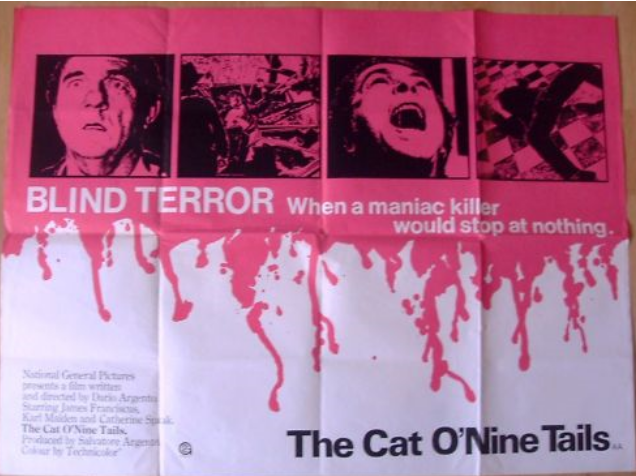
UK Argento posters
Currently on Ebay UK, but priced a bit too high for me, with 'buy it now' prices of £999 each



Friday, 5 March 2010
Wednesday, 13 January 2010
Dario Argento o la alquimia del miedo
Just flicked through this Spanish book, Dario Argento or the Alchemy of Fear.
My Spanish is non-existent, but it looks like a decent alternative or companion to the likes of Maitland McDonagh in English or Jean-Baptiste Thoret in French for those who read the language.
First there's a thematic overview, identifying key motifs in Argento's films - e.g. the elements (agua), animals (gatos) etc.
Then there are chapters on each of his films through to The Phantom of the Opera.
Then there is a 1999 interview with Argento, conducted at the Sitges film festival.
Finally the are portraits of important collaborators such as Morricone, Goblin, Nicolodi and Cozzi.
More: http://www.ciencia-ficcion.com/limites/lm0177.htm
My Spanish is non-existent, but it looks like a decent alternative or companion to the likes of Maitland McDonagh in English or Jean-
First there's a thematic overview, identifying key motifs in Argento's films - e.g. the elements (agua), animals (gatos) etc.
Then there are chapters on each of his films through to The Phantom of the Opera.
Then there is a 1999 interview with Argento, conducted at the Sitges film festival.
Finally the are portraits of important collaborators such as Morricone, Goblin, Nicolodi and Cozzi.
More: http://www.ciencia-ficcion.com/limites/lm0177.htm
Friday, 6 November 2009
Argento colour
From Four Flies on Grey Velvet through to Suspiria there is a progressive shift in colour. In Four Flies colour is still something which tends to inhere in objects, things or images: This curtain is red; the lining of this (fetishistic) box containing a syringe is red; this liquid drawn up into the syringe is blue. In Deep Red colours begin to become independent: While the reds of the opera house still inhere in objects, the blues and oranges of the burning house of the screaming child, as they play on Gianna’s form, are independent. Finally, in Suspiria colours break free. They are in themselves, no longer subordinate to objects. One moment a scene is bathed in red, another blue or green, without commentary from those diegetically engulfed. Colour here, and in Inferno, is pure intensity.
(cf. The impulse image in Bava, in Sam Ishii-Gonzales's Deleuzean reading http://archive.sensesofcinema.com/contents/directors/04/bava.html)
(cf. The impulse image in Bava, in Sam Ishii-Gonzales's Deleuzean reading http://archive.sensesofcinema.com/contents/directors/04/bava.html)
Suspiria question
When Mater Suspiriorum sits down on the bed behind the curtain in Suspiria, is she shot in reverse motion? There seems something unnatural about her movements to me.
Thursday, 5 November 2009
More on another image from Deep Red
Doubling is also an aspect of Deep Red’s soundtrack. Argento originally commissioned jazz composer Giorgio Gaslini, who had done the scores for Five Days of Milan (including a Kubrick/Carlos styled rendition of The Thieving Magpie on synthesiser) and Door into Darkness. In the event, however, Argento encouraged Goblin to reinterpret Gaslini’s work, with the result being a soundtrack which was more Goblin/Argento than Gaslini.
The dominant features of the soundtrack are its intensity and its indifference, or its anempathetic quality, particularly when compared to Morricone’s soundtracks for the Animal trilogy: The musical cues, whether the one which plays over the credits, or over Helga’s murder, or to Marc’s visits to the haunted house, do not reflect these characters’ consciousness, nor any consciousness we are invited to share. Rather, they are intense and exciting, in a distanced way: Aesthetised murder, be it of a man or a woman – gender is irrelevant in pure figural terms – is exciting, even if we may feel revulsion towards its real world, unaestheticised, counterpart. Murder as one of the fine arts is one thing, banal unartistic, real murder another.
[As I paste this, there is the image of Marc and Carlo doing a piano duet, sometimes doubling one another, sometimes departing;..]
The dominant features of the soundtrack are its intensity and its indifference, or its anempathetic quality, particularly when compared to Morricone’s soundtracks for the Animal trilogy: The musical cues, whether the one which plays over the credits, or over Helga’s murder, or to Marc’s visits to the haunted house, do not reflect these characters’ consciousness, nor any consciousness we are invited to share. Rather, they are intense and exciting, in a distanced way: Aesthetised murder, be it of a man or a woman – gender is irrelevant in pure figural terms – is exciting, even if we may feel revulsion towards its real world, unaestheticised, counterpart. Murder as one of the fine arts is one thing, banal unartistic, real murder another.
[As I paste this, there is the image of Marc and Carlo doing a piano duet, sometimes doubling one another, sometimes departing;..]
Thursday, 22 October 2009
More work in progress...
[Four Flies on Grey Velvet]
The film's excessive approach, meanwhile, is first signalled by the elaborate proto-music video credits sequence, which cross-cuts between the band's rehearsal and Roberto's being followed around. The sequence functions as a kind of overture to some of the film's themes. For example, the fly that torments Roberto as he plays and eventually manages to squash within the halves of his hi-hat serves to indicate that Roberto is not someone who “wouldn't hurt a fly,” to paraphrase Psycho. Likewise, the overhead and slow-motion shots of drum playing, along with those from inside a guitar and from atop its neck are not just there for their own sake. In part they showcase Argento's increasing self-confidence, that he too can engage in virtuoso displays of technique if he wants to. But they also foreground the circle and the straight line, along with the theme of time itself. A drummer, Roberto is someone whose job it that of a timekeeper; he beats time. Roberto's response when asked by bandmate Mirko (Fabrizio Moroni) if his performance was bad is telling here: “You're missing your cues. You've got to follow me, that's all.”
Another important figure here is that of the cross, seen in slow-motion as Roberto crosses his drumsticks. In Argento and Cozzi's original script cruciform shapes were used as the visual fragments rather than the four flies, with Nina wearing a cross rather than a pendant containing a fly trapped in plastic. Remnants of this idea recur throughout the film, as Roberto is framed within or around cross shapes, although Nina's pendant has the thematic advantages of being circular and of conveying entrapment.
Unlike Mirko, Roberto does not miss his cues: As Mirko departs, Roberto catches sight of his stalker. The man (Calisto Calisti) is a cliché, the by 1971 familiar figure of the giallo heavy or killer. Indeed, although the man's face is visible rather than in shadow, albeit with his eyes hidden behind obscuring sunglasses, Argento has identified him as being modelled upon the killer in Blood and Black Lace. Confronted with this “sensory-motor image of the thing,” Roberto goes immediately from perception, that this is the man who has been following him for the past week, into action, in turning the tables on his stalker; a reveller's throwing confetti onto Roberto cements the two men's association, with the man having blown confetti off his sunglasses in the credits sequence.
Excess, the theatrical and the bringing together of different image sets are then conveyed as Roberto follows the man into an empty theatre, itself strewn with streamers. To enter the auditorium, Roberto passes through no less than four curtains, three a brilliant red and the fourth a rich blue. While his passage through the first two is presented from his point of view, the angle unexpectedly reverses for the third curtain, as if to signal that he has now entered onto another's scene. This other, of course, is Nina. High up in a box, she illuminates Roberto as he unwitting assumes his designated role, responding to each pre-planned situation, S, with the appropriate action, A.
The man pulls a knife and there is a scuffle. What happens is not entirely clear, other than that the man is now lying in the orchestra pit with a bloody wound to his chest and that Roberto has the knife in his hand, with the incident having been captured by the masked photographer, Nina. The point, of course, is that the photographing of the scene and Roberto's decision to take flight without checking the man, establish the truth Nina desired: Roberto, for all practical purposes, has killed a man. Nina's virtual scenario has become actualised by Roberto, determining his future actions. There are perhaps similar situations in Hitchcock, most obviously Kim Novak's virtual Judy becoming her actual Madeline in Vertigo through Scottie's (James Stewarts's) interventions. However, underlying this there is a single truth: Judy and Madeline are the same woman. As such, the closer point of comparison here is Lang. In Beyond a Reasonable Doubt (1956), one of a number of Lang films mentioned by Deleuze (2005a: 134). In the film a writer, Tom Garrett (Dana Andrews), sets himself up as the prime suspect for a murder in order to show the problems of circumstantial evidence. Unfortunately for Garrett his friend, who was withholding the evidence that was to prove his innocence, dies in an accident, leaving Garrett sentenced to death. In Lang's film the virtual thus becomes the actual. If this perhaps does not push the time-image to its furthest, in that there at a point the circuit of the two poles chasing after one another breaks down, it is still notably developed for a Hollywood genre film of the time. Whereas Deleuze identified Hitchock's films as being about interpretation, he suggests Lang's are more perspectivist, featuring “A Protagoras-style relativism where judgement expresses the ‘best’ point of view, that is, the relation under which appearances have the best chance of being turned around to the benefit of an individual or of a humanity of higher value” (2005b: 134) Lang is thus a more Nietzschean film-maker than Hitchcock, just as the Langian Four Flies on Grey Velvet is thereby a more Nietzschean and time-image film than the more Hitchcockian and movement-image The Bird with the Crystal Plumage. This is not, however, to say that neither Hitchcock nor the movement-image are absent from Argento's third film. Rather, like its predecessors it is still a hybrid. Nina's pursuit of revenge and use of the powers of the false are juxtaposed with her reliance upon Roberto's predictable reactions and the implicit exchange of culpability and crime between him and Nina's father.
As the story develops, Nina begins her scheme to drive Roberto to the brink as a prelude to his murder. He receives the man's identity card in the mail, then finds photos apparently incriminating him planted amongst his records as they entertain guests, and is then visited for the first time by the masked figure.
The delivery of the identity card is notable for two reasons. First, because of a subtle cut. In the immediately preceding shot, Nina is outside, talking with a neighbour in the foreground as the postman (whom Roberto will later attack as his paranoia mounts) makes a delivery in the background. But when Argento cuts to the apparent reverse angle, as Roberto takes the letter, Nina is back in the house. The connection between the two shots is irrational rather than rational. Time is indeed “out of joint” in a time-image manner. Second, because of where the Tobias's live: 23 via F. Lang. Though at one level an in-joke and another example of the film's excesses, this offers further evidence of Argento's prime influence within the film. (In a similar manner, the grave marked 'Peckinpah' in Leone and Tonino Valerii's My Name in Nobody may not be just a casual reference to another filmmaker, particularly when Jack Beauregard's destruction of “the Wild Bunch” is taken into consideration. Leone, it seems, was determined to 'bury' his rival and his most famous film creation.)
The film's excessive approach, meanwhile, is first signalled by the elaborate proto-music video credits sequence, which cross-cuts between the band's rehearsal and Roberto's being followed around. The sequence functions as a kind of overture to some of the film's themes. For example, the fly that torments Roberto as he plays and eventually manages to squash within the halves of his hi-hat serves to indicate that Roberto is not someone who “wouldn't hurt a fly,” to paraphrase Psycho. Likewise, the overhead and slow-motion shots of drum playing, along with those from inside a guitar and from atop its neck are not just there for their own sake. In part they showcase Argento's increasing self-confidence, that he too can engage in virtuoso displays of technique if he wants to. But they also foreground the circle and the straight line, along with the theme of time itself. A drummer, Roberto is someone whose job it that of a timekeeper; he beats time. Roberto's response when asked by bandmate Mirko (Fabrizio Moroni) if his performance was bad is telling here: “You're missing your cues. You've got to follow me, that's all.”
Another important figure here is that of the cross, seen in slow-motion as Roberto crosses his drumsticks. In Argento and Cozzi's original script cruciform shapes were used as the visual fragments rather than the four flies, with Nina wearing a cross rather than a pendant containing a fly trapped in plastic. Remnants of this idea recur throughout the film, as Roberto is framed within or around cross shapes, although Nina's pendant has the thematic advantages of being circular and of conveying entrapment.
Unlike Mirko, Roberto does not miss his cues: As Mirko departs, Roberto catches sight of his stalker. The man (Calisto Calisti) is a cliché, the by 1971 familiar figure of the giallo heavy or killer. Indeed, although the man's face is visible rather than in shadow, albeit with his eyes hidden behind obscuring sunglasses, Argento has identified him as being modelled upon the killer in Blood and Black Lace. Confronted with this “sensory-motor image of the thing,” Roberto goes immediately from perception, that this is the man who has been following him for the past week, into action, in turning the tables on his stalker; a reveller's throwing confetti onto Roberto cements the two men's association, with the man having blown confetti off his sunglasses in the credits sequence.
Excess, the theatrical and the bringing together of different image sets are then conveyed as Roberto follows the man into an empty theatre, itself strewn with streamers. To enter the auditorium, Roberto passes through no less than four curtains, three a brilliant red and the fourth a rich blue. While his passage through the first two is presented from his point of view, the angle unexpectedly reverses for the third curtain, as if to signal that he has now entered onto another's scene. This other, of course, is Nina. High up in a box, she illuminates Roberto as he unwitting assumes his designated role, responding to each pre-planned situation, S, with the appropriate action, A.
The man pulls a knife and there is a scuffle. What happens is not entirely clear, other than that the man is now lying in the orchestra pit with a bloody wound to his chest and that Roberto has the knife in his hand, with the incident having been captured by the masked photographer, Nina. The point, of course, is that the photographing of the scene and Roberto's decision to take flight without checking the man, establish the truth Nina desired: Roberto, for all practical purposes, has killed a man. Nina's virtual scenario has become actualised by Roberto, determining his future actions. There are perhaps similar situations in Hitchcock, most obviously Kim Novak's virtual Judy becoming her actual Madeline in Vertigo through Scottie's (James Stewarts's) interventions. However, underlying this there is a single truth: Judy and Madeline are the same woman. As such, the closer point of comparison here is Lang. In Beyond a Reasonable Doubt (1956), one of a number of Lang films mentioned by Deleuze (2005a: 134). In the film a writer, Tom Garrett (Dana Andrews), sets himself up as the prime suspect for a murder in order to show the problems of circumstantial evidence. Unfortunately for Garrett his friend, who was withholding the evidence that was to prove his innocence, dies in an accident, leaving Garrett sentenced to death. In Lang's film the virtual thus becomes the actual. If this perhaps does not push the time-image to its furthest, in that there at a point the circuit of the two poles chasing after one another breaks down, it is still notably developed for a Hollywood genre film of the time. Whereas Deleuze identified Hitchock's films as being about interpretation, he suggests Lang's are more perspectivist, featuring “A Protagoras-style relativism where judgement expresses the ‘best’ point of view, that is, the relation under which appearances have the best chance of being turned around to the benefit of an individual or of a humanity of higher value” (2005b: 134) Lang is thus a more Nietzschean film-maker than Hitchcock, just as the Langian Four Flies on Grey Velvet is thereby a more Nietzschean and time-image film than the more Hitchcockian and movement-image The Bird with the Crystal Plumage. This is not, however, to say that neither Hitchcock nor the movement-image are absent from Argento's third film. Rather, like its predecessors it is still a hybrid. Nina's pursuit of revenge and use of the powers of the false are juxtaposed with her reliance upon Roberto's predictable reactions and the implicit exchange of culpability and crime between him and Nina's father.
As the story develops, Nina begins her scheme to drive Roberto to the brink as a prelude to his murder. He receives the man's identity card in the mail, then finds photos apparently incriminating him planted amongst his records as they entertain guests, and is then visited for the first time by the masked figure.
The delivery of the identity card is notable for two reasons. First, because of a subtle cut. In the immediately preceding shot, Nina is outside, talking with a neighbour in the foreground as the postman (whom Roberto will later attack as his paranoia mounts) makes a delivery in the background. But when Argento cuts to the apparent reverse angle, as Roberto takes the letter, Nina is back in the house. The connection between the two shots is irrational rather than rational. Time is indeed “out of joint” in a time-image manner. Second, because of where the Tobias's live: 23 via F. Lang. Though at one level an in-joke and another example of the film's excesses, this offers further evidence of Argento's prime influence within the film. (In a similar manner, the grave marked 'Peckinpah' in Leone and Tonino Valerii's My Name in Nobody may not be just a casual reference to another filmmaker, particularly when Jack Beauregard's destruction of “the Wild Bunch” is taken into consideration. Leone, it seems, was determined to 'bury' his rival and his most famous film creation.)
Subscribe to:
Posts (Atom)