The story begins in the West Germany, where Hans Weimer (Tristan Roger, later to appear in producer-director Pete Walker's The Flesh and Blood Show and another softcore sex film, the Spinal Tap-esque titled Sex Farm) is recruited to travel to London to investigate what has happened to au pair Greta (Leena Skoog).
Hans first makes contact with Mrs Marks, with whom Greta was originally living. He learns that Greta was unhappy with the poor treatment she had received at the hands of the Marks family, who regard au pairs as “a type of servant” and whom Greta left after only a week. Hans in turn considers Mrs Marks as a “sow”, a term that gains additional resonance given Hans's nationality and the implication of the Marks/Marx name and Golder's Green residence, in that she is coded as Jewish.
Hans then meets up with Sue, with whom he visits clubs and discotheques, and makes contact with another of Greta's acquiantances, Serena; Walker, making a Hitchcockian cameo as a waiter, gets a pie in the face.
Serena tells Hans that Greta was a nasty piece of work, who exploited her and her friend Kristina, before then leaving them to work at a Soho strip club with Cynthia. (The man enticing men into the club has a patter that likely intentionally references Paul Raymond's approach, of having nude models who move rather than stay static, this prompting a raid from the clearly corrupt police.)
Hans then learns about footballer Roger Maitland (Robin Askwith), who takes a more active role in determining what has happened to Greta...
This confusingly titled entry might be considered the Citizen Kane of the British sexploitation film. That's not referring to its quality, which is no better or worse than most comparable films within the genre and time period, as much as its structure. For it is one that sees the investigator protagonist visit a series of characters who reveal what they know about the missing Greta, A mentioning B, then B mentioning C etc. These flashbacks scenes are presented in black and white, green and red, and in 3D rather than in colour and 2D, with this coding being identified in the opening credits rather than being left for the spectator to figure out. The flashbacks also feature a lot of crude “comin' at ya” shots of things being thrust forward from the screen.
One important area where The Four Dimensions of Greta -- in 3D departs from Welles's film is in placing the diegetic investigator and the viewer on an equal footing. In Welles's film the investigator never learns what Kane's dying utterance, “Rosebud”, refers to. Here, by contrast, we and the investigator simultaneously learn what has happened to Greta.
Another area where the film's classical aspect is evident is how these flashbacks are discreet and largely non-contradictory. This contrasts with another key film exploring the flashback and its relation to truth, Rashomon. Akira Kurosawa's film presents the same incident from a variety of self-interested and subjective perspectives, none of which -- including the observer who was not a participant -- can be trusted to convey the truth.
Showing posts with label Robin Askwith. Show all posts
Monday, 29 October 2012
Tuesday, 8 June 2010
Queen Kong
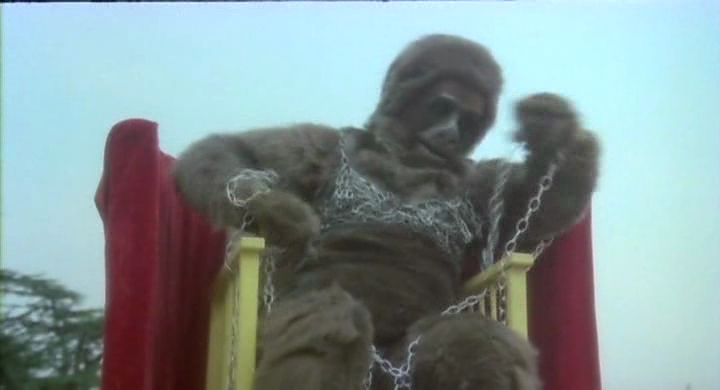
This, as you might know, is the King Kong spoof that was deemed to be a bit too similar to Dino De Laurentiis's remake of the same year (1976) and as a result was prevented from being released. Female lead Rula Lenska was apparently pleased by this turn of events, as she felt that the release of the film would have hampered her career. 30-plus years later it's hard to see what the fuss was about: The film would be difficult to confuse with the De Laurentiis version and, while certainly bad at a technical level, nonetheless has a certain something about it.

We open with a man being chased by hostile natives and ending up in their cooking pot. It is the latest scene in Luce Habit's (Lenska's) latest epic and proves the last straw as far as the actor is concerned.

In case you couldn't tell, and a possible nod to the krimi?
The demanding director returns to London to seek out a new lead and soon finds one in the shape of happy-go-lucky gleaming-smiled rogue Ray Fay (Robin Askwith).


The female gaze and its object; much like Four Flies on Grey Velvet Handel's Hallelujah Chorus plays here
In a nod to the original King Kong Ray's first glimpsed attempting to steal an apple. In a joke at the expense of the remake he then tries stealing an “original reproduction” King Kong poster from an Italian junk shop owner. (Ray: “Where is he, the little Italian fink, I'm gonna sue ya!”)

“I'm taking this peach with me”
Luce pays off said fink, slips Ray a mickey finn as his attention is distracted by some hippy types from whom he attempts to cadge a joint, and has The Liberated Lady set sail before he can awaken and start questioning the contract he may or may not have signed.
The Liberated Lady then arrives at the Island of Lazanga. The high priestess (Valerie Leon) wants to sacrifice Ray to Queen Kong but Luce is having none of it. Ray winds up being offered up to the giant ape anyway only for her to fall in love with him. What neither the high priestess or Luce were expecting, however, was for the feeling to be mutual...
Around about this point the action jumps back to London as Luce decides to put Queen Kong on display...
Throughout the gags come thick and fast, mostly missing but with enough hitting not to be a complete disaster.
The first thing that made the film work for me was the filmmakers' awareness that what they were doing was, at some level, basically crap as when, en route to Lazanga we're treated some highly self-referential and deprecating commentary on the B-film and its limitations.
Luce: We're on our way to Darkest Africa, to make a film that will make you the biggest star in Uganda
Ray: Oh, terrific
Ray: They keep saying Kong, Kong, Kong, Kong, Kong, Kong
Luce: yes, that's true
Ray: Well do you think this has some underlying meaning or symbolism or social significance?
Luce: Perhaps it's a secret code
The second, following in part from this, was the inability to actually position the film as X (bad) or Y (good), with a particular excess of images that could be construed as either sexist or anti-sexist, racist or anti-racist, or both at the same time.
On the one hand we have the crew of The Liberated Lady singing a song that name-checks such feminist figures as Germaine Greer and Jane Fonda:
Burn your bra
Burn your panties
Call you ma
Call your aunties
And ship up on the Liberated Lady
It's the new dance sweeping every nation
As they swing to the beat of women's liberation
Ladies entering into the lion's den
Fighting for their place next to men
Grab a Honda with Jane Fonda
Give a cheer for Germaine Greer
Etc.
On the other hand we have the selfsame crew/singers dressed in hot pants and cropped tops doing a dance routine that presenting the kind of spectacle for the assumed male gaze a Laura Mulvey most definitely would not have approved of:


On the one hand we have the primitivism and ignorance of the inhabitants of Lazanga being foregrounded, as with a public baths which comprises a number of toilets and sinks.
On the other hand its native inhabitants are ethnically diverse and run the place very as a tourist trap – “Lazanga where they do the Konga” and accept American Express and Diners Club cards – offering the possibility that the likes of the baths are there as a joke at the expense of the civilised outsider who thinks he (or she) gets it.
At the core of this and further complicating things in the figure of Queen Kong.
One reading of the original King Kong is, after all, as a specifically white racist fantasy about the white beauty and the black beast: Kong represents a monstrous black male sexuality and must be destroyed so that the white man can continue to enjoy his exclusive access to the white woman.
If this seems far fetched consider Kong author Edgar Wallace's work as a war correspondent during the Boer War; his Sanders of the Rivers novels; or the frequently recurring Murders in the Rue Morgue styled trope of the ape/missing link monster-killer in his thrillers.
Or, in the Italian context of the co-production, consider a Fascist-era propaganda which depicted a US Negro soldier as an ape intent on assigning a price to the Venus de Milo to thereby also implicate the Fascists as defenders of Italian / European civilisation against the primitive/savage other.

The enslavement of the black woman by the white woman?
But what we have here is a scenario where the white proletarian male rebels against the white bourgeois female and affirms his love for a black female of ambiguous class position (Queen in her own land yet taken away from there in slave chains) in a way that cuts across class, gender and ethnic lines in interesting ways.

Unconcious vagina dentata reference?

Linda Hayden as a singing nun
In the end, it all perhaps comes down to that most conservative and radical of powers, the one which every identity ultimately relies upon and yet often also has problems with: Love.
And here there is perhaps one kind of love which proves unacceptable, which is not allowed to speak its name. No, not bestiality, if we read Queen Kong and Ray's relationship as that between ape woman and man, but homosexuality.
Consider the gay-coded actor at the start: “Listen dear, I'll sue you deaf, dumb and blind if you don't get me down from here. Mind the hair dear! Mind me ankles! Now get out the way you silly bitch! I'm calling my agent, and my lawyer, not to mention my tailor!”
Or Luce's remark as she prepares to take Queen Kong to London: “She might have been a Queen on this island, but in London half the guys you meet are queens”
Very much a film of its time...

We open with a man being chased by hostile natives and ending up in their cooking pot. It is the latest scene in Luce Habit's (Lenska's) latest epic and proves the last straw as far as the actor is concerned.

In case you couldn't tell, and a possible nod to the krimi?
The demanding director returns to London to seek out a new lead and soon finds one in the shape of happy-go-lucky gleaming-smiled rogue Ray Fay (Robin Askwith).


The female gaze and its object; much like Four Flies on Grey Velvet Handel's Hallelujah Chorus plays here
In a nod to the original King Kong Ray's first glimpsed attempting to steal an apple. In a joke at the expense of the remake he then tries stealing an “original reproduction” King Kong poster from an Italian junk shop owner. (Ray: “Where is he, the little Italian fink, I'm gonna sue ya!”)

“I'm taking this peach with me”
Luce pays off said fink, slips Ray a mickey finn as his attention is distracted by some hippy types from whom he attempts to cadge a joint, and has The Liberated Lady set sail before he can awaken and start questioning the contract he may or may not have signed.
The Liberated Lady then arrives at the Island of Lazanga. The high priestess (Valerie Leon) wants to sacrifice Ray to Queen Kong but Luce is having none of it. Ray winds up being offered up to the giant ape anyway only for her to fall in love with him. What neither the high priestess or Luce were expecting, however, was for the feeling to be mutual...
Around about this point the action jumps back to London as Luce decides to put Queen Kong on display...
Throughout the gags come thick and fast, mostly missing but with enough hitting not to be a complete disaster.
The first thing that made the film work for me was the filmmakers' awareness that what they were doing was, at some level, basically crap as when, en route to Lazanga we're treated some highly self-referential and deprecating commentary on the B-film and its limitations.
Luce: We're on our way to Darkest Africa, to make a film that will make you the biggest star in Uganda
Ray: Oh, terrific
Ray: They keep saying Kong, Kong, Kong, Kong, Kong, Kong
Luce: yes, that's true
Ray: Well do you think this has some underlying meaning or symbolism or social significance?
Luce: Perhaps it's a secret code
The second, following in part from this, was the inability to actually position the film as X (bad) or Y (good), with a particular excess of images that could be construed as either sexist or anti-sexist, racist or anti-racist, or both at the same time.
On the one hand we have the crew of The Liberated Lady singing a song that name-checks such feminist figures as Germaine Greer and Jane Fonda:
Burn your bra
Burn your panties
Call you ma
Call your aunties
And ship up on the Liberated Lady
It's the new dance sweeping every nation
As they swing to the beat of women's liberation
Ladies entering into the lion's den
Fighting for their place next to men
Grab a Honda with Jane Fonda
Give a cheer for Germaine Greer
Etc.
On the other hand we have the selfsame crew/singers dressed in hot pants and cropped tops doing a dance routine that presenting the kind of spectacle for the assumed male gaze a Laura Mulvey most definitely would not have approved of:


On the one hand we have the primitivism and ignorance of the inhabitants of Lazanga being foregrounded, as with a public baths which comprises a number of toilets and sinks.
On the other hand its native inhabitants are ethnically diverse and run the place very as a tourist trap – “Lazanga where they do the Konga” and accept American Express and Diners Club cards – offering the possibility that the likes of the baths are there as a joke at the expense of the civilised outsider who thinks he (or she) gets it.
At the core of this and further complicating things in the figure of Queen Kong.
One reading of the original King Kong is, after all, as a specifically white racist fantasy about the white beauty and the black beast: Kong represents a monstrous black male sexuality and must be destroyed so that the white man can continue to enjoy his exclusive access to the white woman.
If this seems far fetched consider Kong author Edgar Wallace's work as a war correspondent during the Boer War; his Sanders of the Rivers novels; or the frequently recurring Murders in the Rue Morgue styled trope of the ape/missing link monster-killer in his thrillers.
Or, in the Italian context of the co-production, consider a Fascist-era propaganda which depicted a US Negro soldier as an ape intent on assigning a price to the Venus de Milo to thereby also implicate the Fascists as defenders of Italian / European civilisation against the primitive/savage other.

The enslavement of the black woman by the white woman?
But what we have here is a scenario where the white proletarian male rebels against the white bourgeois female and affirms his love for a black female of ambiguous class position (Queen in her own land yet taken away from there in slave chains) in a way that cuts across class, gender and ethnic lines in interesting ways.

Unconcious vagina dentata reference?

Linda Hayden as a singing nun
In the end, it all perhaps comes down to that most conservative and radical of powers, the one which every identity ultimately relies upon and yet often also has problems with: Love.
And here there is perhaps one kind of love which proves unacceptable, which is not allowed to speak its name. No, not bestiality, if we read Queen Kong and Ray's relationship as that between ape woman and man, but homosexuality.
Consider the gay-coded actor at the start: “Listen dear, I'll sue you deaf, dumb and blind if you don't get me down from here. Mind the hair dear! Mind me ankles! Now get out the way you silly bitch! I'm calling my agent, and my lawyer, not to mention my tailor!”
Or Luce's remark as she prepares to take Queen Kong to London: “She might have been a Queen on this island, but in London half the guys you meet are queens”
Very much a film of its time...
Monday, 7 June 2010
The Confessions of Robin Askwith
In December 1973s Robin Askwith was sent a copy of the script for Confessions of a Window Cleaner by his then-agent, who suggested that he might consider auditioning for the role. The young actor wasn't too sure. Would a low-budget British sex comedy really be a positive career move, considering that his previous screen appearances had included working for Lindsay Anderson on If... and Pier-Paolo Pasolini on The Canterbury Tales?

Still, in the challenging circumstances of the British film industry post-Swinging London few actors could afford to be too choosy. Work was work, after all. Accordingly Askwith auditioned for the part of window cleaner Timothy Lea; won the role which a number of other up and coming thespian friends had already declined; went on to appear in a further three Confessions films, invariably disliked by critics but popular with the audiences; generally helped keep the British cinema in business; and came to be known as much for his bum as anything else.
It's an measure of the importance of the Confessions films to Askwith's life and career that his memoirs are themselves entitled Confessions... and begin much with the story I've outlined above.
His early life comes later – although there are hints of the importance of a traumatic childhood encounter with polio earlier – as do his pre-Confessions experiences in working with Anderson, Zeffirelli and others.
Fans Peter Walker's films may be disappointed that Askwith doesn't say much about them, whether more because he considers Walker a friend and didn't want to dish the dirt too much or because there wasn't too much dirt in the first place.
There are however some amusing anecdotes about the likes of Confessions of a Window Cleaner director Val Guest, who apparently enjoyed filming the multiple versions of the sex scenes required for the film a bit too much; fellow Hammer alumni assistant director Bert Batt, who most emphatically did not; Guest's replacement for Confessions of a Pop Performer Norman Cohen, who suffered from imaginary body odour and had a tendency to say 'Cut' instead of 'Action' and vice-versa; Irene Handl and her shitzu; the troubled Alan Lake; and the notorious trash epic Queen Kong, still legally impounded at the time of the book's publication in 2000.
While it could have done with some better proofreading – not that I can really comment, except for I do this for fun / free – and is first and foremost about Askwith and his enduring association with his most famous role and only secondarily about British popular cinema, Confessions... is a fun read and comes (oo-er) highly recommended.

Still, in the challenging circumstances of the British film industry post-Swinging London few actors could afford to be too choosy. Work was work, after all. Accordingly Askwith auditioned for the part of window cleaner Timothy Lea; won the role which a number of other up and coming thespian friends had already declined; went on to appear in a further three Confessions films, invariably disliked by critics but popular with the audiences; generally helped keep the British cinema in business; and came to be known as much for his bum as anything else.
It's an measure of the importance of the Confessions films to Askwith's life and career that his memoirs are themselves entitled Confessions... and begin much with the story I've outlined above.
His early life comes later – although there are hints of the importance of a traumatic childhood encounter with polio earlier – as do his pre-Confessions experiences in working with Anderson, Zeffirelli and others.
Fans Peter Walker's films may be disappointed that Askwith doesn't say much about them, whether more because he considers Walker a friend and didn't want to dish the dirt too much or because there wasn't too much dirt in the first place.
There are however some amusing anecdotes about the likes of Confessions of a Window Cleaner director Val Guest, who apparently enjoyed filming the multiple versions of the sex scenes required for the film a bit too much; fellow Hammer alumni assistant director Bert Batt, who most emphatically did not; Guest's replacement for Confessions of a Pop Performer Norman Cohen, who suffered from imaginary body odour and had a tendency to say 'Cut' instead of 'Action' and vice-versa; Irene Handl and her shitzu; the troubled Alan Lake; and the notorious trash epic Queen Kong, still legally impounded at the time of the book's publication in 2000.
While it could have done with some better proofreading – not that I can really comment, except for I do this for fun / free – and is first and foremost about Askwith and his enduring association with his most famous role and only secondarily about British popular cinema, Confessions... is a fun read and comes (oo-er) highly recommended.
Subscribe to:
Posts (Atom)