Showing posts with label Paul Naschy. Show all posts

Sunday, 11 April 2010

Último deseo / The People who Own the Dark

You could be forgiven for mistaking this 1976 Spanish horror entry as being the work of Amando De Ossorio, featuring as it does a horde of unseeing, zombie-like monsters much like his Blind Dead along with a small group of people holed up by said monsters a la Return of the Evil Dead.

In fact, however, the film was directed by Argentinean ex-pat Leon Klimovsky from a scenario co-authored by Blood Spattered Bride director Vicente Aranda.

We begin with the introduction of a dozen characters as they assemble at a mansion house for a masked, de Sade-inspired orgy. The six men including Alberto De Mendoza as scientist Professor Fulton and Paul Naschy as military man Bourne. One of the six women functions as mistress of ceremonies. The others, including Teresa Gimpera and Maria Perschy, are there to service the men's requirements.


But before the orgy moves into Jesus Franco territory the dungeon is shaken, as if by an earthquake.


Being a pre-destape film, this is about as far as it goes nudity wise

Venturing into the upper levels of the mansion to see what is going on, the participants find the servants blinded, their eyes burned white. Fulton realises that these symptoms are indicative of a nuclear explosion nearby. (Yes, this makes no sense, except in a Protect and Survive or Duck and Cover don't tell the public too much of the truth about nuclear armageddon way.)


The Beyond meets Horror Express?

Come morning the six men drive into the nearest town to find out what has happened and stock up on supplies. Victor cracks under pressure and kills some of the blind people before himself being killed by Edward; back at the mansion, Edward in turn suffers a breakdown, stripping naked and crawling around on all fours as if he were a pig.


Naschy blasts some of the local wildlife

The situation becomes more desperate as night falls and the blind march on the mansion intent on killing all those within...


A Birds meets Night of the Living Dead shot

One of the greatest strengths of the horror film is often its capacity for allegorical use, the way it allows the filmmaker to obliquely comment on social and political issues to cutting effect.

This can be seen in Night of the Living Dead, as an obvious inspiration for both The People Who Own the Dark and De Ossorio's Blind Dead films, and the Blind Dead themselves: Romero's film allowed him to comment upon the likes of the Vietnam War and the continuing necessity of the Civil Rights movement, while the Blind Dead enabled Ossorio to sneak criticism of the Franco regime past the Spanish censors.


Random Naschy images

The problem in this regard for The People Who Own the Dark is a relative lack of clarity about what the film's message is. With the Blind Dead it was easy to see, in that here were these ancient undead figures who killed those amongst the younger generations who failed to keep silent, or had the temerity to raise an oppositional voice.

Here by contrast we have a mixed bag of reference points also including Pasolini's Salo, Bunuel's The Exterminating Angel, Saura's La Caza, Petri's Todo Modo – coincidentally released in the same year – and, amongst less exalted / more generic texts, Wyndham's The Day of the Triffids and Romero's The Crazies.

The thing that these works have in common with the Blind Dead films and Night of the Living Dead is an internal consistency. Once you have accepted that the bourgeois in The Exterminating Angel cannot leave the house; that the dead are returning to life to eat the living; that there are ambulatory killer plants on the loose amongst an almost entirely blind population; or that a group of bourgeois sadists are intent on exploring every facet of power and perversity that they can, everything else follows logically. You know how to engage with the film, where your sympathies are supposed to lie or, indeed, if you are to take a more detached, observational position.

Here by contrast we don't get any particular cues. This is most apparent when it comes to the most attractive of the female characters, Perschy's tart with a heart. Before the catastrophe, she has an encounter with a blind beggar and gives him alms. Later, post-apocalypse, she attempts to leave the mansion with one of the men to go in search of help.

It's the kind of selfless, heroic gesture that would conventionally be rewarded.

But the couple are then captured and killed by the blind, much like young lovers Judy and Tom in Night of the Living Dead were by the ghouls. The thing is that whereas the ghouls operated on a pure instinctual need to feed, the blind mob is being led by the aforementioned beggar, and dumps the mutilated bodies before the sighted for added impact.

Assembling this, my dominant impression was perhaps of a universe informed by Machiavelli – in the kingdom of the blind the one eyed man is king or, as we might formulate it here, the lifelong blind man is king amongst the recently blind – De Sade and Nietzsche in which the greatest error is not to take advantage of others' weakness when you have the chance for, resenting you, they will seek your destruction as soon as they get the chance.

These ideas aren't a problem, if you are a Pasolini or a Bunuel and attracted their kinds of audience, or if you're single-mindedly intent on making as unrelenting a film as possible, but Klimovsky doesn't appear to be.


Survival?

At least the cynical and nihilistic ending, with with some decidedly ironic use of Beethoven's Ode to Joy via A Clockwork Orange and / or Murder in a Blue World, is well realised and consistent with what has gone immediately before it, to indicate who really owns the dark, the light and the (brave new) world and to take you out of the film satisfactorily.

Alas, it's a slog getting there, with too little in the way of sex, violence and spectacle for the kind of hardened Euro-trash fan who is likely to be the primary audience for the film today.

In sum, very much an oddity as a rip-off of a rip-off that nevertheless subverts imitation with its own curious innovations.

Wednesday, 7 April 2010

La marca del Hombre-lobo / The Mark of the Wolf Man / Frankenstein's Bloody Terror / Hell's Creatures

This is the first film in the Waldemar Daninsky cycle. It could also have been the last, had its success not prompted Paul Naschy to bring his creation back from the dead after he apparently killed by the traditional silver bullet at the film's close.

Like other great horror cycles, this move isn't particularly objectionable insofar as Naschy would develop the character and the mythos as the series went on.

As it is, for the first film in a series Mark of the Wolf Man presents a curious combination of elements that at times seems less indebted to its direct model of Universal's The Wolf Man than the monster rallies which followed it.

For while the film shows how Daninsky became infected with the curse of lycanthropy it also features vampires, albeit masquerading as humans and offering to help treat his condition. The only one of the triumvirate of classic monsters thus absent is Frankenstein's monster. Amusingly, however, the film was released in the US as Frankenstein's Bloody Terror. Being obliged to deliver a Frankenstein film and having a film without either the monster or his creatror, the distributors added in an animated title sequence which purported to explain how the Frankenstein family had been cursed with lycanthropy and became the Wolfsteins.


Part of this is true


This, however, isn't

We begin with a ballroom sequence that nicely establishes its romantic aspects along with the fact that there was a decent budget for the film, some prints of which were actually release in 70mm and with stereo sound.

A masked ball is being thrown for the engagement of Countess von Aarenberg to Rudolph Weismann, with all the local nobility and bourgeois in attendance. Daninsky dances with the countess, who is instantly enchanted by his enigmatic if somewhat sinister presence.


Zurakowska and Naschy...


and the guy playing Rudolph

The next day they are formally introduced at an antique shop before meeting by chance in the grounds of Wolfstein Castle. Daninsky, who explains he often retreats there for peace and quiet, tells the Countess and Rudolph the history of the Castle and the Wolfsteins. Imre Wolfstein was cursed with lycanthropy and, as such, could only be truly killed by being shot with a silver bullet by a woman who truly loved him. As he was stabbed through the heart with a silver dagger, Imre is not truly dead, only prevented from rising from his tomb.

Rudolph is sceptical and drives off with the Countess, forcing a gypsy wagon into a ditch as he unthinkingly speeds past them.

Daninsky helps the gypsy couple get back on the road, but with a storm brewing they ask if there is anywhere they might shelter for the night. Despite its history, Daninsky suggests Wolfstein Castle.


The gypsies approach the castle

The gypsies get drunk on the vintages in the Wolfstein's cellars, find the family tomb and pull the silver dagger out of Imre Wolfstein's remains. He thus comes back to life and kills them, followed by a couple of peasants.

Learning of the latter deaths the locals organise a hunt. During this Daninsky and Rudolph happen upon Imre. Daninsky manages to plunge the silver dagger back into the werewolf's heart to save Rudolph, but is himself bitten. The distinctive star-shape of the wound, the mark of the wolf man, tells him that is fated to become a werewolf himself.


Imre Wolfstein, back from the dead

Rudolph agree to help Daninsky, who tries to keep his distance and his secret from the Countess. Predictably he does not succeed. Going through Imre Wolfstein's papers, the Countess then discovers a forty-year old letter from one Doctor Janos Mikhelov, intimating that he might have found a cure.

It seems like a long shot, but is also the only promising avenue that the trio have found, with Daninsky becoming increasingly despondent that the only cure for his condition is to be a silver bullet.

They thus make contact with Dr Mikhelov – or rather his son. He agrees to assist Daninsky and arrives with his wife, Wandesa. The thing is that far from being the benevolent figures Daninsky was hoping for, they are in fact vampires intent on using him and Imre for their own nefarious purposes...


The vampires


Daninsky transforming

There is a lot to like about The Mark of the Wolfman: The cast, which includes Rosanna Yanni, Dyanik Zurakowska and Julian Ugarte alongside Naschy; the impressive sets and production design; stylised, painterly compositions and cinematography in the vein of Mario Bava or Jack Asher, and a score that is often more than just serviceable and which sometimes even approaches the heights of Krysztof Komeda's work on Dance of the Vampires.


Classic imagery and a beautiful composition

Above all it's the way these pieces fit together as a whole and the overriding sense that not only Naschy but everyone else involved believed in the value of what they were doing. Maybe it wasn't Bunuel, Saura or whoever the ciritics liked. Maybe they had misgivings about aspects of it. Maybe they were just out to collect their pay-cheques. But, if any of this was indeed the case, the point is there is no real evidence of this on screen.

If only more contemporary horror films were like this...

Monday, 5 April 2010

El asesino está entre los trece

This is one of those films that looks a lot better on paper than it actually turns out to be.

It has a solid starting point for a thriller as eleven guests are invited for a weekend at an isolated country house, only to then be told by the hostess that one of them murdered her husband; the thirteenth figure is her somewhat odd son.


The assembled guests, hosts and servants

Admittedly this is clearly derivative of Agatha Christie. But, as the likes of Bava's Five Dolls for an August Moon and Michele Lupo's The Weekend Murders showed, an unoriginal scenario doesn't necessarily mean an unoriginal film.

Writer-director Javier Aguirre has also assembled a solid ensemble cast, with the likes of Patty Shepard, Jack Taylor and Simon Andreu amongst the guests / suspects and Paul Naschy as one of the servants.

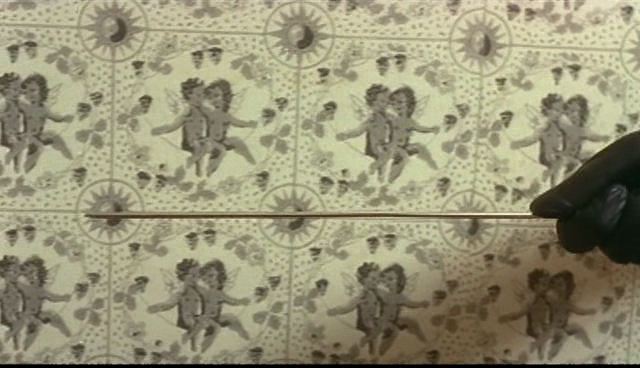
Though more a metteur en scene than an auteur, Aguirre had some talent for horror, as demonstrated by his collaborations with Naschy on Count Dracula's Great Love and The Hunchback of the Morgue. And, indeed, the murder set pieces here, performed by a black-gloved and garbed killer using an assortment of hand weapons, are well executed, pun intended.


The trailer probably looked good, at least

So, where does it all go wrong?

The answer is in the pacing. The first twelve minutes are spent introducing the various characters. At thirteen minutes everyone settles down for dinner and the announcement that a murderer is amongst them is made. Dinner and conversation around this revelation, which everyone takes remarkably calmly, continues for another fifteen minutes.

Everyone then retires for the night, at which point Naschy's character goes to bed with the maid. Like the later hand to hand fight he engages in, it's a scene that crops up in almost every film he was in around this time, making one think it must have been a standard clause in his contract. As they make love, someone watches from outside, priming expectations that things are about to finally kick off.


Some rather obvious matte work

But nothing happens. Come morning everyone is still alive and quite happy to remain at the estate, digging out and divulging guilty secrets for the next half hour; by this point you may be wondering if Aguirre was intent on subverting the thriller by way of Waiting for Godot or The Exterminating Angel.


Two obligatory Naschy moments

Then, with half an hour left, we get two murders in the space of two minutes; a succession of three further deaths at regular intervals; a traumatic flashback; some further improbably calm reactions by those still alive and now proven innocent of the original murder, and a 'surprise' reversal with five minutes remaining. FIN.

Sunday, 31 January 2010

Muerte de un quinqui

Retrospectively one thing about Paul Naschy's films, regardless of where we situate them generically, whether as horror, giallo- or crime-thriller, is that his presence seems to guarantee the inclusion of particular scenes and ideas that we would not get were someone else cast in the role.


As in Italy circa 1975, crime appears out of control in Spain as well; a guarded attack on the regime?

Scripted by Naschy himself under his real name Jacinto Molina, Muerte de un QuinquiDeath of a Hoodlum – is a case in point.


The heist

Naschy plays a psychopathic robber, Marcos, who guns down two men during a jewellery heist, stamps and kicks his girlfriend into a coma (Seul contre tous, anyone?), and flees from the rest of the gang with the loot which he had been safekeeping until their fence arrived.

As with the limping Peter Dockerman in the Jose Luis Madrid directed Spanish giallo Jack the Ripper of London, Marcos is physical handicapped, wearing a hearing aid as a result of being beaten by his father as a child.

As with Gilles in the Carlos Aured directed Blue Eyes of the Broken Doll, he's also psychologically traumatised, being fixated on his mother, who was killed by his father in the same incident, and defending her name against any criticism.


Mummy


Her traumatic murder


And its consequences

More generally Marcos is one of Naschy's tragic villains / monsters, as much a victim of circumstances and history as anything else. This links him back to the most famous of his characters, the reluctant werewolf Waldemar Daninsky.

Having arrived in the sticks, Marcos gets a job as a handyman on a farm. At this point the similarities with Blue Eyes of the Broken Doll are again foregrounded in that the farm is inhabited by three people, one in a wheelchair. This time, however, it's a husband and wife – he is the one in the chair – and their attractive daughter. The mother and daughter look like sisters and, like the sisters in Aured's film, are soon both romantically involved with Marcos.

In addition to bedding his co-stars, Naschy also strips down to his waist to chop some wood and generally show off his weightlifter's physique, again all as per usual.


Cody Jarrett redux?

Eventually the rest of the gang, headed by Frank Brana, show up, just as the games between Marcos and the family turn deadly serious...

Leon Klimovksy, who also produced, directs with his usual efficiency.

[See also http://www.naschy.com/muertequinqui.html]

Saturday, 12 December 2009

RIP Paul Naschy

Just found out about this :-(

http://thekinskifiles.blogspot.com/2009/12/rip-paul-naschy.html


Weird that only last Thursday I watched Blue Eyes of the Broken Doll again...

Saturday, 11 July 2009

El jorobado de la Morgue / The Hunchback of the Morgue / Rue Morgue Massacres / The Hunchback of the Rue Morgue

Which Spanish horror star of the 1970s do you think would be the obvious choice to play the Hunchback of the Morgue?

If you answered Paul Naschy / Jacinto Molina, the one-man horror factory who seems to have made it his mission to play each and every monster he could, you would be right - although the question may also be a somewhat easy one in that there really aren't any other Spanish male horror icons of that time.

Naschy imbues his character, named Gotho in apparent reference to the Gothic, with all the familiar traits: He is monstrous, but in a tortured, suffering, Romantic way. His enemies, the normal people who conceal their evil crimes and schemes beneath a virtuous and attractive veneer, are the real monsters.

If Gotho is in the first instance derived from Victor Hugo and Lon Chaney - it is always difficult to say when we are dealing with films that remain far better known than their literary sources - the film as a whole has a distinctly Frankenstein feel to it.

And, while the character of the hunchbacked assistant first appeared in James Whale's Frankenstein via Dwight Frye, the film's immediate models seem more Terence Fisher's Frankenstein films, with elements of The Revenge of Frankenstein and Frankenstein Created Woman particularly evident, along with that same general structural opposition between the good and the ugly on the one hand and the evil and the attractive on the other.


Spanish poster for The Hunchback of the Morgue, with obvious classical horror allusions

Though there are also affinities with Frankenstein and the Monster from Hell these may be taken as coincidental rather than deliberate seeing as both films were released in the same year; the same may also be said of the world-weary Dracula of Naschy and director Xavier Aguirre's Count Dracula's Great Love and his namesake in Hammer's The Satanic Rites of Dracula.

The Revenge of Frankenstein also featured a none-too intelligent hunchbacked assistant, Karl, a hospital worker who was promised a new body by Frankenstein in return for his help. Gotho, who works at the Feldkirch Hospital, is made a similar promise by his mad scientist Dr Orla, involving bringing Gotha's terminally ill and now recently deceased loved one, Ilse, back to him. Yet this also foregrounds a romantic subplot more aligned with Frankenstein Created Woman's Christina and Hans - the two young lovers who together eventually constitute that film's severely troubled monster through Frankenstein's intercessions in the natural order of things.

But for all these intertexts - to which we might also add Joe D'Amato's delirious Buio Omega, as another necro-philiac/mantic entry - The Hunchback of the Morgue is also unmistakably a Paul Naschy film.

In Frankenstein Created Woman the unimaginative authorities went after the ill-fated Hans for a crime he did not commit. Here, by contrast, Gotho is guilty of at least some of the crimes he is accused of. Moreover, those defending him do so not out of a sense of justice, as Peter Cushing's progressive Baron Frankenstein did, but rather because of their own self-interest, in Dr Orla, or liberal naïvete, as in the case of Elke, who is in charge of the Feldkirch Women's Reformatory. (Yes, there's even a bit of WIP thrown into the mix.)

As played by Rosanna Yanni, Elke is also your classic Naschy love interest figure, impossibly beautiful and inexplicably drawn to his doomed character like a moth to a flame.

Were it not for the fact that Naschy was already happily married by the time he made most of his films you could almost believe he was operating some sort of casting couch system through them as a means of obtaining the otherwise unobtainable / unattainable.

The presence of the reformatory also serves to remind us that Gotho's crimes might be excused on grounds of his simple-mindedness, and that the film takes place not in some ambiguous 19th century mittel-European Erehwon but in contemporary 1970s Germany.

This location also affords a hint of political commentary via the caverns where Gotho hides out and Dr Orla establishes his secret laboratory. We are told they once used by the Knights Templar in the Middle Ages and more recently saw service during the Second World War.

But, as with Naschy's other non-Spanish set films, it's difficult to determine the extent to which there is an anti-Francoist point to this or whether it was simply taking advantage of the ambiguities that a more distanced foreign setting afforded.

As it is, the most problematic aspects of the film as far as today's audiences and censors are concerned are surely the rumours that a real corpse was used in some of the morgue scenes, along with some real life animal cruelty as some rats get burned alive. In fairness, the scene with the rats also demonstrates Naschy's commitment to his art, inasmuch as he also let himself be attacked by them for the sake of authenticity - De Niro eat your heart out!

[See also The Mark of Naschy's review at http://www.naschy.com/jorobado.html]

Thursday, 21 August 2008

Jack el destripador de Londres / Sette cadaveri per Scotland Yard / Seven Murders for Scotland Yard

Present-day London is in the grip of a serial killer whose modus operandi recalls that of Jack the Ripper nearly a century before, suggesting someone with surgical training – or at least the skills of a butcher.


The lost world of British sexploitation advertising

This evidence suggests that the crimes may be the work of Pedro Dorian (Paul Naschy). A Spaniard who attended medical school for a couple of years in his home country, he also happens to have a limp, sustained as the result of a circus accident, and thus fits a young eye-witnesses' description of the man the police are looking for.


Classic giallo imagery

But while academic amateur investigator Windsor Derby Christian (Andrés Resino) is convinced Dorian must be the man responsible for the crimes, his professional counterpart and friend Commissioner Henry Campbell (Renzo Marigano) continues to have his doubts – at least until the bodies and the evidence against Dorian begin to mount, most notably when an anonymous tip off leads to his being found with his date from the previous night, dead, mere days after the murder of his own wife...

This 1971 Paul Naschy vehicle sees the Waldemar Daninsky star trying to board the giallo bandwagon, with mixed results.

For while featuring the obligatory black gloved, knife-wielding killer, his identity concealed by various point-of-view shots, along with a decent body count, the film never really goes all out on the sleaze front, with little nudity to speak of, a tendency for the victims to die somewhat neatly after one or at most two stabs and a preference for telling us rather than showing us the more extreme of the ripper's depradations.

Nor does the whodunnit aspect amount to much. Working on the premise that Naschy cannot be the murderer, both for the extra-diegetic fact that it's not his style to draw his audience in and pull the rug from under us, that the typically tragical nature of his monster figures depends on our knowing their true nature, and the diegetic sense that someone is trying too hard to make him the most – i.e. too – obvious culprit, we're left with only really two other candidates in a population of seven million: Windsor and Henry.

Given that the filmmakers approach to the Scotland Yard authority figures seems rather more krimi than Investigation of a Citizen Above Suspicion – and here also remembering that the Spanish half of co-production team were still subject to the strictures of Francoist censorship – the genre-literate viewer may soon quickly reduce this short list to one.

If all this starts to read like a spoiler, bear in mind that the typical viewer for the film is likely to have seen a fair number of better gialli and Naschy entries; certainly when I watched the film with a friend who had never seen Seven Murders for Scotland Yard but who possesses this wider awareness he had no difficulty whatsoever in correctly picking out the guilty party almost as soon as he had appeared on screen.

If similar points could be made about many other gialli, they are usually at a bit better at finding a number of other suspects.

One telling point of comparison here, given the nature of their killers and use of locations foreign to the filmmakers is The New York Ripper, with the coincidences further enhanced by the presence of another foreign suspect marked out as different, in the form of Mickey Scellenda with his missing finger, and of an suave and sophisticated, intellectual, chess-playing investigator / suspect, in Dr Davis, within Fulci's film.

What Fulci succeeds in doing, however, is really conveying a sense of New York-ness to his film and, more significantly, making this sense and integral part of the overall sensibility of his film through the way in which his other characters, those with no real counterparts in Seven Murders for Scotland Yard, are made part of the warp and weft of the film.

Though Naschy and company clearly did travel to London to pick up some location shots of his character wandering around Soho these paradoxically lessen the overall effectiveness of the piece precisely because they jar with the other, rather too obviously Mediterranean exteriors found elsewhere in the film. (Much like their more pervasive counterparts in The New York Ripper there's also a nice incidental documentary aspect to these images, showing the difference between the still relatively staid Soho of 1971 with posters for films and shows promising more than they likely ever delivered, and the hell-on-earth of 42nd Street just prior to the AIDS and crack epidemics; in characteristic displays of British reserve many of the bystanders also do their best to move out of the camera's gaze or to cover their faces.)

Seven Murders for Scotland Yard is also rather lacking in pace. In part this is quite literally the case, thanks to the Naschy character's disability and the longer than usual shots of his walking from one scene to another that result. But it's also down to the curious almost real-time pacing of the film, where scenes and shots have a tendency to be held beyond the moment when their dramatic point has been made in a manner that is oddly, if presumably unintentionally, reminiscent of Antonioni.

Consider the opening murder: For two minutes we have shots streets of Soho from the POV of the unidentified killer. He then silently picks up a prostitute. They enter the block where she has her room and ascend the stairs, watched by a girl, Margaret, whose eye-witness testimony will later prove important. Once in the room, the woman then proceeds to slowly strip off, the camera alternating between close-up and longer shots that probably no longer correspond with to the killer's POV insofar as he as busy taking out his knife; we're now at the four and a half minute mark.

The killer then advances on the woman, whose look turns from one of feigned pleasurable expectation to terror, and, after all this build up calmly stabs her twice. A few credits roll over the freeze-framed, red tinted image of the dead woman's body on the bed and the killer slowly makes his exit, taking us to almost the seven minutes in before the second sequence starts.

This sees Naschy's character in a nearby bar, nursing a wound to his hand. After finishing his drink, he gets up and walks home, arriving there about the 8 minutes 30 seconds mark.

As far as the performances go Naschy is, well, Naschy, complete with the regulation bare-chested and mano a mano fight scenes, no fewer than three of them.

Indeed, given that the aforementioned footage of him shuffling around Soho proves remarkably reminiscent of similar scenes in the later Waldemar Daninsky entry Dr Jekyll versus the Werewolf and that a final showdown in the madman's dungeon-cum-laboratory could easily have also come from just about any entry in the same series, you half expect him to transform at just about any moment.


Oops, I've done it again?

Still, whatever Naschy may lack as an actor he compensates for in the sheer commitment he always brings, coupled with a surprising willingness to take on somewhat unsympathetic and unheroic roles. Here Pedro does little more than drowning his sorrows with one whisky after another. If this leads to some obligatory giallo traumatic flashbacks, tinted blue to hint at an ambiguous association with the red tint over the opening murder, that his whisky of choice is Vat 69 rather than J&B again seems to foreground the Spanishness of the production.

The other performers are satisfactory in their one-note roles although the exaggerated dubbing accents used on the English-language version adds further unintentional humour to what is already often some rather doubtful dialogue:

“It's alarming how many crimes of a sexual nature are being committed at the moment.”
“Did you say anything dear?”
“No, nothing – I was merely thinking aloud”

“Jack – Jack the Ripper!”
“Yes, his signature's all over the bodies of those two women.”
“But surely Jack the Ripper's dead, isn't he?”
“Undoubtedly – or extremely old”

Piero Piccioni delivers some engaging jazzy themes which affords him plenty of opportunity to whizz around the keys of his Hammond. Unfortunately these themes never really integrate that well with the film as a whole, giving the impression of being library music or at least pieces originally composed for some other purpose.

Saturday, 25 August 2007

Los Ojos azules de la muñeca rota / The Blue Eyes of the Broken Doll

This 1973 Spanish amarillo – i.e. giallo in all but name – sees weightlifter turned one-man horror factory Paul Naschy play a mysterious, evidently troubled drifter, Gilles, who takes a job as handyman to a trio of sisters on their farmhouse high the the French Pyrenees.

Soon after his arrival, a local girl is murdered. Soon after this the killer strikes again, this time also mutilating their victim by removing her eyes.


Who is the real auteur here star Paul Naschy / Jacinto Molina or director Carlos Aured?

Needless to say, Gilles is immediately under suspicion – especially seeing as the local chief of police is sure he recalls seeing his face somewhere before and his doctor colleague suggests that “the killer possesses uncommon strength,” having “ran her through with a single blow.”

Given the deserved reputation the three sisters have amongst the local populace – the alternative English title for the film House of Psychotic Women is only a slight piece of exploitation cinema hyperbole – he is hardly the only suspect, however.


As the title suggests, both eyes and broken doll motifs prove significant to the maniac's psychosis

Given the generic rules, coupled with numerous flashbacks type sequences showing a traumatic scene in Gilles’ past, in which he strangles a woman, perhaps Gilles is in any case too obvious a culprit.

Then again, perhaps the sisters – one scarred and sans some digits following an accident; another wheelchair bound yet apparently devoid of actual physical symptoms and the third a jealous, possessive nymphomaniac; the mother was committed to an asylum while their father, suffering from an incurable disease, committed suicide – could also be red herrings, such that detectives and viewers should be searching elsewhere, perhaps in the direction of to the new nurse who arrived unexpectedly, say...


A photo hides a clue

Though the contribution of director Carlos Aured cannot be ignored, there seems little doubt that Los Ojos azules de la muñeca rota / The Blue Eyes of the Broken Doll is really first and foremost the product of its star and co-writer, Naschy. The character of Gilles comes across as very much a naturalised / thriller version of his most famous creation, the werewolf Waldemar Daninsky, as a tragic, romantic figure who is the victim of bestial impulses he cannot fully control, the connection being made almost explicit in a sequence near the end where a posse, led by the police chief, chase Gilles across snowy, mountainous terrain, only managing to catch up with him when he inadvertently gets his foot caught in a jawed trap evidently left by a hunter.


Obligatory moments in a Paul Naschy film #1 he gets his kit off


Obligatory moments in a Paul Naschy film #1 – she gets her kit off


Obligatory moments in a Paul Naschy film #3 he gets in a fight and turns the tables on his better armed assailant through his superior physical prowess

The problem as far as reading the character goes is, however, that while Naschy hardly provides an uncritical endorsement of machismo and misogyny here or elsewhere his explorations of gender politics, much like those of Dario Argento and Jesus Franco, equally fail to provide the (too) neat, comfortable, unequivocal, politically correct, mainstream feminist message some would look for, whilst the more naturalistic setting here also removes something of the comfortable distance of fantasy as seen in the Daninsky films.

A key scene in this regard is that where a frustrated Gilles confronts one of the sisters in the house's barn, throwing her against the hay and remarking “You don't have to go anywhere to look for a man – you’ve got one right here,” only for a(nother) traumatic flashback to cause him to recoil, such that the object of his attentions – not particularly appreciating them, no clearly meaning no – is not required to fend him off with the farm implement she had reached out for a few seconds previously...


The obligatory enigmatic flashback / dream sequence

Likewise while elsewhere we certainly get the obligatory scenes where Naschy takes his shirt off to display his physique, engages in some mano a mano action with a rival – his predecessor as the handyman, as it turns out, and thus another potential suspect – and indulges himself with the ladies, there’s always something not quite right about the way these scenes come across such that they cannot simply be read as wish fulfilment fantasies on the part of either actor or (male) viewer who (mis)identify with the character, something more complex that requires a double-take.

Much the same can be said of the filmmakers' deployment of popular psychoanalytic discourses around such themes as trauma, mind-body dualism and fetishism. They do not do so uncritically, evincing what the non-believer would probably identify as a healthy degree of scepticism, and the acolyte as yet further demonstration of deeper repression in a refusal to confront the Freudian / Lacanian capital-T Truth. To say much more could spoil things, so we will simply cite that old Biblical chestnut of “physician, heal thyself...” (what was that about the Law of the Father again?)

Aured's direction tends towards the over-emphatic, too many scenes breaking down into zoom, close-up, zoom, close-up, whether anything is being signified thereby or not. The stalk and slash set pieces are well executed, however, minimising the killer's physical presence to prevent us from being able to see whether the shape is that of Naschy or another and thus sustaining the mystery and suspicion surrounding the characters.

Likewise, while there is a sense that other techniques, including Dutch angles, freewheeling hand-held camera and even some slow-motion and step printing are being deployed more on the basis that they can than as fully worked through instances of form expressing content or vice-versa (nevermind their becoming indistinguishable) one can at least thereby see that the director was making the effort.

It's a quality that is a consistent feature of Naschy's oeuvre as a whole and, in the end, one of its most endearing qualities. For while may not be able to take a film like Blue Eyes of the Broken Doll entirely seriously – and indeed much of the pleasure we derive from it likely to be other than that the filmmakers themselves intended, with then-fashionable trappings that now seem the very epitome of 70s kitsch very much in evidence – the very fact that they themselves took what they were doing seriously and did their best deserves our respect and recognition.


More Italian-style black glove fetishism


Another young, attractive victim dies like a pig, as her throat is unceremoniously slit

The thing that many are likely to find most problematic about the film is the unexpected inclusion of some real life animal killing, a pig having its throat slit on camera. While this scene is gratuitous, in the sense that it could be excised without affecting the overall meaning of the piece too much – i.e. if you watched a cut version without the pig slaughtering you wouldn’t necessarily be aware that it had been cut – it can also be justified as another quotidian detail that helps establish the reality of the rural milieux.

Likewise the very juxtaposition of the real animal and faked human killings again serves, intentionally or not, to raise the kind of questions of representation that the uninitiated might not expect of a genre film like this; if this kind of thing again seems odd, recall that the theme of the hunt was one often used by Spanish film-makers around this time to make a coded point against the Franco regime, Carlos Saura’s La Caza and Jesus Franco’s La Comtesse Perverse thus having more in common than many of the former’s art-house fans might care to admit...

Those familiar with Deep Red, with its nursery rhyme playing killer, may also want to note that the maniac here has a similar leitmotif, specifically Frere Jacques...