As the corrections to my PhD thesis, on Deleuzean Hybridity in the Films of Leone and Argento, have now been approved, here it is for those who wish to read it.
Basically what I say is that Deleuze formulates his concepts of the movement-image and the time-image primarily in relation to classical Hollywood genre cinema and modern European art cinema respectively. As such, the films of Leone and Argento raise questions regarding this framework, in being post-WWII European films, but also being genre films (westerns, thrillers, fantasy-horror, and a gangster film). I then try to bring out how these films have hybrid characteristics, and relate this to certain earlier and later films to place the two directors within a broader tradition.
Showing posts with label Sergio Leone. Show all posts
Showing posts with label Sergio Leone. Show all posts
Thursday, 21 March 2013


Tuesday, 15 May 2012
Fact and Fiction
One important aspect of Harry Grey's The Hoods, the inspiration for Leone's Once Upon a Time in America, is how fact and fiction merge within it. Given this, it was interesting to read a description of how two real-life gangsters, Lepke and Shapiro, met and elements of similarity with Noodles and Max in Leone's film; in Grey's book the two are already friends, whereas in Leone's film they are rivals when they first meet:
"Lepke took to stealing pushcarts, and one day, he tried to rob a pushcart that was already being robbed by another street tough named Jacob “Gurrah” Shapiro. The two became fast friends, and started a relationship that would last the rest of their natural lives.
Lepke and Shapiro teamed up, and became a menace to the downtown pushcart owners. They
tried to climb the ladder to bigger scores, but in 1918, Lepke was caught robbing a downtown loft, and as a result, he was sent to Sing Sing Prison for a five-year stretch.
Lepke's time in prison was the equivalent to a college education for criminals. When Lepke, at the age of 25, was released in 1923, he was now a hardened thug, with the knowledge to make it big in a life of crime. Lepke teamed up again with his old pal Shapiro, and they decided they could make a mint selling “protection,” to bakeries all throughout New York City." -- Joe Bruno Mobsters, Gangs and Other Creeps
Friday, 13 January 2012
Framing in Argento -- fragment of a Deleuzean reading
Like Leone, Argento used 2.35:1 widescreen Techniscope until commercial considerations of television and video sales encouraged use of the 1.85 ratio on Inferno and Tenebre. While Argento's compositions perhaps do not draw attention to the shape of the 2.35:1 frame as often as Leone does, the effect on those occasions where he does so is thereby arguably heightened. In Leone's films the use of the all areas of the frame, the out of field/frame and quasi-split screen effects generally does not serve any obvious purpose beyond making the conventions of classical cinema evident. In contrast the likes of the widescreen composition in Deep Red when Marc, on the far left, and Carlo, on the far right, shout to one another across a space dominated by the central statuary, also have a pedagogical role. For in conjunction with Carlo's remarks on the distinction between what Marc thought he saw and what he actually saw this image draws attention to Marc's reading of the image of Carlo's mother in the bottom left of the frame as a face in the painting she was reflected into. This image also establishes a crystal-image circuit between the actual - Carlo's mother - and the virtual - Carlo's mother as mirrored into the painting that confuses Marc.
Monday, 28 March 2011
A decidedly Ugly poster
New Zealand playbill for Once Upon a Time in the West, which looks like it was sketched from the US poster, by a non-artist...


Spanish The Good, The Bad and the Ugly poster
A Spanish (?) The Good, The Bad and the Ugly poster, presenting Tuco but neither of the others.
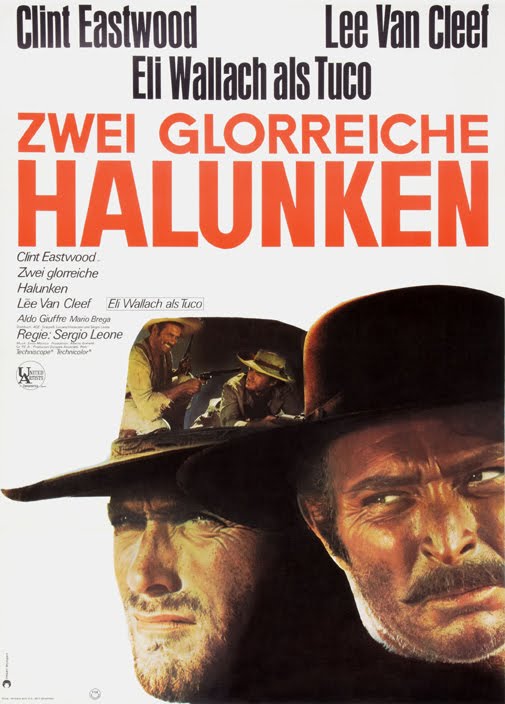
Interesting to compare with the West German poster, in terms of how particular actors / characters were emphasised and downplayed.

Interesting to compare with the West German poster, in terms of how particular actors / characters were emphasised and downplayed.

West German The Good, The Bad and the Ugly poster
Under the Two Magnificent Rogues title, but note that the faces shown are not those of the two rogues - i.e. Eastwood's Good and Tuco's Ugly - but Eastwood and Van Cleef, i.e. The Bad.

Monday, 23 August 2010
Once Upon a Time in America site
Just about everything you could ever want to know about the making of the film, its locations, Harry Grey's novel and more:
http://msb247.awardspace.com/contents.htm
http://msb247.awardspace.com/contents.htm
Sunday, 22 August 2010
Nice remark on Leone
There was a reason why the 2.35:1 frame was invented, and it was Sergio Leone. Some have come close to matching his sense of scene composition, but none have consistently performed photographic miracles like Leone. Leone is a stunning example of why Pan And Scan should be outlawed under penalty of death by being cut in half
From an IMDB review
From an IMDB review
Saturday, 29 May 2010
The bar-room brawl in the US and Italian western
One of the distinctive, but little remarked upon, features of the Leone western is the absence of the 'fun' bar-room brawl where no-one really gets hurt. This is, however, seen in most other Italian directors' westerns, even when they are otherwise trying to emulate Leone.
I think this reveals a fundamental thing about violence in Leone: It is always for real, for keeps; when someone gets beaten (Eastwood in A Fistful of Dollars, Eastwood and Van Cleef in For a Few Dollars More) it's to near-death.
I think this reveals a fundamental thing about violence in Leone: It is always for real, for keeps; when someone gets beaten (Eastwood in A Fistful of Dollars, Eastwood and Van Cleef in For a Few Dollars More) it's to near-death.
Friday, 14 May 2010
Nice Leone posters
More works of art than mere advertising, with good play upon iconic images and concepts from the three films:


Sunday, 15 November 2009
A Fistful of Dollars
I know this is an apprentice work, which sees Leone trying out things without necessarily integrating them into a coherent whole.
But
God damn
He still framed like no-one else had done.
Similarly, I now wonder about the bad day for night shooting in the cemetery scene, and the apparent inability of the (dead) soldiers to hear what is going on around them: Does this signify that they are "playing at cowboys and indians," in a cinema-cinema way?
Wednesday, 7 October 2009
Tuesday, 15 September 2009
Thesis work #1
Paola Marrati – Gilles Deleuze: Cinema and Philosophy (2008)
Paola Marrati’s key idea is that the Cinema books are as concerned with politics as aesthetics. In particular, they introducing new ideas of action and agency that Deleuze would further develop in What is Philosophy? – a book that, significantly, takes up the question and its title from the closing lines of Cinema 2 (x, 89).
Within What is Philosophy, co-authored with Guattari, Deleuze develops a notion of immanence diverging from that found in earlier works, such as Difference and Repetition. In these, Deleuze had characterised immanence as a marginal tradition, practiced by occasional figures like Duns Scotus, Spinoza and Nietzsche. In What is Philosophy? he argues that immanence is in fact more prevalent, but that the historically tendency for it to be subordinated time and again to transcendence has prevented us from seeing this (90-91).
Relating this back to the Cinema books, Marrati emphasises that the idea of immanence is also central to the notion of the time-image advanced in Cinema 2, such that filmmakers in the post-war period were (asymptotically) in advance of their philosopher and political theorist counterparts (xv).
This claim is founded upon a series of distinctions between the movement-image and the time-image, which might be summarised as follows: The movement-image cinema was based upon 19th century understandings that were transcendental and historicist. Filmmakers such as Griffith and Eisenstein believed in a world to come and the effectiveness of human agency, as epitomised by the sensory motor schema of the action-image and the large SAS’ form, to actualise this world. Compared to these common elements the differences between them, of Griffith’s emphasis upon the individual and the US as Christian utopia, and Eisenstein’s emphasis upon the collective and the USSR as Communist utopia, were unimportant:
If Griffith and Eisenstein privilege the active form of montage, it is because they share a faith in human agency and in history. However different their conceptions of history might be, they share the belief that history is made through humans’ actions, and in this respect it matters little whether what triggers the events is the passions of a traitor, the love of a woman, or class struggle. The form of classical cinema – American cinema, doubtless, but not only American – is constructed around the action-image. (51)
Belief in transcendence, historical telos and the efficacy of human action were then shattered by the Second World War, clearing the way for the emergence of the time-image cinema based upon immanence. The breakdown of the action-image and the concomitant emergence of the seer, the long take and other new figures and concepts in the time-image allowed filmmakers to explore new ways of thinking about our place in this world: “The greatness of the filmmakers of time is that they were able to create other livable [sic] configurations of thought in images themselves; this is how they attained a force comparable to the now failing force of the action-image.” (79)
Though Marrati does not specifically mention him, there are possible affinities here with Siegfried Kracauer’s (1960) notion of cinema as the “redemption of physical reality,” albeit taking place within a specifically time-image understanding of ‘reality’.
More important for my purposes, however, is to relate Marrati’s reading of Deleuze to modernity and post-modernity. The issues here is that, like Deleuze, Marrati uses the former term but not the latter. I would contend, however, that her analysis, as it implicates a single meta-narrative within the movement-image followed by a multiplicity of language games within the time-image, can be understood in postmodern terms. What we have, that is, are a ‘classical’ cinema of the movement-image which is (19th century) ‘modern’ insofar as it believes in a transcendent Truth and a ‘modern’ cinema of the time-image which is (post World War II) ‘postmodern’ insofar as it denies this in favour of immanence and localised, performative, contingent truths.
Relating Maretti’s analysis to my filmmakers would seem to have differing implications. Leone,
as an Italian pessimist sceptical about the “American dream,” would seem presents an obvious modern/postmodern/time-image counterpart to the classical/movement-image John Ford, with his optimistic belief in this dream.
While Ford himself admittedly became more questioning of the US utopia in his later films such as The Man Who Shot Liberty Valance (“This is the West, sir. When the legend becomes fact, print the legend”) and Cheyenne Autumn, it is significant that these were the films Leone felt came closer to his own understanding of the west. As Neil Campbell (2008) summarises Leone’s remarks on Once Upon a Time in the West:
My version of the story of the birth of a nation” acted by “the most worn-out of stereotypes: the pushy whore, the romantic bandit, the avenger, the killer who is about to become a businessman, the industrialist who uses the methods of a bandit. These “worn-out” figures exit the stage to leave the whore to be transformed and transforming, to symbolize this “birth” of a new nation and the end of another world—“the beginning of a world without balls,” […]The “ancient race” (as the film calls them) of mythic men linked in chains of brutality is “worn-out”
As I will also argue Leone’s ‘America’ trilogy thereby provide different, immanent, alternatives to a faith in a transcendent utopia.
For Argento’s gialli thrillers the obvious point of comparison is Antonioni’s anti-gialli, most notably Blow-Up. The apparent problem here, besides the near-unassailable position of Antonioni as one of the masters of the time-image/postmodernist cinema, is that Argento’s films tend to present a re-engagement with action following a period of becoming seer: Whereas Blow-Up’s Thomas is witness to a murder and proves unable to act, his Deep Red double/virtual image Marcus (both characters being played by the same actor, David Hemmings) resolves to solve the case and as such becomes (something of) an agent again. Argento’s own journalistic criticism of Blow-Up, as Antonioni’s “abandonment” of his “duty” towards the audience, is instructive: The two filmmakers would seem implicated in different language games here. Blow-Up suggests a lack of faith in any truth (there is no body and thus no murder...), Deep Red a faith in a “will to truth” (there was murder, as demonstrated by this body...). The point, of course, is that Antonioni and Argento’s language games can only be judged in their own (performative) terms, of what works best in their particular contexts, not by some universal criteria. What worked for Antonioni’s arthouse audience (along with the mass audience brought in by the promise of a flash of pubic hair, as first for 1967; we must not forget the exploitation cinema and its configurations of "sex and violence") was not necessarily what worked for Argento’s crossover audience in 1975.
Crucially Marrati also suggests that the time-image itself allows for action, so long as it was sufficiently considered, rather than automatic, and geared towards immanence rather than utopia:
It is not out of passivity, powerlessness, or resignation that one is no longer capable of immediately and “appropriately” responding to a given situation or event. It is quite the opposite: the response is suspended because one has become aware that certain actions are powerless. Habits of conduct, patterns of behaviour, are deemed to express weakness or strength, love or contempt, indignation or revolt. Not to engage in the appropriate response, not to express the appropriate affect may seem to imply passivity, or worse. Deleuze’s point, though, is that sometimes, perhaps even often, “acting in the appropriate way” is precisely the lack of response and the refusal to acknowledge our helplessness. (xii)
The issue then becomes that of interpretation, of one filmmaker’s time-image formulation against that of another, alongside the point at which a refusal to act, or the apparent inaction, paradoxically itself constitutes a form of action.
In Leone’s cinema we may think, for example, of Noodles’ refusal to accept the role of assassin-avenger than Max assigns him in Once Upon a Time in America, and of whether this refusal occurs in actuality or virtuality. We might also consider the likes of Dr Villega’s refusal to jump from the explosives-loaded train in Duck You Sucker, despite the forgiving Sean’s imploring that he do so, along with the alternatives of desperately trying to escape versus stoically facing death that are presented to other revolutionaries as they face firing squad. In Questi’s cinema, meanwhile, we might think of the passivity of Tomas Milian’s unnamed protagonist in Django Kill, his refusal to act for gold/dollars or revenge, as would conventionally provide the spaghetti western protagonist, as seen in Leone’s films, amongst others, with ample motivation. (Perhaps Deleuze’s anti-phenomenological, post-modern, existentialism does not provide us with the clear guide to action that Sartre’s ‘no excuses’ phenomenological, modern, existentialism did? The limit situation of facing an executioner, of giving a gaze of defiance or attempting to escape at the likely cost of others’ lives, would presumably represent the test case here.) This combination of classical movement-image generic situation, that Django Kill is a western which should present a clear SAS’ narrative as Milian’s character gets his revenge and/or the gold, followed by a time-image development, as he passively observes, might also help explain the film’s and Questi’s marginality relative to Leone and Argento: As a postmodernist avant la lettre who refused the high/low, art/popular, time-image/movement-image binaries still extant in a structuralist 1960s, Questi made films which confounded audiences on both sides of each binary. Leone and Argento by contrast were less extreme in their images and more adroit at performing a balancing act on these either/or binaries.
Related to this, the problem is perhaps that we cannot use postmodern in brackets: If we say ‘postmodern’, in whatever formulation, we immediately bring into play a set of assumptions about what this ‘postmodern’ is, with these inevitably defined positively or negatively in relation to the ‘modern’. We lack a vocabulary which is both/and or neither/nor, that something may be ‘modern’ and ‘postmodern’, or neither of these, depending on how we define our terms. In relation to Deleuze’s Cinema theories, this is compounded by his movement-image/time-image distinction, as one which he identifies as being about the ‘classical’ and ‘modern’ cinema rather than, for example, the ‘modern’ (1920s) and the ‘neo-modern’ (1960s), as in Orr (1993).
[Let me know if you want more, as I can happily post one or two thousand words a day of this stuff; apart from anything else I would like comments from the ordinary and academic audiences.]
Sunday, 17 May 2009
Saturday, 9 May 2009
Duck You Sucker - observations on an observation
I'm re-reading Christoper Frayling's Sergio Leone: Once Upon a Time in Italy, where a comment on Duck You Sucker! caught my attention. He notes that, while not a commercial success, it was critically well received in France and Italy, with commentators noting that the characters 'grow' during the course of the story.
How far is this because of the film was the first of Leone's to be 'historical' rather than 'mythical'?
The identities of The Good, The Bad and The Ugly and of Frank, Harmonica and Cheyenne are unchanging mythic archetypes; Juan and Sean (Johnny) historically situated figures.
Once Upon a Time [in] the West against Leone's avoidance of Once Upon a Time the Revolution and A Fistful of Dynamite, as imposed in France and the US respectively.
What does it mean to position 'the revolution' with 'once upon a time'? That it too belongs to the realm of myth? Presumably in some respects it does, but don't then individual revolutions occur in specific historical circumstances?
What is the wider context to the Mao quote which opens the film, other than a reference to 'one class violently overthrowing another' or similar, omitted by Leone? Was Mao making an abstract statement or one about revolution in China?
Tuesday, 18 November 2008

Tuesday, 12 August 2008
Il Conto è chiuso / The Last Round
A mysterious stranger enters a town controlled by two criminal factions. After proving his abilities and learning who's who in the process, he plays them off against each other, before cleaning up those who are still left...

The drifter on the road
If The Last Round's scenario sounds familiar, it should. For the film is a contemporary update of A Fistful of Dollars set in a northern Italian town, with a revenge subplot involving a music box clearly derived of For a Few Dollars More – even as the protagonist's skill with a knife, which he prefers over the gun if he is forced to use something other than his fists for reasons of range, is more reminiscent of Yojimbo.

The music box and photographic memory
The stranger, Marco Russo, is played by Argentinean middleweight boxing champion Carlos Monzon, who understandably makes up for in physical presence what he may have lacked in acting ability.
The leader of one faction, Rico Manzetti, is played by poliziotti regular Luc Merenda, with his brothers and gang including such familiar filone faces as Gianni Dei and Gianfranco Cianfriglia.


Merenda shows his prowess with a gun, aiming not for the heart but a range of targets, including the left and right eyes.
The leader of the other faction, Belmondo (sic), is played by Leone regular Mario Brega. His faction is not as like the Baxters as Merenda's are the Rojos, in that he's neither the law in the town nor dominated by his wife – indeed, we never actually see his family.

Monzon demonstrates his skills
In the middle of all this are a blind girl and her adoptive father who live in a shack near a run down factory and provide Russo with information and assistance, and a second girl and her mother who kept prisoner by Rico Manzetti. They are played by Giampiero Albertini, Eleonora Fani, Annaluisa Pesce and Mariangela Giordano, the last of whose presence serves to also highlights the involvement of Gabriele Crisanti as executive producer and of his frequent screenwriting collaborator, the prolific Piero Regnoli.

I know the face, but not the name
While Luis Enrique Bacalov's imaginative and varied score also highlights the spaghetti western connection, the actual representation of the town and its two gangs has more in common with the poliziotto and Dashiell Hammett's 1929 novel Red Harvest, itself a largely unacknowledged reference point for Kurosawa and Leone's film alike.
Although we are told that the police have been bought off they never appear as an obstacle to Marco, a plot point which would perhaps have better emphasised the gangsters' power, although against this a magistrate who does make a public stand against them is almost immediately gunned down.
More generally the references to the running down of the city's industry, labour unrest and its heavily polluted atmosphere suggest a wider context not too far removed from that of Hammett's Poisonville.
Though certainly entertaining – the main issue, it must always be remembered – and stimulating – the secondary issue – I was not convinced that The Last Round's relocation of the Leone spaghetti to 1970s Italy really worked.

A nice re-imagining of the Leone corrida in a present-day setting – the two gangs in a sports arena, with Russo watching from above in the middle
The issue isn't so much with corrupt town, which one can easily believe in as an exaggerated version of an actual city in northern Italy at the time – though the selection of this is somewhat unexpected, given that the specific cultural framework of the spaghetti has been convincingly argued to be a southern Italian one by critics like Christopher Frayling – as the juxtaposition of two fundamentally different approaches to place, time and action or, to use Bakhtin's notion, chronotopes.
Marco belongs to the 'mythic' realm, where the single heroic individual can triumph through strength (the peplum film) and / or skill and guile (the spaghetti western) over seemingly impossible odds. These same impossible odds, as they are presented in the poliziotto context of The Last Round, however belong far more to the 'real' world (more so than the superspy films of the previous decade, as a form that cross-fertilised with the spaghetti western in certain ways), where they either cannot be surmounted or the hero's triumph is necessarily 'imaginary'.
This division is apparent in some other poliziotteschi, being highlighted by the traditional maverick cop on a one-man crusade as incarnated by Maurizio Merli, but it is also less pronounced because he is embedded in this same world. To put it crudely, he uses guns versus guns, not a knife or his fists. He can also be defeated, die, or achieve a victory that is partial or pyhrric.
It could also be said, however, that the distinctive combination of character and environment in The Last Round serves to make the imaginary aspect of its solutions to real problems more prominent than in 90 per cent or more of mainstream films, including most other poliziotteschi.

Mario Brega, looking a little like Lucio Fulci here
In real life, that is, the individual is arguably fundamentally powerless, or at least tends to have his or her capabilities overstated by the (non)powers that be for various reasons. (Just try to imagine a politician or party whose message was that they really had little or no control in the grand scheme of things.)
Stelvio Massi's direction is brisk and efficient, presenting a one-two combination of surprisingly elegant camera movements, especially in the studio-bound and interior sequences, and crash zooms. He also throws in some tricksy mirror shots as Russo and Belmondo meet for the first time, an approach which seems less showing off for its own sake as a externalisation of the duplicities inherent in the set up and Russo's character as a trickster hero.
The fight sequences sometimes make use of slow motion to highlight Monzon's pugilistic abilities, although the blows still sound like car doors slamming – realism, that is, is again limited by the higher priority of entertainment...
[The film is on Region 1 DVD from Noshame. The package also includes a CD of contemporary interpretations of 70s poliziotto music and a somewhat surreal extra in the form of a tour of Luc Merenda's antique shop]
Monday, 28 July 2008
The Films of Sergio Leone

This 2008 volume from Scarecrow Press presents a revised, expanded and corrected edition of author Robert Cumbow's long unavailable 1987 original, made at a point when, as he notes, information on the auteur and his work was in relatively short supply.
The first chapter, the only one in the introductory section, provides an overview of Leone's life and career. Thought really given little more than the bare minimum – Leone was born in 1929, died in 1989 and made only a few films during his life, which tended to be more successful with audiences than critics – this is all that is needed insofar as Cumbow points the reader more interested in the man than the films to Christopher Frayling's exhaustive biography Something to do with Death whilst setting out his own approach as different yet complementary to Frayling's in his emphasis on the text.
The second chapter, beginning the second section of the book, on the films, also quite brief, is again new and discusses Leone's pre-western work and the continuities between the peplum and the western in terms of narrative conventions and character types, particularly in the mythic dimensions that they tended to assume. There is the odd factual error, like identifying the origin of the term peplum in lying with a type of sandal, and one might have liked to see a more thoroughgoing analysis of Leone's debut film, The Colossus of Rhodes, but the overall analysis is sound and establishes a solid basis for considering the director's better known, 'mature' films.
The third chapter discusses A Fistful of Dollars in more detail and begins to really establish Cumbow's way of working and its distinctive strengths, as he works his way through the film in an almost image by image and scene by scene way to bring out their underlying possibilities. What we see on screen and hear on the soundtrack is, that is to say, what really matters. Though clearly not averse to theory, insofar as he brings out the structural oppositions undergirding the film, thus establishing certain patterns whose continuities, discontinuities and developments he will chart across Leone's subsequent films, Cumbow refuses to put the cart before the horse in the way that most academic studies would by identifying their standpoint as explictly marxist, psychoanalytic, semiotic or whatever.
What he ultimately emerges as is thus an old school Cahiers du Cinema / Sarris / Movie type humanistic, auteurist, mise en scène critic, the kind who is well versed in cinema, culture and ideas in general and who uses his erudition in the first instance to help illuminate the films themselves and only then turns to wider questions; as the book goes on we get references to Nietzsche, Bergson, Jansenism, Bettelheim, Eliade and others, all justified rather than show-offish.
One key reference point in this regard are Chabrol and Rohmer's seminal early study of Hitchcock– a connection made explicit in the 16th and final chapter, where Cumbow concludes with an analysis of Leone as a specifically Catholic filmmaker whose work expressed and advanced a distinctive morality.
Another, more implicit than explicit, seems to be Wollen's influential Signs and Meanings in the Cinema, as one of the few more theoretical works mentioned in the bibliography and as a text which, according to the postscript interview in third edition between Wollen and his one-time alter-ego Lee Russell, questions of art and aesthetics are paramount. (This is something which Wollen's discussion of the usefulness of structural linguistics to the study of film in the main body of the text itself can all too easily make us forget by giving the work a more scientific seeming cast.)
I had the occasional difference of opinion when Cumbow moved away from the details of the films to the wider context, as with his analysis of how different Fistful really was, but found his analysis of the film itself enormously rich in ideas. (Cumbow argues, correctly in my opinion, that Leone's work has come to represent the entirety of the spaghetti western to the general audience for better or worse but I am less certain of his contention that Leone's work was less innovative and more conventional than is commonly thought. I would contend that what's needed here is a finer distinction between the pre-Leone Italian western, with its more imitative approach to the Hollywood western, and the large number of post-Leone westerns which took on board and attempted to imitate his distinctively Italian innovations.)
The remaining six chapters of this section subject For a Few Dollars More, The Good the Bad and the Ugly, Once Upon a Time in the West, Duck you Sucker, My Name is Nobody and Once Upon a Time in America to similar close readings and are again highly impressive and compelling in the main. A recurring theme here, helping account for the inclusion of the Valerii directed / Leone scripted and supervised My Name is Nobody, itself an elegy for the end of the Leone-style western, is the gradual shift from myth to history.
Of the analyses here, I felt that of Once Upon a Time in America to be the weakest, perhaps because Cumbow does not subject the film's mythic images of the gangster film to the same depth of analysis as the westerns and instead tends to subsume them into their more general framework. It may be, of course, that the film is not a meta-gangster movie in the same way as Once Upon a Time in the West is a meta-western, but the importance of film cliché within Harry Grey's source novel The Hoods – which Cumbow is too quick in my opinion to dismiss as bearing almost no relation to the finished film, as per one of Leone's remarks – may suggest otherwise.
Certainly, I would have liked to have seen more of a discussion of the film and its intertexts, particularly given the strength of Cumbow's discussions of the relationship between Yojimbo and A Fistful of Dollars or the traces of past roles carried by the likes of Van Cleef and Fonda or by image after image in Once Upon a Time in the West. (Then again, maybe this gives other Leone scholars something to do ;-))
The third section of the book, titled The Company gives consideration to Leone's casts and crew and their importance in realising his vision. Though there are perhaps some omissions here – Once Upon a Time in the West comes across as a writing collaboration between Leone and Bertolucci, for example – the two chapters also serve to show that Cumbow is no crude auteurist unawares of the difference that a cinematographer, production designer or editor can make to their director.
The fourth section, entitled The Vision, recapitulates and recontextualises some of the key points made in the film-by-film analyses by presenting them in a more thematic form.
Chapter 12 explores what Cumbow identifies as “the moral geometry of Sergio Leone,” or the way in which his compositions, camera movements and editing are in the final analysis as much moral as aesthetic choices, much as per Godard's oft-cited remark that “Morality is a question of tracking shots.”
Chapter 13 provides a comprehensive lexicon of Leone themes and images from A (anonymity) through to V (violence), providing a useful checklist of key moments to rewatch for anyone interested in his use of and / or attitudes towards – to give a few other examples – musical instruments, timepieces and rape.
Chapter 14 discusses Leone's most important collaborative partnership, that with Morricone, on a theme-by-theme and motif-by-motif basis but without using or relying upon any familiarity with music theory. (There is a book by Charles Leinberger on The Good, The Bad and The Ugly's score for anyone who is interested in something more specific / specialised here, although I haven't read it myself.)
The following brief chapter discusses the issue of the operatic in relation to Leone's cinema beyond the Morricone leitmofit, making the provocative suggestions that had Leone lived 100 years earlier he might have worked in the opera, as the spectacular art form of that era, and that had Verdi lived 100 years later he might have been a filmmaker for the same reasons.
As already mentioned, the last chapter returns us to the moral by bringing out the conscious and accidental Christian iconography of Leone's films to conclude that, once upon a time, he was the redeemer of the western genre.
Appendices provide complete credits and synopses for the films, a bibliography and details of DVD and CD releases.
All told, a thoroughly enjoyable and stimulating read that, like all the best film books, leaves one wanting to watch the films again and, more importantly, anew.
Monday, 21 July 2008
Red Harvest
I picked up this seminal world of hard-boiled fiction on the grounds that it was an inspiration for both Kurosawa's Yojimbo and Leone's A Fistful of Dollars and had also attracted Bernardo Bertolucci at one point, though his attempt at making a more faithful adaptation of it appears to have came to naught.
One of Dashiell Hammett's Continental Op stories, it is told in the first person by the unnamed private investigator, a representative of the aforementioned agency. He arrives in the mining town of Personville AKA Poisonville, population 40,000, having been hired by one of the town's public citizens, Donald Willson.
The Op and Willson never get the chance to meet, however, with Willson being gunned down the same night as the Op arrives. He soon learns that Willson's was a relative newcomer in Poisonville but had already earned the reputation as an honest man and thus troublemaker, and that his father, Elihu Willson, had built up the town from nothing but then lost control over it during a labour dispute:
“[O]ld Elihu didn't know his Italian history. He won the strike, but he lost his hold on the city and the state. To beat the miners he had to let his hired thugs run wild. When the fight was over he couldn't get rid of them. He had given his city to them and he wasn't strong enough to take it away from them. Personville looked good to them and they took it over.”
The Op's confidant, a labour organiser named Quint, identifies four different figures who run the town from behind the scenes, maintaining an uneasy balance of power amongst themselves and with Willson: bootlegger Pete the Finn; bondsman and fence Lew Yard; chief of police Noonan and gambler 'Whisper' Thaler.
While his subsequent attempts to clean up the city see him make arrangements with and feed information to each of the five men, the scenario cannot really be described as a 'servant of two masters' plot in the manner of Leone's film, with the intrigue and conflict between the various figures considerably more complicated than that between the Baxters and Roho, and the Op tending to present himself as more of a neutral power broker rather than identifying himself with any faction.
The Op also brings in some outside help in the form of another couple of men from the agency rather than being self-reliant, although their role is primarily that of observers and might be compared to that of the coffinmaker and barkeep in Fistful.
There is also less sentimentality than Leone's film, with no counterpart to the 'holy family'. Instead the two women who appear, Willson's widow and especially Dinah Brand, who is out for whatever she can get from the Op and the other men around her, are hard, uncaring figures.
A good read in its own rights and an interesting one in seeing how things changed cross-culturally when it was liberally adapted for the screen. (Though the most faithful in its prohibition America setting, Walter Hill's Last Man Standing also takes liberties with the source material, in giving Bruce Willis's character a more heroic role in defending a prostitute and in again reducing the number of factions and subplots to more manageable numbers.)
Also of note, though more in terms of the giallo, is a subplot late on where the Op is uncertain whether he has committed a murder himself and must thus find the real perpetrator before he is caught by the (corrupt) police.
Monday, 14 July 2008
Il Colosso di Rodi / The Colossus of Rhodes
Set in the period between Greece decline and Roman ascendancy, The Colossus of Rhodes begins with the ceremony marking the completion of the titular Wonder of the World.
Ten years in the making, the giant statue over the entrance to the island state's main harbour promises to alter the balance of power in the Mediterranean, giving Rhodes and its allies a near impregnable base.


Two views of the Colossus, in benign mood / mode

A later fight on its shoulders, giving an idea of the film's scale
Accordingly the Phenecians, the first villains of the piece, have sent an emmisary to Rhodes to negotiate with King Sirse for access to the harbour, the plan being to raid Greek ships and split the proceeds.
Sirse is wise enough, however, to impose a limitation on the number of Phenecian ships and men permitted into the harbour at any one time, both as a means of securing his own position and hopefully avoiding arousing suspicion amongst the Greeks, Rhodes traditional ally.
Sirse's advisor Thar has his own plans and is secretly plotting to overthrow his ruler with the aid of the Phenecians, hundreds of whose troops are being brought into the island in the guise of Macedonian slaves.

Sirse, Thar and the Phenecian emissary negotiate over a model of the harbour – a precursor to McBain's simulacra of Sweetwater station?
In addition another faction amongst the island's nobility also hopes to bring about a regime change, being dissatisfied with Sirse's rule and what they see as the vainglories of the Colossus. Unlike Thar they are loyal to their homeland and are looking to Greece for assistance.
All this means that everyone wants to know where the loyalties of the heroic half-Rhodean warrior visiting his uncle after his recent wartime exertions for Greece, Dario, lie and if he is just the innocent abroad that he appears to be...
Though entirely enjoyable in its own right, the main interest that The Colossus of Rhodes holds for many viewers today – myself included – is likely in its status as the official directorial debut of Sergio Leone and the extent to which it contains the same signature touches and themes as can be found in his later films.
The chief differences from the westerns are that the distinctions between the good guys and the bad guys are more straightforward and obvious, and the failure of the protagonist to play different factions against one another for his own benefit.
As Dario says at one point, “I don't play the hero” – rather he is the hero.
Leone's approach to history is also somewhat distinctive here, playing that bit faster and looser in terms of historical details. Though he acknowledged that it would probably take a lifetime's research to pursue authenticity here, it could be argued that in the case of the western he did do this research into its myths and history. Just like his later films, however, Leone also proves inclined to go for what he felt to be right in terms of the impact or effect it would have on the audience, as with a Colossus three times the size of its historical counterpart, positioned in a different place and tricked out with all sorts of fancy gadgets.


The Colossus reveals one of its secrets, raining fire down on a ship trying to pass beneath it
The film's approach to identity and allegiance is also somewhat reminiscent of Leone's later films, as when the difference between a Macedonian slave and a Phenecian warrior comes down to a uniform or the way in which Dario's love-interest Diala and uncle Lissipus do not revealing their true allegiances until late in the day.
There are also some surprising reversals of expectation, as with the way it looks like these selfsame slaves are about to be sacrificed to the god Baal rather than be housed in the dungeons of the temple until the moment to strike arrives, or the attempted forcible abduction of Dario by the Rhodean rebels after he stubbornly refuses to come along quietly and listen to what they have to say.
While the film is very much on an epic scale, it also largely succeeds at the more intimate level. In particular two of the female characters rank amongst the best developed ones to appear in a Leone film for some time, albeit with a relatively straightforward good girl / bad girl, if not madonna / whore, distinction emerging as the film goes on.
There's also an intriguing aspect to the rebels' motivation. It's not entirely clear what Sirse has done to incur their enmity other than following what they feel – admittedly correctly – to be the bad counsel of Thar and, perhaps, putting his own personal glory above that of Rhodes and the welfare of its people.


Some Blondie-style sharpshooting threatens to send a rebel to i leoni
Nevertheless, the other citizens of the Island seem happy enough with the building of the Colussus and the promise of prosperity and security that it offers, or are at least not generally that vocal in their complaints.
As such, there is perhaps the hint that the conflict is, much like the subsequent representation of American and Mexican civil wars in The Good the Bad and the Ugly and Duck You Sucker, primarily between two elite factions and the kind of thing which the masses would do best to avoid getting entangled in.

A somewhat unexplained, Duck You Sucker style massacre scene
There is a difference from these later films in that it is more idealism rather cynicism that eventually triumphs. Given Leone's remark that the distinction between his and Ford's westerns could in part be attributed to their respective backgrounds – Roman pessimism and American optimism – this may be a reflection of the film's own historico-mythic setting or that Leone was not interested in undertaking a wholesale re-invention of the peplum in the same way as he would later be with the western.


Two of the rebels undergo torture in a classic piece of homoerotic sadism
It is perhaps somewhat curious in this regard that the film is credited to Leone whereas A Fistful of Dollars was originally accredited to the pseudonymous Bob Robertson, such that he moved from being identified with his work to a position non-identification – albeit with a name that referenced his director father, Roberto Leone – before going back to identification from For a Few Dollars More onwards.
Presumably this loss of authority on Fistful can be accounted for by the fact that at the time it was still a relatively untested genre for Italian directors. Whereas the the historical and mythical epic was actually invented by the Italians in the silent era, such that the contemporaneous work of Cottafavi and others could be understood as a post-fascist reclamation of Italian cinematic heritage, the western, like the Gothic horror, was initially perceived as a foreign genre which Italians had no obvious aptitude for, leading filmmakers to attempt to pass off their product as of US or UK origin as generically appropriate.
This said, just as the practiced viewer can easily spot the stylistic and thematic differences between Hammer and Italian Gothics, part of the whole reason for the spaghetti westerns proving so fresh and attractive to many audiences at the time was their evident differences and departures from the Hollywood models.
It is this, despite Leone's attraction to The Colossus of Rhodes as a project apparently residing mostly in the opportunities it afforded him to ironicise the form after his uncredited and unofficial, straight debut on The Last Days of Pompeii, is perhaps where the finished product proves lacking compared to its immediate successors.


The deceptiveness of appearances, as we think the slaves are about to be sacrificed to Baal's gaping maw
The balance between following convention and introducing innovation is more heavily weighted towards the former than would later be the case here, such that cliché and pastiche tending to appear as such rather than as parody, subversion, deconstruction or any of the other preferred oppositional critical terms of choice.
Though some horse riding sequences outside of the city of Rhodes and some brutal and inventive torture scenes could easily have seen service in one of the later westerns with different musical accompaniment, costuming and design, the urban and sea-front locations that dominate elsewhere tend to makes Leone's direction generally that bit more anonymous than it would later become.
The contrasts between close-ups and background vistas are less extreme and more conventional, the former serving more in a classical Hollywood manner than as the exploration of the geography of weather-beaten, life-worn, distinctly unglamorous physiognomies. (As an aside, there is perhaps also a connection to be explored here between Dreyer's Joan of Arc, as the film of the facial close up, Pasolini – who, as Bertolucci notes in an interview, greatly admired Dreyer's film and drew inspiration from it when making his directorial debut, Accatone – and Leone's mature work a few years later.)


The camera assumes an independence from Dario's point of view, circling back to incorporate the seer within the seen of the set.
Leone's rhetorical, mannerist camera style is however in evidence when Dario pursues Diala into the crypts of her ancestors, where a 360 degree pan starts from his point of view and concludes by incorporating him within the camera's gaze as it comes to rest once more. The same sequence also sees a (wo)man with no name incident when Dario, reading out the names atop each mummified noble, encounters Diala standing in a vacant spot and plays along with her – “Hm, no name here” – before continuing on his way as if he had not seen her.
Likewise, traces of The Good, the Bad and the Ugly can perhaps be seen when a galley full of rebels proves to have been beneath Dario at the quayside all along and in a colisseum sequence where ranks of Phenecian archers are dramatically revealed at the back of the arena as Thar makes his bid for power.


Somehow Dario remained unaware of the ship's presence until it was pointed out to him

Similarly no-one in the coliseum seems to have noticed the rank of Phenecian archers amassing above them
As with the likes of the shoot out between Blondie and Tuco and Angel Eyes' gang and in the remarkably silent battlefield the two magnificent rogues stumble into shortly afterwards, there is here the sense of Leone experimenting with off-screen and on-screen space and the relationship between visual and aural data sets, formulating these for the first time along the lines that if you can't hear it or see it within the frame then it doesn't have any existence.
There's perhaps also vague hint of Tuco and Blondie's repeated riffs on “two kinds of people” in Dario's ironic references to Rhodes as the “Island of Peace” every time someone gets attacked or murdered.
A number of the performers like George Rigaud and Roberto Camardiel would go on to be spaghetti western regulars, the two actually appearing together as Scots and Irish patriarchs in Seven Brides for the McGregors, with Camardiel also appearing in For a Few Dollars More.
Subscribe to:
Posts (Atom)