Showing posts with label jesus franco. Show all posts
Showing posts with label jesus franco. Show all posts
Friday, 13 January 2012
Some random 4.30 AM Jesus Franco questions
What are your favourite and least favourite periods of Franco's films? And why? Do you find that there are individual films within them that you like and don't like / like less? Is it just an all-encompassing Francoverse where the more you watch, the more you see the connections, perhaps a bit like Frank Zappa's xenochrony and conceptual continuity in his music?


Wednesday, 27 October 2010
Apocalipsis sexual
Though written and directed by Carlos Aured this 1982 Spanish entry has something of a Jesus Franco feel to it, thanks to the presence of the iconic Lina Romay and Ajita Wilson and somewhat subversive way in which it approaches its subject(s).

Let's just say it's hard to find screengrabs from this film that are acceptable to post...
The story is one of a group of kidnappers who abduct the daughter of a wealthy businessman and subject her to all manner of abuses. Despite, or more disturbingly because of this, she develops a case of Stockholm Syndrome, particularly in relation to the gang’s leader. This in turn leads to increasing divisions amongst them...
In its presentation the film is more a hardcore porn than crime thriller however, perhaps somewhat reminiscent of a Hot Summer in the City, Spanish-style. For the bulk of the running time is taken up by a procession of sexual numbers. Certainly some of these are integrated, having a narrative function. Much of the time, however, they are simply there, more as the raison d’etre than padding.
This is foregrounded by the way the all-important opening moments play out, with nearly five minutes of faux-lesbian poolside action between Romay and another woman before one of the other gang members cools them down with a bucket of water and announces that it is time to go to work.
The kidnapping takes up the next three minutes or so, following which there are another seven minutes of sex scenes. Then we get the first humiliation of the virgin victim, involving a pool cue being inserted into her vagina and the deliberately awkward blurring of the boundaries of yes/no, pleasure/pain and so forth.

The face of the victim/'victim' during the pool cue scene
Following this, at 23 minutes in – all timings here refer to the Italian dubbed version, which runs a brief porn-like 68 minutes – one of the kidnappers makes their ransom demand, while another exchanges pleasantries with the victim. He then watches as the three women amongst the gang have sex, whilst another of the men rapes the victim.
The two sex scenes are cross-cut, the same porn funk cue and dubbed moans playing over them to again make us wonder how we are supposed to respond, The subversive effect is however somewhat undercut by the porn convention of the external ejaculation being used in both scenes, with the lesbian three way in the first perhaps thereby perhaps also being recontextualised as appetiser to the heterosexual main course.
By now the pattern is becoming increasingly clear: A brief scene in which an exchange of dialogue or looks exposes the changing relationship between the victim and one of her kidnappers, followed by a longer sequence in which bump and grind takes precedence and narrative grinds to a halt.
A reprise of the pool cue scene, this time involving a flick knife, further confirms that this is not a film for everyone; it might however make for an interesting double bill with Paul Schrader's Patty Hearst for anyone feeling especially perverted.

Let's just say it's hard to find screengrabs from this film that are acceptable to post...
The story is one of a group of kidnappers who abduct the daughter of a wealthy businessman and subject her to all manner of abuses. Despite, or more disturbingly because of this, she develops a case of Stockholm Syndrome, particularly in relation to the gang’s leader. This in turn leads to increasing divisions amongst them...
In its presentation the film is more a hardcore porn than crime thriller however, perhaps somewhat reminiscent of a Hot Summer in the City, Spanish-style. For the bulk of the running time is taken up by a procession of sexual numbers. Certainly some of these are integrated, having a narrative function. Much of the time, however, they are simply there, more as the raison d’etre than padding.
This is foregrounded by the way the all-important opening moments play out, with nearly five minutes of faux-lesbian poolside action between Romay and another woman before one of the other gang members cools them down with a bucket of water and announces that it is time to go to work.
The kidnapping takes up the next three minutes or so, following which there are another seven minutes of sex scenes. Then we get the first humiliation of the virgin victim, involving a pool cue being inserted into her vagina and the deliberately awkward blurring of the boundaries of yes/no, pleasure/pain and so forth.
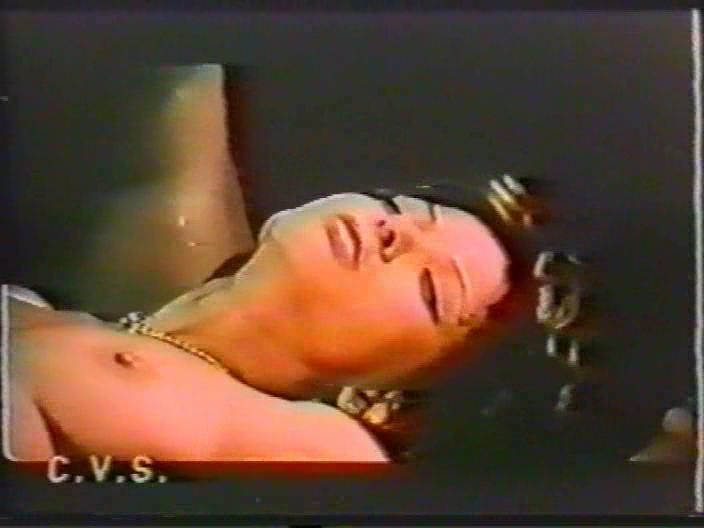
The face of the victim/'victim' during the pool cue scene
Following this, at 23 minutes in – all timings here refer to the Italian dubbed version, which runs a brief porn-like 68 minutes – one of the kidnappers makes their ransom demand, while another exchanges pleasantries with the victim. He then watches as the three women amongst the gang have sex, whilst another of the men rapes the victim.
The two sex scenes are cross-cut, the same porn funk cue and dubbed moans playing over them to again make us wonder how we are supposed to respond, The subversive effect is however somewhat undercut by the porn convention of the external ejaculation being used in both scenes, with the lesbian three way in the first perhaps thereby perhaps also being recontextualised as appetiser to the heterosexual main course.
By now the pattern is becoming increasingly clear: A brief scene in which an exchange of dialogue or looks exposes the changing relationship between the victim and one of her kidnappers, followed by a longer sequence in which bump and grind takes precedence and narrative grinds to a halt.
A reprise of the pool cue scene, this time involving a flick knife, further confirms that this is not a film for everyone; it might however make for an interesting double bill with Paul Schrader's Patty Hearst for anyone feeling especially perverted.
Sunday, 15 August 2010
Jesus Franco / Jazz
Two of Franco's jazz pseudonyms are Dave Tough and Clifford Brown.
http://en.wikipedia.org/wiki/Dave_Tough
http://en.wikipedia.org/wiki/Clifford_Brown
http://en.wikipedia.org/wiki/Dave_Tough
http://en.wikipedia.org/wiki/Clifford_Brown
Sunday, 4 July 2010
Der Todesrächer von Soho / Allarme a Scotland Yard: sei omicidi senza assassino / The Corpse Packs his Bags / El muerto hace las maletas
The opening minutes of this 1972 krimi gave me a strong sense of deja vu: Hadn’t I seen it before?
I hadn’t, with my impression being down to the fact that the film uses the same Bryan Edgar Wallace source as the first of producer Artur Brauner's CCC krimis, The Mystery of the Black Suitcases some ten years earlier.
The mystery of the that title is somewhat clarified by this film’s own title, the corpse of the English and Spanish titles title referring to the fact that several people have been murdered by the knife-throwing death-avenger of the German title.

The walls are closing in
But while the hotel’s Soho location is familiar, the way director Jess Franco presents it is not. He doesn’t bother giving us stock location footage and Big Ben’s chimes in a vain attempt to convince us that this really is London we’re seeing, not Spain.

Making the camera operator work for his money
Although Scotland Yard are soon introduced, in the form of Inspector Rupert Redford (Fred Williams), the film as a whole continues to do things very much its own way:
While krimi regulars Siegfried Schurenberg and Horst Tappert are among those present, they’re both cast against type. Schurenberg plays a drug smuggler rather than a Scotland Yard higher-up, Tappert a decidedly enigmatic and ambiguous figure.
Nor is there a romantic subplot between the Scotland Yard man and the ingénue in danger that ends in their inevitable marriage. And while the final confrontation does take place in dungeon-cum-laboratory there’s a conspicuous lack of dozens of armed regular uniform police.
All this is perhaps to be expected given that this is a Franco film. While undoubtedly familiar with the krimi universe (the name of his most famous character, Dr Orloff, derives from the 1939 version of Dark Eyes of London, remade by Rialto as Dead Eyes of London in 1960) the director has always tended to approach the business of adaptation very much on his own terms.


Into the void

Neo-noir
The thing that makes the film interesting as a Franco film, meanwhile, is its visual style. There isn’t a great deal of zooming. But there are numerous striking images and some stunning compositions - a Welles-inspired shot of two characters in an infinity of mirrors, a Bava or Argento style staircase spiralling into the void, a studied use of colour and its selective absence - all beautifully captured by cinematographer Manuel Merino.
A definite curio.
Thursday, 28 January 2010
Tiempos duros para Drácula
Having turned up at the hospital in desperate need of a blood transfusion, a man claiming to be Count Dracula is referred to an analyst and proceeds to recount the sorry story of his life.
His troubles begin with having to live up to his family's daunting legacy and with having to bring in money to pay the mortgage on the family castle and the electricity bill, to which end he has turned it into a tourist trap.

Dracula greets visitors to his castle - Christopher Lee meets Howard Vernon
Unfortunately the number of visitors has declined and so the electricity company pulls the plug, forcing Dracula to pawn his cape...
Having got it back and wearing his top hat, he is mistaken for a chimney sweep and then berated for putting on airs and graces and failing to show the appropriate solidarity with his fellow worker...
He gets a job advertising a toothpaste – whether coincidentally or otherwise Fulci's Dracula in the Provinces featured a vampire who operates a toothpaste factory – but is then thrown out the studio when it is decided he looks too much like a famous politician...

Teeth / fangs

Needles

Women to be penetrated...


Mirrors
This is followed by playing Dracula in a kung-fu / horror / sexploitation film, in which he loses a fang in a fight scene. The dentist proposes a gold replacement which Dracula cannot afford, refuses to glue the apparently decayed tooth back in place, and throws him out of the surgery.
Surmising that the episode pretty much destroyed Dracula's self-prestige, the analyst suggests that a relationship with a good woman might help, only for Dracula to then recount another tale of woe as he marries Sonia, who proves only interested in him because he provided her with information for her book about vampires (?!) and divorces him soon thereafter, citing mental cruelty. If this wasn't enough, he also proves to be impotent...
So it continues for the rest of its 73 minute running time, with scene after scene piling on the embarrassments and failures – the picking up of a transvestite in a disco, being mistaken for a spy's contact, and so on.
The relative lack of a narrative drive doesn't particularly prove an issue through a combination of the film's brevity; the fact that enough of the scenes are entertaining and amusing; various incidentals and just the simple fact that it's put together nicely with everyone's contributions working together to produce something greater than the sum of the individual parts. First among equals here is writer director Jorge Darnell. Lifante, best known as Martin in Jorge Grau's Living Dead at the Manchester Morgue, is endearingly pathetic, whilst Adolfo Waitzman's piano, synth and concrete score manages to be both oppressive and quirky at the same time as it plays variations on Chopin's funeral march.
Fans of Spanish pop cinema will likely appreciate the spy scene as a riff on the street of spies in Lucky the Inscrutable, the seeming coincidence becoming an intentional reference when we also consider the presence of Jess Franco's regulars Luis Barboo and Antonio Mayans in the cast; the overt quotation of the director's 1970 Dracula as the film within the film, and the distinctive visual similarity between Jose Lifante's look and that of Howard Vernon in the same director's Dracula vs Frankenstein.

Another Franco trope - the Disney T-shirt?

Christopher Lee as a very different Dracula
Psychoanalytically minded types can play the game of identifying and explaining the phallic symbolism in advance of their on-screen counterpart does. Those beyond this may meanwhile care to consider the prevalence of mirrors within the mise en scene and what these say, in Lacanian terms, about this Dracula in relation to his imagined / idealised ancestor. They might also consider all this in relation to the film's nature as an Argentinian-Spanish co-production, given the enormous popularity psychoanalysis in general enjoys in the former country [cf. http://www.theargentimes.com/socialissues/urbanlife/cult-of-psychoanalysis-in-argentina-something-to-talk-about-/]
Perhaps the only people who may be disappointed are those seeking a bit more sex and violence, who would probably be better served by George A. Romero's Martin or Paul Morrissey and Antonio Margheriti's Blood for Dracula. Again, however, the incidental details of the film's nudity – or relative caution thereof – are of significance when we consider it as a 1976 film that pre-dated Francisco Franco's death and thus the destape – i.e. undressing – period that followed it.
In sum, a good film to show to the Eurocult naysayer.
Subscribe to:
Posts (Atom)