Showing posts with label TV Spin off. Show all posts

Monday, 24 September 2012

Sweeney 2

The commercial success of Sweeney! the film ensured a sequel would soon follow. Though entitled Sweeney 2, the story here does not follow on from its predecessor and generally plays like an extended episode of the TV series, with a straightforward cops and robbers plot rather than a high-level conspiracy

The film starts in media res with George Carter (Dennis Waterman) in charge of an operation against a gang of blaggers, whilst his superior Jack Regan (John Thaw) has been called upon as a defence witness for his old boss, Jupp (Denholm Elliot), who is facing corruption charges.

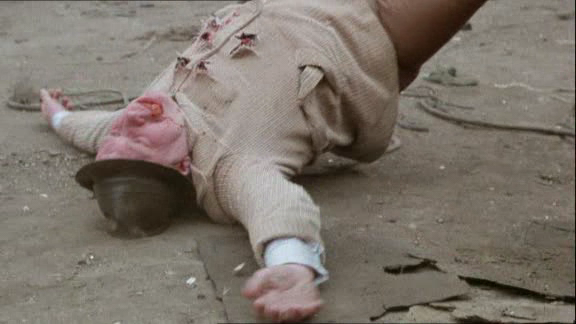
As with Sweeney! Regan and Carter's usual boss, Haskins, is absent. His absence is less noticeable. For one thing his substitute Dilke (Nigel Hawthorne) occupies a similar role. For another the back-story between Regan and Jupp is both shown in flashbacks and proves relevant to the current case -- one that sees a rare failure for the Sweeney, along with the deaths of bystanders, hostages and blaggers alike, one of the latter being killed by his compatriots in a manner reminiscent of The Wild Bunch. (To reinforce the Peckinpah connection one of the robbers is played by Ken Hutchison of Straw Dogs.)

Notably we don't see all this, only the aftermath and Regan's encounter with the father of the hostage and learning that his regular driver, Big John, has had to have a foot amputated. This both gives Regan an additional personal stake in the case and results in the young, likely university educated, vegetarian Robert being assigned him, leading to some amusing culture clash interplay.

Regan and Carter's pursuit of the blaggers is complicated by the fact that they live in Malta, outside the Sweeney's jurisdiction. The gang are of comfortable, educated backgrounds and decided to leave the UK with their families because of their belief the country was finished.


Some nice rack focus and point of view

While these aspects of the writing work well and give the film a socio-political edge, the gang's modus operandi of always taking the same amount of money -- and thus leaving anything in excess of it -- and use of a sawn-off, gold-plated Purdey shotgun, seem gimmicky. (Just how do they take the gun in and out of the UK?)

A sense of padding out the running time is evident in a stand-alone sequence that sees Regan and Carter being called to a hotel where a bomb has been found. While perhaps reflecting the reality of being interrupted by unpredictable events, and topical, it felt too long to be throwaway but insufficiently developed to constitute a sub-plot to me. One thing this sequence does do, however, is present Patrick Malahide as one of the police involved with the case. Malahide was, after all, soon to become a regular alongside Waterman in Euston's next major series, Minder.

In sum, of interest if you like the TV series or 1970s gritty crime films.

A nice extended discussion of the film is here: http://www.thetvlounge.co.uk/sweeney/viewtopic.php?f=10&t=1579

Sunday, 23 September 2012

Sweeney!

This was the first of two film spin offs from the popular Thames Television series and marked Euston Films first actual venture into the big screen. All the regular cast are present with the exception of DI Jack Regan (John Thaw) and DS George Carter’s (Dennis Waterman’s) superior officer, Frank Haskins (Garfield Morgan). This is because the plot sees Regan being isolated from and then suspended from the titular Sweeney -- Cockney rhyming slang for Flying Squad -- including for a time Carter. As such, Regan’s boss has to be someone the audience has no prior knowledge of or empathy with. While Regan and Haskins were often at odds over methods, both men knew that they could rely on one another when it mattered.

Another difference from the TV series is that the usual Sweeney versus Blaggers (i.e. armed robbers) narrative is dealt with in the second sequence of the film, the first having shown the murder of a prostitute, Janice Wyatt, as a means to compromise and pressurise the alcoholic Government Oil Minister Baker (Ian Bannen), with whom she had been in a relationship.

The mastermind behind the scheme (which has affinities with the way Michael Corleone deals with Senator Geary in The Godfather Part II) is McQueen (Barry Foster, at the time the star of another Thames/Euston series, Van Der Valk), a US lobbyist. Regan then gets brought in because the now legit gangster who had given him a tip off about the blaggers, Ronnie Brent, had also been in a relationship with Janice, and doubts she committed suicide.


Initially Regan is sceptical, but when Ronnie and his men are machine-gunned by two of McQueen’s men posing as police officers, he realises that Ronnie was right. After a few drinks Regan is then stopped by these same ‘policemen’ for driving under the influence. He tries to get them to let him off by playing on his force connection, but is instead arrested, force-fed a bottle of whiskey and then sent off in his car. He crashes and, having been caught driving whilst inebriated, is suspended from duty and finds himself under investigation and target as he continues to dig into the Profumo Affair-like conspiracy.

What makes the conspiracy especially interesting is that McQueen had previously been employed by the British and has now found a backer, likely an US rather than a Soviet one, willing to pay more, thus indicating that duplicity and dirty tricks are to be found amongst allies with an alleged Special Relationship and, indeed, between different agencies within the individual state, as when Regan is encouraged to drop the case by a civil servant type.

It’s a cynical attitude that is as one with the hard-bitten sensibilities of the TV show and, arguably, mid-late 1970s Britain as a whole. In this light the film’s treatment of party politics is also significant. For Baker is also being encouraged by his unseen, unnamed PM to manipulate the oil price -- a topical issue in the light of OPEC and North Sea Oil at the time -- to effect a short-term boom, allowing his aging Prime Minister's Government to win a snap election and thereby remain in power for another few years, rather than face life in the shadows of opposition, regardless of what it means for the longer-term benefit of the nation and its population.

There’s a bit more swearing and violence than was permissible or acceptable in the TV series. Sometimes these more ‘adult’ elements are a touch obvious, whether positively -- the Peckinpah-esque gunning down of Ronnie and his men, with its bullet ballets of death and close-up of a submachine gun firing at the spectator in the manner of the closing image of Bring Me the Head of Alfredo Garcia -- or negatively -- the commutation of a number of “bastards” to “fucks” or George saying he has to “go take a piss”.

In the end, however this Sweeney (!) film at least has an organic connection to its TV source which the new Sweeney likely lacks.

For I recently watched 2012 Sweeney director Nick Love’s remake of Alan Clarke’s football casual production The Firm, finding it to be a severe case of style over substance, in both the late 1980s period fashions and Love’s directorial approach, and in the absence of the subtext and insight Clarke brought to the material.